That breakout candle can feel like your last chance to enter before prices run higher. You buy, the market hesitates, and the move collapses before you can react. In crypto, this can happen within minutes—especially when volume is thin or leverage is high. Knowing which signals deserve your trust can help you avoid chasing a rally that was never strong enough to last.
What Is a Bull Trap in Crypto?
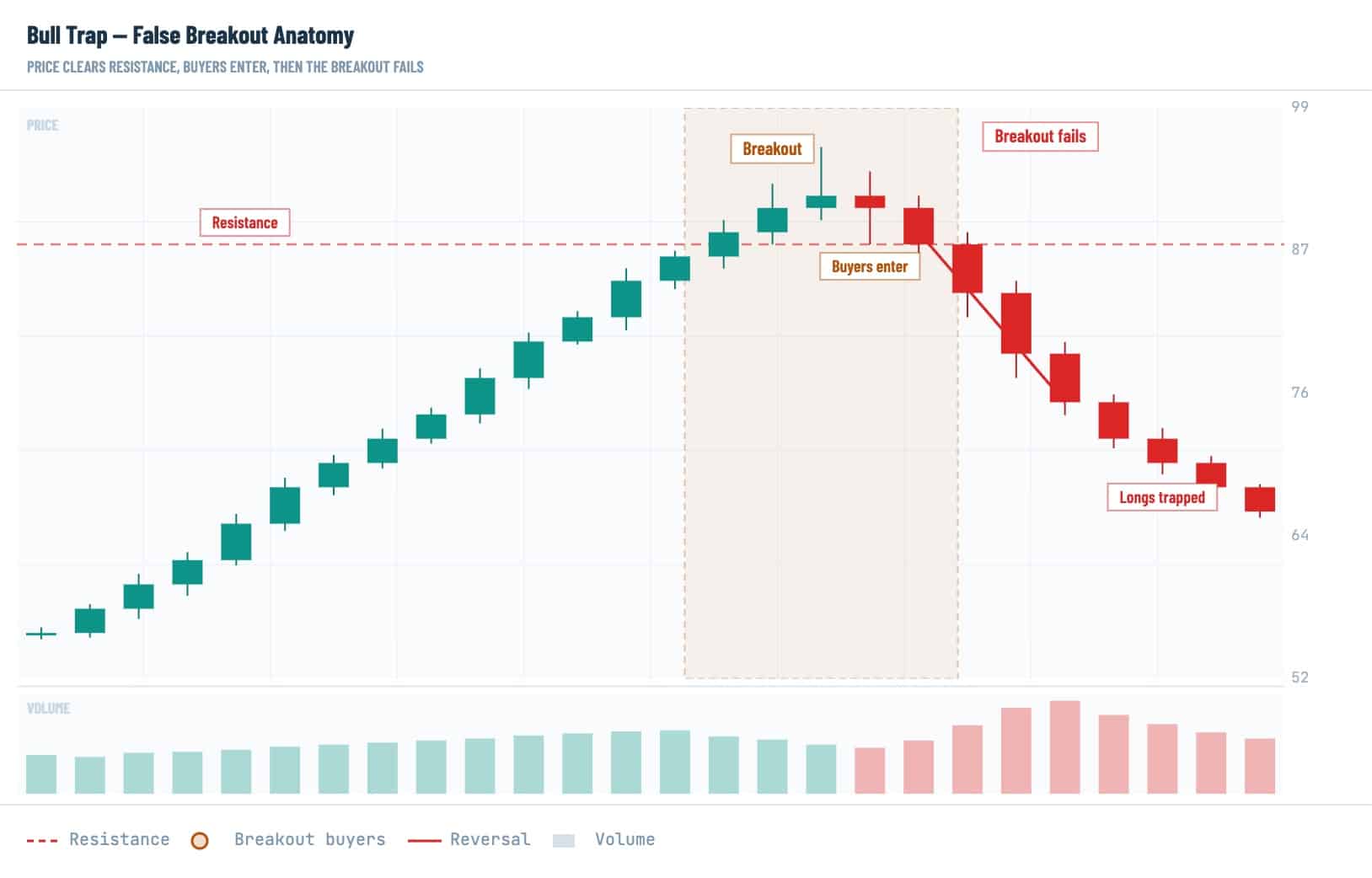
A bull trap in crypto is a false bullish signal that appears when a cryptocurrency’s price starts moving upward, often above a key resistance level, but can’t sustain the breakout. The market price then reverses lower, leaving buyers and long positions caught on the wrong side of the move.
A bull trap is the bullish-side version of a false breakout, failed breakout, or fakeout. It’s also sometimes described as a whipsaw pattern because price changes direction quickly after encouraging you to believe that a strong uptrend has begun.
Bull traps often appear as false recoveries during a downtrend or bearish market structure. However, they can also occur in sideways market conditions or after an extended rally.
Learn more: Best Indicators for Crypto Breakouts
Bull Trap as a False Bullish Signal
A bull trap creates the impression that bullish momentum has returned. Price rises, market sentiment improves, and retail traders or investors enter because they expect the upward movement to continue.
The false signal becomes clearer when the rally loses momentum, sellers regain control, and price reverses. Buyers who entered late may then sell at a loss or have their stop-loss orders triggered.
Bull Trap as a False Breakout or Fakeout
A common bull trap occurs when price breaks above resistance and attracts buyers looking for breakout confirmation. The market may trade above the level briefly, but that first upward spike isn’t enough to prove that a valid breakout has occurred.
If price can’t close above resistance, fails its retest, or quickly falls back below the level, the move becomes a failed breakout. The reversal traps buyers who entered believing that resistance had been broken.
Why Do Bull Traps Happen in Crypto?
Bull traps happen when an apparent breakout doesn’t attract enough buyers to sustain the move. The price may rise initially, but selling pressure, weak momentum, or changing market sentiment prevents it from developing into a lasting trend.
Not every bull trap is deliberate manipulation. In many cases, the market simply lacks the demand and follow-through required to hold above resistance. Common causes include:
- Insufficient buying momentum. Price breaks resistance, but there aren’t enough buyers to keep pushing it higher.
- Selling pressure near resistance. Sellers use the rally to exit positions, take profits, or open short positions.
- Thin order book liquidity. A relatively small number of orders can move the market price sharply before it reverses.
- News-driven volatility. Headlines can create a temporary rally that fades once the initial reaction passes.
- FOMO and late buying. Many traders enter after seeing green candles, giving earlier buyers or sellers liquidity to exit.
- Broader bearish conditions. Breakouts that move against the overall trend often struggle to attract sustained interest.
- Market manipulation. Large market participants may sometimes push price above a visible resistance level to attract buyers, although you shouldn’t assume that every failed breakout was manipulated.
How Does a Bull Trap Work Step by Step?
A bull trap often develops through the same basic sequence: an existing downtrend or range, a move above resistance, new buying, weak confirmation, and a sharp reversal below the breakout level.
Price Approaches a Key Resistance Level
Price moves toward a resistance level that previously acted as a ceiling. Buyers may test the level several times, creating the impression that selling pressure is weakening and a breakout is becoming more likely.
The surrounding market conditions remain important. If price is still making lower highs and lower lows, the move toward resistance may be a temporary rally within a broader downtrend.
Breakout Attracts Buyers and Long Traders
Once price breaks above resistance, buyers enter because they expect the upward movement to continue. Breakout orders may be activated, while FOMO encourages retail traders to join the rally before they believe the opportunity disappears.
At this point, the breakout still needs confirmation. A brief move above resistance can show buying interest, but it doesn’t prove that buyers have gained lasting control.
Weak Confirmation Behind the Upward Move
The breakout begins to look unreliable when trading volume stays low, price struggles to close above resistance, or momentum indicators fail to confirm the new high. Price may continue rising briefly, but the movement becomes increasingly difficult to sustain.
For example, price rising on falling volume suggests that fewer market participants are supporting the rally. Bearish divergence can also appear when price makes a higher high while the Relative Strength Index, or RSI, makes a lower high.
Price Reversal Below Resistance
Selling pressure increases as buyers fail to hold the breakout. Price then reverses and closes back below the resistance level, invalidating the bullish signal.
A sharp rejection often confirms that the market hasn’t established a successful support-resistance flip. The former resistance level remains resistance instead of becoming a new support level.
Trapped Long Positions and Forced Exits
Buyers who entered above resistance are now holding losing positions. As price moves lower, some close their trades manually, while predetermined stop-loss orders trigger automatically.
The decline can accelerate when leveraged long positions are liquidated. Each forced exit adds selling pressure, which may push price farther below the failed breakout level.
What Role Do Support and Resistance Play in a Bull Trap?
Support and resistance are central to bull trap pattern recognition because the setup usually develops around a visible price structure level. Resistance acts as a price ceiling, while support acts as a floor where buying interest may appear.
Several reactions around these levels can help you identify a possible bull trap:
- Resistance level as the breakout trigger. The trap begins when price moves above a level that previously stopped rallies.
- Failed resistance breakout. Price trades above resistance briefly but can’t close or remain above it.
- Support-resistance flip failure. A valid breakout often turns former resistance into support. In a bull trap, the retest fails and price drops below the level.
- Price closing below the key level. A decisive close back below resistance weakens the bullish setup and suggests that the breakout has failed.
| Aspect | Bull Trap | Valid Breakout |
| Close above resistance | Weak close or no sustained close | Decisive close above the level |
| Retest | Fails with rejection or strong selling | Holds former resistance as support |
| Support-resistance flip | Price falls back below resistance | Resistance becomes support |
| Follow-through | Rally stalls and reverses | Price continues higher |
| Trading volume | Often weak or declining | Usually expands with participation |
| Momentum | Fades or diverges from price | Supports the upward movement |
Valid breakouts and bull traps can look nearly identical during the first price move. You’ll usually gain a better understanding of the setup by waiting to see whether price closes above the level, retests it, and holds it as support.
How Can You Tell a Bull Trap From a Real Breakout?
You can’t identify every bull trap with certainty, but several confirmation signals can help you distinguish a false signal from a stronger breakout.

A valid breakout is more likely to close decisively above resistance, attract increased trading volume, and hold the broken level during a retest. It should also fit the overall trend or show clear evidence that the previous bearish structure is changing.
A possible bull trap often has the opposite characteristics. Price breaks resistance on weak volume, fails to establish support above the level, and reverses after forming rejection candles or lower highs on a shorter timeframe.
You should also compare multiple signals rather than trusting one technical indicator. Volume, market structure, momentum, candlestick patterns, and broader market conditions provide more useful context when considered together.

How to Get Free Crypto
Simple tricks to build a profitable portfolio at zero cost

What Are the Main Warning Signs of a Bull Trap?
Most bull traps show several warning signs before or shortly after the reversal. One signal alone doesn’t confirm the pattern, but a combination of weak volume, failed price action, and fading momentum should make you more cautious.
Low-Volume Breakout
A breakout with low or declining trading volume suggests that market participation may be too weak to sustain the move. Price can still rise temporarily, but the rally becomes more vulnerable to selling pressure.
Compare breakout volume with recent average volume rather than using an arbitrary number. What counts as high or low volume depends on the asset, exchange, and timeframe you’re analyzing.
Failed Retest
After a breakout, price may return to the former resistance level. In a valid support-resistance flip, buyers defend that level as new support and price starts moving higher again.
A failed retest occurs when price falls through the level or gets rejected immediately after trying to recover it. That reaction suggests that sellers remain in control.
Bearish Candlestick Rejection
Indecisive or bearish candlestick patterns near resistance can warn that the breakout is weakening. Long upper wicks show that price moved higher but encountered enough selling pressure to close well below its peak.
A doji, doji star, shooting star, or bearish engulfing candle may support the bull trap interpretation. However, candlestick patterns are more useful when combined with weak volume, a failed retest, or other confirmation.
Weak Momentum
Weak momentum means that price is rising without a comparable increase in the strength of the movement. Candles may become smaller, upward progress may slow, or price may start forming lower highs after the breakout.
Momentum indicators can help you evaluate this change, but they shouldn’t replace price action. Indicators react to historical market data and can produce false signals during volatile conditions.
RSI Divergence
Bearish RSI divergence occurs when price reaches a higher high while RSI forms a lower high. The difference suggests that the latest rise has weaker momentum than the previous one.
Divergence doesn’t guarantee a reversal, but it can increase bull trap risk when price is already struggling near resistance. You should wait for price confirmation before acting on RSI alone.
MACD Weakness
The Moving Average Convergence Divergence, or MACD, can show whether trend momentum is strengthening or weakening. A fading histogram, bearish crossover, or divergence between MACD and price may indicate that the rally is losing force.
MACD signals can lag behind fast market price movements. Use them alongside volume and support or resistance levels rather than treating them as standalone entry signals.
Overextended Price Near Bollinger Bands
Bollinger Bands measure volatility around a moving average. A rapid move above the upper band can show that price has become overextended, especially when the breakout occurs on weak volume.
Touching or moving outside the upper band doesn’t automatically indicate a bull trap. The warning becomes stronger when price quickly returns inside the bands and closes below resistance.
Why Are Bull Traps Common in Crypto Markets?
Bull traps occur in stocks, commodities, and other financial markets, but several features of crypto can make false breakouts faster and more severe.
24/7 Trading Environment
Crypto markets operate continuously, so price can break an important level at any hour. A move that begins during a quiet trading period may reverse before many participants have time to react.
Continuous trading also means that market sentiment can change immediately after news, large transactions, or sudden activity on major exchanges.
Thin Weekend Liquidity
Trading activity and order book depth can be lower during weekends or other off-hours. When liquidity is thin, smaller orders may have a greater effect on price and create movements that resemble genuine breakouts.
These spikes can reverse quickly once sellers enter or liquidity returns. You should be particularly careful when a breakout occurs without broad participation across major markets.
High Volatility in Crypto Assets
Crypto prices can rise or fall sharply within short periods. This volatility creates more breakout-like movements, but it also makes price more likely to cross a level temporarily before reversing.
A single candle may therefore provide less reliable confirmation than a close, retest, and sustained move above resistance.
Altcoin Liquidity Risks
Smaller altcoins often have less order book liquidity than major assets such as Bitcoin or Ethereum. Limited market depth can produce wider spreads, greater price impact, and more extreme wicks.
Because fewer orders are needed to move the market, an altcoin breakout may look convincing even when it’s supported by relatively little money or trading interest.
Fast-Moving Sentiment Cycles
Crypto sentiment can change rapidly as investors react to news, social media, price predictions, and market narratives. FOMO can attract buyers after a sudden rise, while fear can cause the same buyers to sell during the reversal.
These fast sentiment cycles can turn a weak rally into a crowded trade. Once price starts falling, panic selling may accelerate the decline.
How Do Leverage and Liquidations Make Bull Traps More Dangerous?
Leverage lets you control a position larger than the money committed as margin, which magnifies both potential profits and losses. During a bull trap, even a relatively small adverse price move can cause a leveraged long position to lose value quickly.
If the account no longer meets the exchange’s maintenance margin requirement, the position may be partially or fully liquidated. Liquidations create additional market sell orders, which can add downside pressure and trigger further liquidations among other long positions.
Funding rates and open interest may provide extra context. High open interest or strongly positive funding can indicate crowded bullish positioning, although neither metric confirms that a bull trap will occur.
Because each exchange uses its own margin and liquidation rules, you should understand the contract before opening a leveraged position. Avoid assuming that a stop-loss order will always protect you before liquidation, especially during sharp price movements or reduced liquidity.
How Is a Bull Trap Different From a Bear Trap?
A bull trap is a false upward breakout that traps buyers or long positions before price reverses lower. A bear trap is the opposite pattern—a false breakdown below support that traps sellers or short positions before price rebounds.
Read more: Bear Trap in Crypto
| Aspect | Bull Trap | Bear Trap |
| Direction of false break | Above resistance | Below support |
| Who gets trapped | Buyers and long positions | Sellers and short positions |
| Expected movement | Continued price rise | Continued price decline |
| Actual reversal | Downward | Upward |
| Common trigger | Failed bullish breakout | Failed bearish breakdown |
Both patterns use an apparent break of a key level to encourage market participants to enter in the wrong direction. Confirmation through closes, retests, volume, and price structure can help you manage the risk of either setup.
How Is a Bull Trap Different From a Pullback or Dead-Cat Bounce?
A bull trap is a failed breakout above resistance that reverses and traps buyers. A pullback is a temporary decline within an established uptrend and doesn’t necessarily invalidate the broader bullish structure.
A dead-cat bounce is a short-lived recovery after a substantial decline. It usually occurs within a broader bearish trend and ends when selling resumes, but it doesn’t always involve a breakout above a defined resistance level.
The patterns can look similar while they’re forming. To separate them, examine the overall trend, the location of support and resistance, trading volume, and whether price confirms or invalidates the attempted breakout.
How Can You Reduce Bull Trap Risk?
You can’t avoid every false breakout, but you can control how much risk you take when the market sends an uncertain signal. A predetermined plan can prevent FOMO from deciding when you enter, exit, or increase a position.
Waiting for Confirmation
Don’t treat the first move above resistance as proof that the trend has changed. Wait for price to close above the level and look for follow-through or a successful retest.
Waiting may mean entering at a slightly higher market price. However, confirmation can reduce the risk of buying a temporary spike that quickly reverses.
Checking Trading Volume
Compare breakout volume with recent activity. Stronger volume suggests broader participation, while weak or falling volume may indicate that the rally doesn’t have enough support.
Volume isn’t a guarantee of continuation. It should confirm price action rather than replace your analysis of resistance, market structure, and momentum.
Using Multiple Timeframes
A breakout can look convincing on a five-minute chart while remaining insignificant on a four-hour or daily chart. Higher timeframes can show whether price is still below major resistance or moving against the overall trend.
Use shorter timeframes to refine an entry only after you understand the broader market structure. This approach can prevent you from mistaking ordinary volatility for a meaningful breakout.
Defining Invalidation Levels
Before entering, decide which price level would prove that your setup is wrong. The invalidation point should come from market structure, such as a close below the breakout level or a loss of nearby support.
A clear invalidation level helps you avoid holding a losing position because you’re hoping that price will reverse again. It also gives you a basis for calculating position size and potential loss.
Managing Position Size
Choose a position size based on how much money you’re prepared to lose if the trade fails. A smaller position reduces the damage caused by a sharp reversal and gives you more control during volatile market conditions.
Avoid increasing your position simply because price starts falling after your entry. Adding to a losing trade without a predetermined plan can increase risk faster than expected.
Avoiding Excessive Leverage
High leverage leaves less room for normal market volatility. A brief move below your entry may trigger liquidation even if the asset later recovers.
Using lower leverage or trading without leverage can reduce liquidation risk. You should also check the exchange’s maintenance margin rules and understand how other positions affect your available collateral.
Using Stop-Loss Orders Carefully
A stop-loss order can exit a position when price reaches a predetermined level. Place it according to your invalidation point rather than choosing an arbitrary percentage or moving it whenever the market approaches.
Remember that a standard stop order generally becomes a market order after it’s triggered. During a sharp reversal, thin liquidity or slippage may cause the final execution price to differ from the stop price.
What Mistakes Should Traders Avoid During a Possible Bull Trap?
Many losses during bull traps come from rushed decisions rather than the pattern itself. Avoiding the following mistakes can help you manage risk:
- Chasing green candles. Entering after a rapid rise can leave you buying near the point where earlier buyers begin selling.
- Ignoring weak volume. A price break without increased participation may not have enough support to continue.
- Trusting one indicator only. RSI, MACD, Bollinger Bands, and candlestick patterns can all produce false signals when used alone.
- Entering without a plan. Define your entry, invalidation point, position size, and exit before committing money.
- Moving stop-losses emotionally. Moving a stop lower to avoid accepting a loss can turn a controlled trade into a much larger one.
- Assuming every trap is manipulation. Some bull traps involve large participants, but many happen because demand simply weakens or market conditions change.
- Ignoring the overall trend. An upward move inside a series of lower highs and lower lows may be a temporary rally rather than the beginning of a new trend.
- Using excessive leverage. A leveraged position can be liquidated before you have time to reassess the setup.
Final Thoughts
A bull trap can make a weak rally look like the start of a strong uptrend, but the failed breakout becomes clear when price can’t hold above resistance. You can’t eliminate the risk, but waiting for confirmation, checking volume, and defining your exit can keep one false signal from becoming a major loss. Stay patient, follow your plan, and don’t let a single green candle make the decision for you.
Disclaimer: Please note that the contents of this article are not financial or investing advice. The information provided in this article is the author’s opinion only and should not be considered as offering trading or investing recommendations. We do not make any warranties about the completeness, reliability and accuracy of this information. The cryptocurrency market suffers from high volatility and occasional arbitrary movements. Any investor, trader, or regular crypto users should research multiple viewpoints and be familiar with all local regulations before committing to an investment.