This shortlist of best crypto wallets in 2026 focuses on wallets whose custody model, security history, supported chains, and recovery design can all be verified through official documentation, audits, and reputable reporting, not marketing claims or affiliate rankings. It deliberately spans multiple categories: open-source and certified hardware, mobile and browser-extension software, smart-contract/account-abstraction wallets, a treasury-grade multisig, a Bitcoin-focused setup, and an MPC wallet.
The order below loosely reflects the strength and breadth of verifiable security evidence and category coverage, not a claim that the top entry is the “best” for everyone. The right wallet depends entirely on who you are and what you hold. None of these wallets is unhackable, and none removes your own responsibility.
In the table, “Audited” means published third-party audits exist, and “Risk/limitation” is a short summary of trade-offs, not a safety score.
| Wallet | Type | Audited | Hardware support | Chains/standards | Cost | Best for | Risk/limitation |
| Trezor (Safe 5/7) | Hardware, cold | Yes | Is the device | BTC, ETH/EVM, 1000s of assets | Paid (~$79–premium) | Transparency-focused cold storage | Physical attack surface; learning curve |
| Ledger (Flex/Nano X/Nano S Plus) | Hardware, cold | Yes (Jan 2026) | Is the device | BTC, ETH/EVM, Solana, very broad | Paid (~$79–$249) | Widest asset coverage on hardware | Closed secure element; past supply-chain & data incidents |
| Sparrow + Coldcard | Desktop SW + air-gapped HW | Yes | Air-gapped signer | Bitcoin only | Sparrow free; signer paid | Bitcoin power users & cold storage | BTC only; steep learning curve |
| Safe | Smart-contract multisig | Yes (extensive) | Pairs with HW signers | ETH + major EVM | Free (gas costs) | DAOs, treasuries, large balances | Interface/supply-chain risk (Bybit 2025) |
| MetaMask | Hot (extension + mobile) | Yes | Yes | ETH/EVM, Solana, Bitcoin | Free (swap markups) | Everyday EVM/DeFi users | Phishing target; seed-only recovery |
| Rabby | Hot (extension + mobile + desktop) | Yes | Yes | EVM (130+ chains) | Free | DeFi power users | EVM only; hot-wallet exposure |
| Phantom | Hot (mobile + extension) | Yes (reported) | Yes (Ledger) | Solana, ETH, BTC, Polygon, Base, Sui | Free (swap fee) | Solana-first multi-chain users | Largely closed-source; hot-wallet exposure |
| Coinbase Smart Wallet | Smart-contract (ERC-4337) | Yes | N/A | Base, ETH + EVM | Free | Beginners/app onboarding | Contract + infra risk; cloud-tied recovery |
| Argent | Smart-contract (ERC-4337/Starknet) | Yes | Limited | Ethereum, Starknet | Free (network fees) | Smart-account + social recovery, esp. Starknet | Network-specific; smart-contract risk |
| Zengo | Hot (mobile), MPC | Reviewed (claims) | No | BTC, ETH, Polygon, 100+ | Free/Pro tier | Seedless mobile self-custody | Provider-dependency; partially closed |
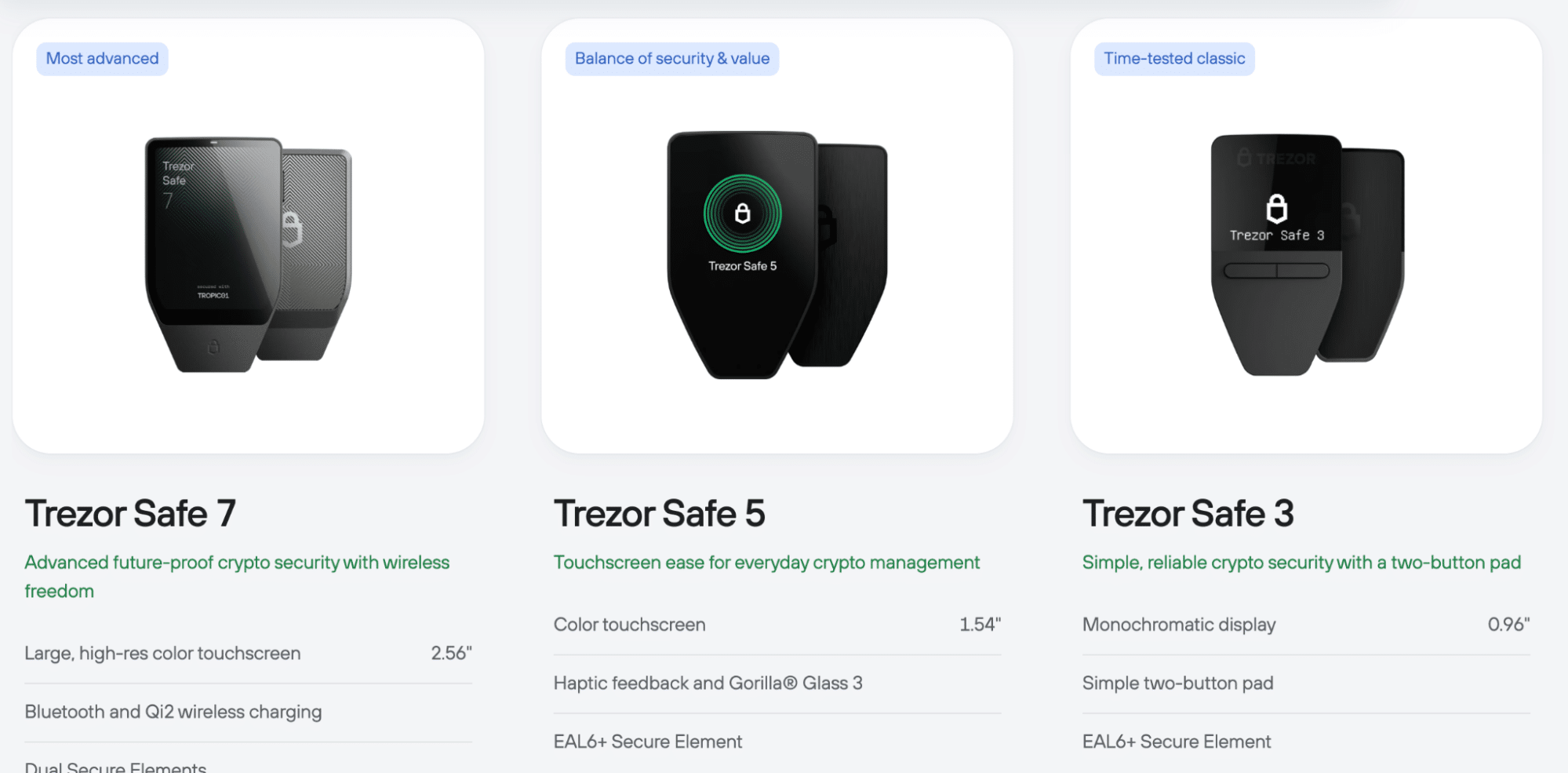
Trezor (Safe 5/Safe 7)
- Developer: SatoshiLabs (Prague)
- Type: Hardware, cold, non-custodial
- Hardware support: Hardware wallet
- Key features: Open-source firmware, EAL6+ secure element, SLIP39/Shamir backup, passphrase
- Cost: Paid: Safe 3 ~$79, Safe 5 ~$169, Safe 7 premium tier
Trezor’s defining trait is fully open-source firmware so the code can be independently audited. The Safe 3, 5 and 7 add an EAL6+ “NDA-free” secure element (Infineon) to resist physical and supply-chain attacks, and the Safe 7 adds Bluetooth and a “transparent” secure element.
Keys are seed phrase–based and isolated on-device, with optional SLIP39 multi-share (Shamir) backups that split your seed across an M-of-N threshold. It suits holders who value transparency and want auditable cold storage for Bitcoin and thousands of other assets.
Earlier seedless Trezors without a secure element were shown by researchers to be physically extractable. The newer secure element addresses this, but physical access remains a risk for any hardware wallet, and advanced features carry a learning curve.
Ledger (Flex/Nano X/Nano S Plus)

- Developer: Ledger (France)
- Type: Hardware, cold, non-custodial
- Hardware support: Hardware wallet
- Key features: CC EAL6+ secure element, secure screen, very broad asset support, polished mobile app
- Cost: Paid: Nano S Plus ~$79, Flex ~$249
Keys are seed phrase–based and isolated on a certified secure element, with a secure screen driven by the chip and physical approval per transaction. Ledger Live covers desktop and mobile and supports a very large range of assets across Bitcoin, Ethereum/EVM, Solana and more. Ledger’s operating system receives recurring third-party audits, most recently by Synacktiv in January 2026. The key caveat is that the secure-element firmware is closed-source, which open-source advocates criticize.
Ledger’s history is also a lesson in operational and supply-chain risk, not just device security: A 2020 customer-database leak exposed personal data, and in December 2023 attackers compromised an ex-employee’s npm account and pushed malicious “Connect Kit” code into many DeFi front-ends, stealing roughly $600,000 before a fix was shipped. The device keys weren’t compromised, but the software around a hardware wallet is part of its risk. It suits users who want the broadest asset coverage and a polished experience and accept an audited but closed secure element.
Sparrow + Coldcard

- Developers: Sparrow (open-source desktop coordinator) + Coldcard signer (Coinkite, since 2017)
- Type: Bitcoin-only; desktop software + air-gapped hardware; non-custodial
- Hardware support: Pairs with air-gapped signers (Coldcard and others)
- Key features: Coin control, full UTXO/PSBT tooling, Tor by default, single-sig and multisig
- Cost: Sparrow free; signer paid (buy direct from the manufacturer)
This pairing is for Bitcoin-only self-custody with maximum transparency. Sparrow is open-source with reproducible builds, full UTXO and coin control, complete transaction visibility, and connects to your own Bitcoin node. Coldcard stores keys in dual secure elements from two different manufacturers, signs fully air-gapped via microSD/QR, and runs open-source, reproducible firmware you can verify yourself.
Recovery is seed phrase–based (optionally generated from dice rolls), and multisig across devices from different vendors reduces single-vendor supply-chain risk. It suits Bitcoin power users and anyone wanting air-gapped or multisig cold storage; the trade-offs are Bitcoin-only support and a steeper learning curve.
Safe (formerly Gnosis Safe)

- Developer: Safe Ecosystem
- Type: Smart-contract multisig; non-custodial
- Hardware support: Pairs with hardware signers
- Key features: M-of-N threshold signing, optional ERC-4337 module, Safe Apps
- Cost: Free (you pay gas)
Funds move only when a threshold of signers (e.g., 3-of-5) approves, so no single compromised key drains the wallet. Safe’s contracts are extensively audited and have secured a very large share of on-chain treasury assets across DAOs and companies over several years.
An important nuance: the February 2025 $1.5 billion Bybit hack—the largest crypto theft on record—involved Safe. Forensic reviews by Sygnia and Verichains concluded that attackers linked to North Korea’s Lazarus Group compromised a Safe developer’s machine and cloud infrastructure and injected malicious JavaScript into the Safe web interface, so signers approved a transaction that looked normal but wasn’t. Investigators found the Safe smart contracts themselves were not vulnerable.
The lesson is that a sound multisig contract doesn’t help if the interface you sign from is compromised and you blind-sign—independent verification on a hardware device is the defense. Safe suits DAOs, funds, and individuals securing large balances who can manage multiple signers.
MetaMask

- Developer: Consensys
- Type: Hot software (browser extension + mobile); non-custodial
- Hardware support: Yes (Ledger, Trezor)
- Key features: dApp browser, in-wallet swaps, smart-account support, third-party transaction scanning
- Cost: Free (swap/bridge fee markups)
Keys are seed phrase–based and stay on your device. MetaMask’s code is publicly viewable (source-available, not fully open-source since 2020) and it has been repeatedly audited over its decade of existence. Plus, it integrates third-party transaction scanning. After its multichain update it natively supports Ethereum and EVM Layer 2s, Solana (Extension v13.5/Mobile v7.57), and Bitcoin (rolled out December 2025), with more chains planned. Hardware-wallet accounts were EVM-only at launch.
Recovery is seed-phrase only, so losing the phrase means losing access. As one of the most-used self-custody wallets and a primary DeFi gateway, it’s a strong everyday choice—ideally paired with a hardware wallet for larger balances. Its main risk is that as a hot extension it’s a top phishing and fake-extension target, and you bear full responsibility for approvals.
Rabby

- Developer: DeBank (Singapore)
- Type: Hot software (extension + mobile + desktop); non-custodial
- Hardware support: Yes
- Key features: Pre-sign transaction simulation, batch approval revoke, risk/scam alerts, auto chain detection
- Cost: Free, open-source
Rabby’s distinguishing feature is a pre-sign security engine that simulates each transaction, previews balance changes, flags risky approvals, and warns of suspicious contracts and sites, directly addressing the blind-signing problem behind many losses. It’s open-source on GitHub, has been reviewed by external auditors such as Least Authority, and stores keys encrypted locally.
It covers EVM chains (130+) with automatic chain switching, and recovery is standard seed phrase–based. It suits active DeFi users who want clearer signing and approval hygiene across many EVM networks. Limitations are that it’s EVM-only (no native Bitcoin) and, as a hot wallet, still exposed to device malware.
Phantom

- Developer: Phantom (backed by Paradigm)
- Type: Hot software (mobile + extension); non-custodial
- Hardware support: Yes (Ledger)
- Key features: Transaction previews, scam/malicious-domain detection, staking, NFTs, in-wallet swaps
- Cost: Free (swap service fee ~0.85%)
Keys are seed phrase–based and user-controlled. Phantom publishes third-party audit materials and runs a bug-bounty program. The caveat is that its core application is largely closed-source, so some security claims rest on audits and reputation rather than fully public code—label it accordingly.
Once Solana-only, it now also supports Ethereum, Bitcoin, Polygon, Base and Sui, with monthly active users reported in the 15–17 million range during 2025. Recovery is seed phrase–based. It suits Solana-centric users (NFTs, staking, DeFi) who want light cross-chain coverage in one mobile-first app. It’s weaker for advanced Bitcoin use and, as a hot wallet, isn’t a substitute for cold storage of large balances.
Coinbase Smart Wallet

- Developer: Coinbase
- Type: Smart-contract (ERC-4337) wallet; non-custodial
- Hardware support: N/A
- Key features: Passkey login (no seed phrase), gas sponsorship, transaction batching
- Cost: Free
There’s no seed phrase by design: a WebAuthn passkey is the primary signer, generated in the device’s secure enclave, and the open-source contracts are published on GitHub. It works across Base, Ethereum and several EVM chains, with the same address resolving across them.
Recovery uses passkey sync via Apple iCloud Keychain or Google Password Manager, far more forgiving than a seed phrase, but it ties recoverability to your cloud account’s security, a different trust model rather than the absence of trust. Researchers flagged that the wallet set passkey “userVerification” to “preferred” rather than “required,” so check current behavior. It suits beginners and app onboarding. Risks include smart-contract and ERC-4337 infrastructure dependence and its relative newness.
Argent

- Developer: Argent (now partly branded “Ready”)
- Type: Smart-contract wallet (ERC-4337 on Ethereum; native account abstraction on Starknet); non-custodial
- Hardware support: Limited (guardians can include hardware devices)
- Key features: Guardian-based social recovery, gas sponsorship on Starknet, first-class DeFi integrations
- Cost: Free (network/service fees)
Argent helped popularize social recovery: instead of a seed phrase, you designate guardians (friends, other wallets, hardware devices, or a recovery service) who can collectively restore access, with a typical 2-of-2 design pairing a signer key on your phone with a guardian contract.
Its smart contracts are externally audited before deployment, with public Ethereum and Starknet audit repositories, and the team has used account abstraction since 2018. It’s open-source and free, with deep DeFi integrations (Aave, Lido, Morpho) and gas sponsored on Starknet. It suits users who want smart-account features and seedless recovery, especially on Starknet. Trade-offs are network specificity, smart-contract risk, and an evolving product focus.
Zengo

- Developer: Zengo (Tel Aviv; since 2018)
- Type: Hot mobile software; non-custodial via MPC
- Hardware support: No
- Key features: No seed phrase, biometric “3-factor” recovery, in-app swaps and staking
- Cost: Free core wallet; optional paid Pro tier
Zengo uses multi-party computation (2-of-2): one secret share lives on your device, one on Zengo’s server, and a full private key is never assembled in one place, so Zengo can’t move funds alone and there’s no seed phrase to lose or be phished for. Recovery uses email, an encrypted cloud backup, and a 3D face biometric to restore access on a new device.
The company reports no wallets hacked since 2018, and the codebase is only partially open-source. It supports Bitcoin, Ethereum, Polygon and 100+ assets, and suits users who fear losing seed phrases. The key trade-off is that long-term access depends on Zengo’s infrastructure remaining available (Zengo publishes a recovery mechanism for provider-failure scenarios), and it’s still a hot wallet on an internet-connected phone.

How to Get Free Crypto
Simple tricks to build a profitable portfolio at zero cost

Crypto Wallet Trends in 2026
A wallet doesn’t hold your coins, it holds the keys that move them, which is why custody design matters more than almost any other choice. The 2026 market spans hardware (cold) devices, software (hot) extensions and apps, smart-contract/account-abstraction wallets (passkeys, social recovery, gas sponsorship, enabled by ERC-4337 since 2023 and ERC-7702 since the May 2025 Pectra upgrade), MPC wallets, and multisig.
Two trends dominate: multi-chain convergence (MetaMask and Phantom now reaching across Bitcoin, Ethereum/L2s and Solana) and friendlier recovery. Throughout, security, convenience and self-custody responsibility pull against each other—and most real-world losses come from phishing, fake apps, malicious approvals and supply-chain attacks rather than broken cryptography.
Wallet Types, Briefly
- Hot wallets are internet-connected (convenient, more exposed).
- Cold wallets keep your keys offline (safer from remote attacks, less convenient).
- Custodial means a company holds your keys (easy recovery, counterparty risk).
- Non-custodial means you alone control your keys (no reset and full responsibility). Also keep in mind that certain “self-custody” products still depend on a provider’s servers, so always confirm who really holds the keys.
- Software wallets store keys on a general-purpose device.
- Hardware wallets isolate them on a dedicated chip.
- Browser extensions add auto-update and supply-chain risk.
- Smart-contract wallets unlock recovery and passkey features at the cost of contract risk.
- Multisig requires several signers, which is strong for treasuries, though the signing interface can still be attacked.
How to Judge a Wallet
Brand popularity, a slick interface, and a high app-store rating are not evidence of security. Several of the largest user-fund losses in recent years involved popular, good-looking wallets. What actually matters and what we counted on while making the list:
- Who controls the keys? This is the single most important question. Seed phrase, MPC, multisig, hardware-isolated, or passkey—each has different failure modes. Confirm it before funding anything.
- Is the code open-source? Open-source code lets independent researchers inspect it. It is not a guarantee, but closed-source code asks you to trust claims you cannot verify.
- Are there published audits and a bug bounty? External audits and an active bug-bounty program show the developer invites scrutiny. A wallet with no audit history offers no third-party verification.
- Is there a certified secure element (for hardware)? Common Criteria EAL6+ secure-element chips are the current benchmark for resisting sophisticated physical attacks.
- How sound is recovery? A wallet’s backup and recovery design matters as much as its attack prevention. Watch for recovery paths that silently reintroduce custodial trust.
- Does it show you what you’re signing? Transaction simulation, “clear signing,” and phishing/approval warnings prevent the kind of blind-signing that drained funds in major 2023–2025 incidents.
- What is the track record? How has the developer handled past incidents? Disclosed, fixed, and compensated is very different from denied and silent.
A useful rule is that custody model and security architecture matter more than feature count or marketing. A wallet with fewer features but a verifiable security posture is usually a safer base than a feature-packed wallet you can’t audit.
Final Thoughts
There’s no single best crypto wallet—only the best fit for how much you hold, what you do on-chain, and how much responsibility you want. A common pattern works well: a hardware wallet (or multisig) for the bulk of your holdings, a software wallet with transaction simulation for everyday DeFi, and a clear, tested backup for whichever you choose. Open-source code, published audits, certified hardware, and a sound recovery design are worth more than any feature list or brand name.
Whatever you pick, verify official download sources, write your backup offline, test recovery before funding, and read every transaction before you sign. No wallet is unhackable, and with self-custody you are the last line of defense.
FAQ
What is the safest type of crypto wallet?
Hardware (cold) wallets are generally considered the most resistant to remote attacks because keys stay offline and every transaction needs physical approval. Still, no wallet is risk-free: phishing, physical theft, and user error all remain.
Do I really need a hardware wallet?
If you hold more than you’d be comfortable losing to a phone or browser compromise, a hardware wallet (or multisig) is usually worth the cost. For small, active balances a reputable software wallet with transaction simulation may be enough.
What happens if I lose my seed phrase?
With a standard non-custodial wallet, losing the seed phrase usually means losing access permanently. There’s no reset. Seedless designs (MPC or passkey/social recovery) avoid this but introduce other dependencies.
Are open-source wallets safer than closed-source ones?
Open-source code can be independently audited, which is a meaningful advantage, but it isn’t a guarantee of safety on its own. Audits, track record, and recovery design matter too.
Can a crypto wallet be hacked?
Yes—most losses come from phishing, fake apps, malicious token approvals, and supply-chain attacks rather than the wallet’s cryptography being broken, which is why verifying sources and reviewing every transaction matters so much.
Disclaimer: Please note that the contents of this article are not financial or investing advice. The information provided in this article is the author’s opinion only and should not be considered as offering trading or investing recommendations. We do not make any warranties about the completeness, reliability and accuracy of this information. The cryptocurrency market suffers from high volatility and occasional arbitrary movements. Any investor, trader, or regular crypto users should research multiple viewpoints and be familiar with all local regulations before committing to an investment.