The U.S. labor market is showing signs of weakness.
The Labor Department’s JOLTS report, released on the 29th of September, shows that U.S. job openings decreased to 7.079 million in August from a revised 7.335 million in July. The job-openings rate also slipped to 4.3% from 4.4%, while hiring increased slightly to 5.192 million. Quits were largely unchanged at 3.066 million, while layoffs and discharges decreased to 1.641 million.
In short, the labor market is cooling, with weaker demand for workers pointing to a gradual slowdown in employment conditions. As expected, this raises a key question for Bitcoin [BTC] and risk assets heading into Q4: Could a cooling labor market actually become a bullish liquidity catalyst?
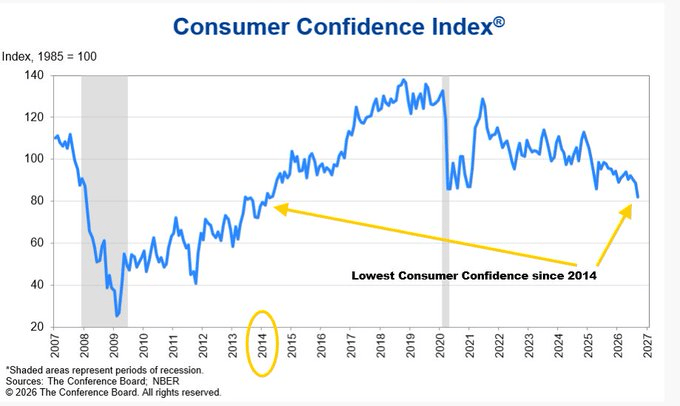
From a sentiment standpoint, the setup is becoming more notable. As the chart above shows, the Conference Board’s Consumer Confidence Index fell to 81.9 in September, the lowest level since early 2014. To put that in perspective, confidence was 85.7 in April 2020 and 81.7 in April 2014, showing just how cautious consumers have become.
The drop comes as Americans deal with rising fuel prices, soaring borrowing costs, and weak labor market conditions. More importantly, consumers are now expecting business conditions and the labor market to deteriorate over the next six months. Bloomberg’s latest note provides another bullish angle for Bitcoin, arguing that long-term unemployment in the U.S. is rising at a pace “unprecedented outside recessions,” with the average job search now taking more than six months.
That suggests that the labor market is weakening, which could lead the Fed to loosen monetary policy. If markets start pricing in faster rate cuts and looser liquidity, Bitcoin could benefit from the improved macro outlook. Notably, there are already early signs that this shift could be underway.
Why this October could look different for Bitcoin
October has traditionally been one of the best months for Bitcoin.
Bitcoin has averaged nearly 20% in October, managing to post only three negative yearly Octobers in the past 13 years. Nevertheless, BTC managed to close last year down by 3.6%, thus ending a six-year streak of bullish Octobers.
The key takeaway? BTC hit a peak of almost $126k before undergoing a near 40% correction. The FUD around that sell-off was so strong that Bitcoin is still well below those highs.
And yet, Bitcoin sentiment has hit its “greediest” level since July 2025. That means despite last year’s October crash, traders are growing confident once again. The chart below speaks for itself as it shows that the market probability for the October Fed hike now stands at 50%, down from about 70% previously.
This is explained by the statement from the Fed’s Williams saying that there is “no rush to act”, giving markets more room to price in a less hawkish Fed.
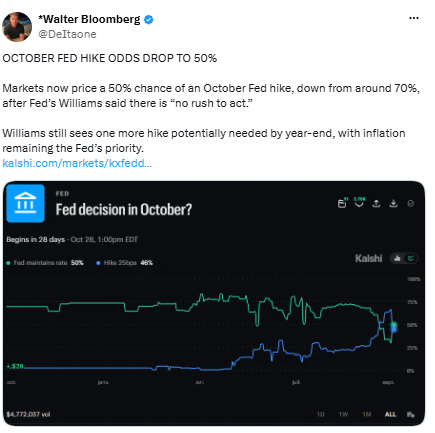
For Bitcoin, the change in expectations may set up an entirely different October this year. Instead of the liquidity crunch, and heavy selling pressure seen last year, BTC is entering the month with improving sentiment and mounting expectations of easing monetary policy.
If the trend persists, then Bitcoin can finally break away from the pattern it saw in October of last year, and capitalize on the bullish momentum heading into Q4.
Final Summary
- Weak jobs data and lower Fed hike odds could support Bitcoin.
- BTC could avoid last year’s October crash and gain momentum in Q4.