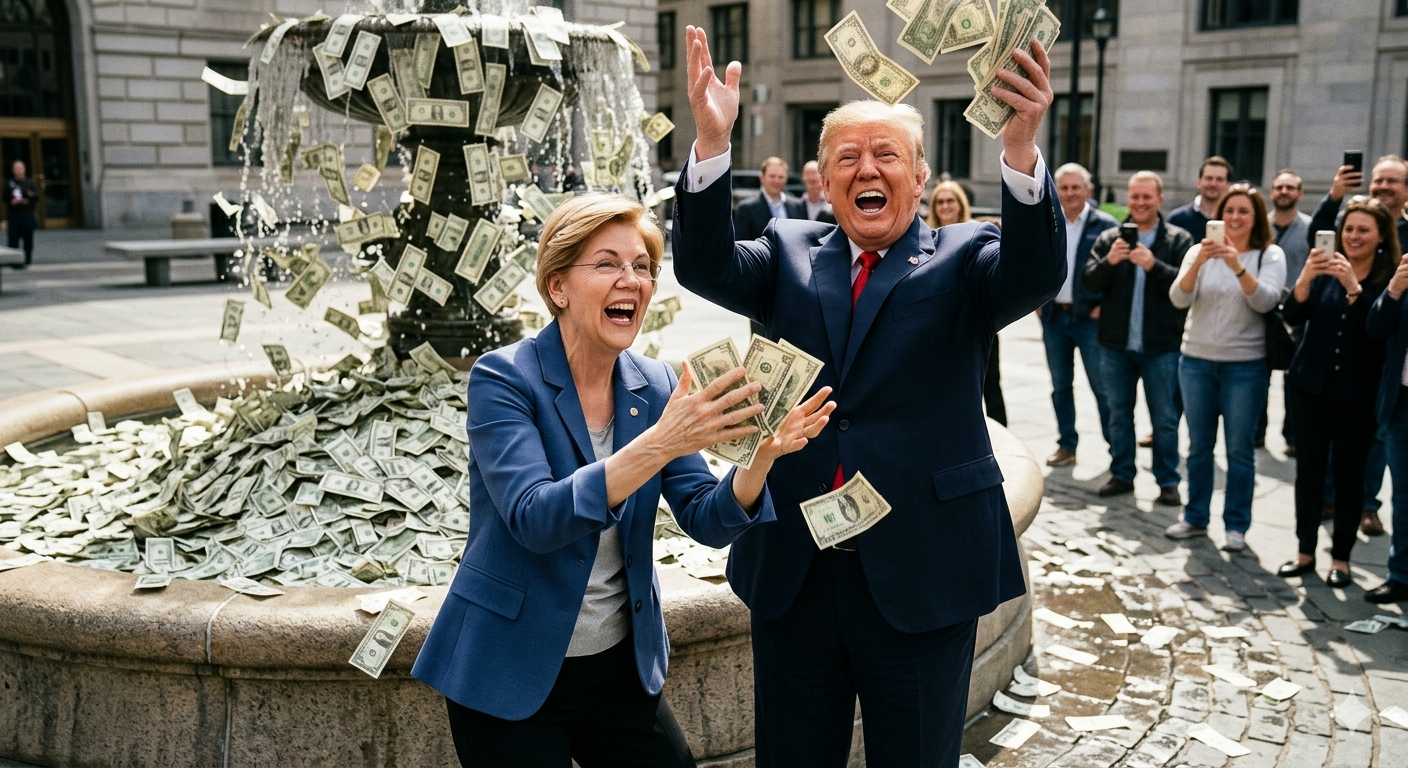
Crypto is not inherently corrupt. It is a technology that can be used to build open financial infrastructure or to quietly buy influence and exploit gaps in our oversight systems.
-
The unfolding relationship between Crypto.com, President Donald Trump’s media empire, and senior Democratic staff in Senator Elizabeth Warren’s own banking shop shows how both parties, and a long list of regulators and corporate partners, were put on notice about serious red flags and still chose inaction.
Crypto as technology, not villain
At its best, cryptocurrency offers programmable money, new payment rails, and transparent on‑chain records that can enhance accountability rather than undermine it. Crypto.com itself promotes its work to provide “safe, secure, and regulated” access to digital assets through its exchange, cards, wallet infrastructure, and the Cronos (CRO) blockchain (see: https://crypto.com).
But technology does not police itself. When large sums and powerful politicians are involved, the integrity of the system depends on human choices: what executives decide to disclose, what lawyers are willing to swear to, and whether regulators and corporate partners act when they see smoke. That is where the Crypto.com story becomes troubling.
The Trump–Crypto.com partnership: conflicts layered on complexity
In 2025, Trump Media and Technology Group, the president’s media company behind Truth Social and related ventures, announced a sweeping strategic partnership with Crypto.com.
According to public announcements and financial press coverage, including:
- Crypto.com release: https://crypto.com/us/company-news/trump-media-cryptocom-close-purchase-agreement
- Joint partnership release: https://www.globenewswire.com/news-release/2025/08/26/3139282/0/en/trump-media-crypto-com-announce-strategic-partnership.html
- Wall Street Journal coverage: https://www.wsj.com/finance/currencies/trumps-media-company-launches-new-business-to-buy-billions-in-niche-crypto-coin-1d629f30
- BroadbandBreakfast coverage: https://broadbandbreakfast.com/trump-family-empire-expands-with-crypto-com-partnership/
The deal, as described in those sources, works roughly like this:
- Trump Media integrates Crypto.com’s digital wallet infrastructure and adopts the Cronos (CRO) token as a utility token for rewards on Truth Social and Truth+.
- Trump Media acquires around 684 million CRO tokens, roughly 2% of the circulating supply, at about $0.153 per token, through a mix of stock and cash. A value of approximately $1 billion.
- A broader plan is announced, via a Trump‑branded CRO treasury vehicle and a SPAC tied to Yorkville Advisors, to build a CRO‑denominated “digital asset treasury” expected to reach roughly a billion dollars’ worth of CRO, plus hundreds of millions in cash and a multibillion‑dollar credit line.
Trump Media presents this as an innovative use of digital assets to build a modern corporate treasury and loyalty ecosystem. Ethics experts, however, have warned that when a sitting president’s closely held company enters large bespoke deals with a previously investigated exchange, and the president maintains an economic stake, it creates unprecedented conflicts of interest.
The concern is not that a company is experimenting with digital assets. It is that a regulated firm with significant legal exposure can entangle itself financially with the president’s business at the same time that executive‑branch agencies are making life‑or‑death decisions about its regulatory fate.
A parallel case in California: alleged “intrinsic fraud” and corporate identity games
While Trump and Crypto.com were deepening their business relationship, a consumer case in California raised disturbing questions about how a Crypto.com affiliate handled basic corporate and procedural obligations.
In Ryan v. Foris Dax Inc. dba Crypto.com (San Diego Superior Court, Case No. 25CU054346C), a self‑represented plaintiff has moved to disqualify Foris Dax’s counsel, alleging a multi‑layered “fraud on the court.” Key filings include motion to disqualify counsel, the memorandum of points and authorities, and a supplemental memorandum. And while these issues have not yet been fully adjudicated they have been mentioned in a half dozen filings and in oral argument in court. In every instance crypto.com chose not to address them with a single sentence even when explicitly asked to in court. Judge Blaine Bowman, however, saw enough merit to grant an order shortening time so that they would have to address them for the first time before August 28th, 2026.
According to those documents, Foris Dax Inc. was listed as “FTB SUSPENDED” by the California Franchise Tax Board during the full 30‑day period it had to respond to the complaint, meaning it lacked legal capacity to defend the case at all. Despite that suspension, the company filed a motion to compel arbitration in the final hours of the response window without disclosing its suspended status, and only acknowledged the suspension 11 days later after the plaintiff moved for default. Of note the entire default was 420 days.
The plaintiff identifies seven specific misrepresentations in declarations and proofs of service, including:
- A declaration from a compliance manager asserting that users could register only via mobile app, contradicted by archived web sign‑up pages already in the court record.
- A paralegal’s proofs of service stating that electronic service on a self‑represented litigant was “authorized by court order or consent,” when no such order or written consent existed under California Code of Civil Procedure section 1010.6.
- Declarations about the relationship between Foris Dax Inc. and Foris Dax US Inc. that appear irreconcilable with Secretary of State records and later company filings.
The supplemental memorandum adds two more categories. First, “post‑notice perjury,” where additional proofs of service filed on November 13, 2025 repeat the same contested electronic‑service language more than fifteen hours after counsel had been formally notified in a court‑filed motion that the original proof was allegedly false. Second, a “certificate of revivor substitution,” where counsel represented that a certificate of revivor existed and could moot questions about the suspension, but instead of filing the certificate, submitted screenshots of the Secretary of State website and a name reservation belonging to an unrelated third party.
These highlight a structural problem: when courts and counterparties accept screenshots and lawyer‑curated exhibits instead of certified records, it becomes easier to blur which entity is actually licensed or revived and harder for consumers or regulators to enforce basic accountability.
Who was told: regulators and corporate partners on notice
Separate from the public court record, whistleblower materials underlying this article (email logs and read receipts to be published separately) indicate that, by late April and early May 2026, a wide network of institutional actors had been given detailed notice of the alleged intrinsic fraud and corporate identity issues.
Crypto.com adjacent and partner executives at High Roller Technologies and TKO Holdings/UFC received the California filings and supporting documentation by April 21–24.
- READ RECEIPT – April 21 notice to TKO Holdings Executives
- READ RECEIPT – April 24 notice to High Roller Technologies leadership
Regulators and bank supervisors were notified early. An attorney at the Office of the Comptroller of the Currency and senior compliance personnel at Visa reportedly received the materials around April 24–May 1, outlining the suspended‑corporation timeline, contested proofs of service, and questions about which entity actually held the revived charter.
- READ RECEIPT – April 24 notice to OCC counsel
- READ RECEIPT – May 1 notice to Visa executive leadership
Derivatives and futures watchdogs were brought in. Multiple staffers at the National Futures Association were emailed the same packet by May 7. One staffer responded that the organization was “looking into it,” then, according to the whistleblower, went silent without further update.
- READ RECEIPT – NFA acknowledgment email dated May 7
- Jennifer Sunu even replied acknowledgement the same day here.
Major venue and sponsorship partners were also notified. Executives at AEG Worldwide, a key player behind some of Crypto.com’s high‑profile naming rights and events, received the filings around May 1, raising questions about ongoing sponsorships while serious allegations remained unresolved.
This record shows not a gap in awareness but a failure of escalation. Many of the institutions that benefit from Crypto.com’s payments volume, branding dollars, or strategic partnerships had the same court filings that are now before a California judge and treated them as someone else’s problem.
Elizabeth Warren’s rhetoric vs. her office’s inaction
No national figure has been more vocal about the dangers of Trump‑linked crypto ventures than Senator Elizabeth Warren.
In 2025, she repeatedly described Trump’s crypto activities as an “insane level of corruption,” a “superhighway of corruption,” and an “$800 million grift,” arguing that his ventures created “unprecedented conflicts of interest” and made it impossible to discuss crypto regulation without addressing his personal financial stake.
Representative coverage and statements include:
- “Senator Elizabeth Warren Warns Current Crypto Framework Could Blow Up the U.S. Economy” – https://uabonline.org/english-news/senator-elizabeth-warren-warns-current-crypto-framework-could-blow-up-the-u-s-economy/
- Business Insider: “Warren: Stablecoin Bill Will Make It Easier for Trump to ‘Line’ His Pockets” – https://www.businessinsider.com/elizabeth-warren-trump-stablecoin-bill-cryptocurrency-meme-coin-congress-2025-5
- Summaries of Warren warning of a crypto “superhighway of corruption” tied to Trump’s ventures – for example: https://www.webull.com.my/news-detail/14116732333540352
She has warned that the existing crypto regulatory framework is weak, industry‑friendly, and capable of being captured and used to amplify President Trump’s potential for corruption, that stablecoin legislation like the GENIUS Act could accelerate Trump’s corruption by supercharging the stablecoin market and boosting the reach and profitability of his USD1 product, and that Congress risks aiding and abetting his corruption if it fails to close these gaps.
Those critiques focus on real vulnerabilities. Yet the staffing and actions, or inactions, inside Warren’s own operation raise uncomfortable questions about whether those words are being matched by deeds.
The Eric Nguyen factor: when the watchdog’s chief counsel looks away
Public biographies from George Washington University Law School, the American Law Institute, and congressional directories describe Eric S. Nguyen as chief counsel on the Democratic staff of the U.S. Senate Committee on Banking, Housing, and Urban Affairs, where Warren is a senior member. He previously served as deputy general counsel at the U.S. Treasury Department and senior counsel to the Deputy Attorney General, giving him deep experience at the intersection of financial regulation, enforcement, and markets.
According to the whistleblower’s email records, Nguyen was directly sent the California filings and supporting documentation outlining the suspended status of Foris Dax Inc. during its filing of a motion to compel arbitration, the alleged misstatements in declarations and proofs of service, and the disputed handling of the certificate of revivor and the relationship between Foris Dax Inc. and Foris Dax US Inc.
Those records indicate that Nguyen had notice of this material by May 1, 2026.
From that point on, Warren’s public rhetoric about Trump’s “superhighway of corruption” and the dangers of weak crypto rules continued and even intensified. But there has been no visible sign that her office used its considerable platform to highlight this specific fact pattern: a major exchange partner of the president’s own media company, accused in court of gaming corporate identity and basic procedural rules, while a wide circle of partners and regulators looked away.
That gap between message and action is the heart of the hypocrisy. Warren has built her brand on the claim that she will call out corruption no matter who it offends. Once her own chief banking counsel is on notice, failing to elevate concrete, document‑backed allegations involving a key Trump partner, and key financial‑regulation issues, looks less like ignorance and more like selective enforcement.
Trump’s executive leadership: normalizing pay‑to‑play
On the other side of the aisle, Trump’s executive leadership has embraced a model in which his personal business interests, digital‑asset ventures, and public policy are intertwined.
Public reporting describes Trump‑linked crypto ventures like World Liberty Financial raising substantial sums through deals with foreign investors, even as the administration makes consequential national‑security and export decisions, a presidential media company that partners with a regulated exchange to build a billion‑dollar CRO treasury, all while agencies under Trump’s appointees set the enforcement tone for that same exchange and sector, and a public posture that frames criticism as partisan witch hunts rather than engaging with conflict‑of‑interest concerns raised by ethics experts and reporters.
Trump is correct that crypto is now an enduring feature of global finance. But by using the presidency to promote ventures in which his own businesses have deep, opaque stakes, he has made it harder, not easier, for the public to trust any crypto‑related decision from the executive branch.
The common denominator: human accountability, not protocol design
Across these episodes, the problem is not that crypto exists, or that firms explore legitimate business partnerships. The problem is that executives, lawyers, and staff may treat core legal obligations such as corporate capacity, truthful declarations, and clear identity as negotiable when the stakes are high enough, regulators and corporate partners may treat credible, documented allegations as reputational issues to be managed rather than triggers for formal escalation and transparent resolution, and politicians in both parties may speak strongly about corruption and conflicts in the abstract but pull their punches when the facts implicate their own allies, staff, or narrative framing.
Crypto does not cause that behavior; it amplifies incentives and opacities that already exist. The same dynamics would be dangerous in any complex, high‑value market. The difference in crypto is the speed and global reach with which value and ownership can move. Another major difference is that one ruling of “fraud on the court” or one major public scandal of character and fitness can easily lead to a FTX like collapse overnight. Much like FTX it then becomes important who knew what and when. The list above is not exhaustive more will come out in due time.
What real accountability would look like
If we take these combined facts seriously – Trump’s entangled business dealings with Crypto.com, the unresolved California allegations about Foris Dax’s conduct in court, the whistleblower’s broad notice timeline, and Warren’s staff’s apparent inaction – several reforms suggest themselves.
-
Harder conflict‑of‑interest rules for presidents and senior officials
A president should not be able to own or control a business that enters bespoke commercial arrangements with firms under active or recent federal investigation or supervision. For crypto specifically, when a president or senior official has a direct stake in a token or platform, there should be automatic recusals or prohibitions on related regulatory and procurement decisions.
-
Certified records, not screenshots, for key corporate claims
Courts and regulators should require certified Franchise Tax Board and Secretary of State records whenever corporate capacity, revivor, or identity is at issue, rather than accepting unauthenticated screenshots or curated exhibits that can omit inconvenient details.
-
Mandatory escalation for documented fraud and capacity concerns
Agencies like the SEC, OCC, CFTC, and NFA should have clear protocols: when they receive detailed, document‑backed allegations of suspended status, perjury, or identity games involving a regulated entity, they must open a matter, assign a case number, and provide at least a high‑level public outcome (for example, “no action” or “investigation opened”). Likewise, major corporate partners – payment networks, venues, sponsors – should have governance policies that prevent them from ignoring credible red flags involving flagship partners.
-
Aligning rhetoric with action in Congress
Lawmakers who campaign on rooting out corruption in crypto should commit to specific triggers: when their staff receives credible documentation that aligns with their public warnings, they will either publicly raise it, refer it for investigation, or explain why they believe the concerns are unfounded. Silence should not be an option.
None of this requires being anti‑crypto. It requires being pro‑integrity, insisting that the same basic standards of honesty, transparency, and conflict management apply whether the asset is a bank deposit, a stock, or a token. This is the only way crypto will see mass adoption and shake its image as the “wild wild west”.
Actions, not headlines, will decide whether this space matures
Crypto’s future in the United States will not be decided by one SPAC, one lawsuit, or one viral speech. It will be decided by whether people with actual power – presidents, senators, regulators, general counsels, and board members – treat documented red flags as lines they cannot cross, or as heat they can outlast.
The Trump–Crypto.com relationship, the California Foris Dax filings, and the whistleblower’s notice records show a system where too many actors chose the latter. If there is a lesson here for crypto, it is not that the technology is uniquely corrupting. It is that the technology’s scale and speed make our existing accountability gaps impossible to ignore.
Closing those gaps is not a partisan or anti‑crypto project. It is the bare minimum required to make sure that, the next time everyone knows, someone actually acts. Hopefully before Crypto.com finishes their likely crash course into becoming the next FTX.
- This article was written by Jeremy Ryan also known as NFT Demon, an industry expert. For more on him go to linktr.ee/nftdemon which includes a comprehensive profile article a guest columnist wrote about him here. Patrol Crypto has no ads and has been going strong since 2022. Jeremy is currently facing unconstitutional charges related to retaliation for his journalism. If you would like to pitch in to help with his expenses you can find ways to do that here.