Although the CLARITY Act failed to advance in the Senate on the 15th of September, the cryptocurrency industry is still moving toward mainstream financial infrastructure.
According to a recent post by by Marcin Kazmiercza, co-founder and COO of RedStone, the SEC has provided a pathway for certain tokenized stocks to trade on blockchain-based platforms, while the CFTC has offered relief to some software developers.
Remarking on the same, he said,
In the 10 days since, US regulators have put out more crypto policy than Congress managed in two years.
How crypto moves forward without the CLARITY Act
U.S. regulators are considering frameworks for crypto exchanges, leveraged trading, stablecoins, and blockchain-based recordkeeping. Additionally, the Fed’s proposed GENIUS Act rules would also establish requirements for stablecoin reserves and risk management.
At the same time, traditional financial assets such as stocks, funds, and Treasury-backed products are increasingly being represented and traded on blockchains.
However, these regulatory steps are not equivalent to a permanent law. Exemptions and regulatory guidance, according to SEC Chair Paul Atkins, can be changed or withdrawn in the future. So, while the industry may have a regulatory gap to fill right now, long-term certainty will still require legislation.
Looking beyond the CLARITY Act
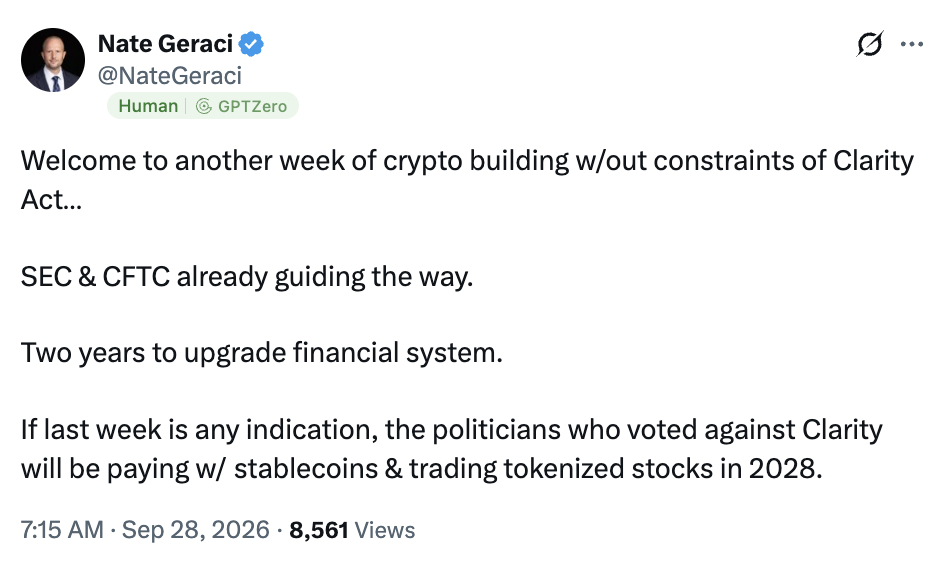
Nate Geraci’s post reiterated the importance of the CLARITY Act when he said,
Here, the key point is that the failure of the CLARITY Act does not mean crypto regulation has stopped in the U.S.
The SEC and CFTC can still use powers already granted to them by Congress to address areas such as tokenized securities and crypto market infrastructure. In fact, SEC Commissioner Hester Peirce reiterated that these agencies have been doing this for nearly two years.
I think that’s what we should be doing under the authority that we have is using it to try to answer some of the questions that, frankly, have been hanging in the air for many, many years now.
In fact, according to a recent report by AMBCrypto, many industry leaders such as Circle CEO Jeremy Allaire and Michael Saylor have also argued that the setback does not halt crypto’s broader progress.
Frustration and unceratinty remains
Still, many are still expressing frustration on the delay, as noted by Senator Cynthia Lummis, who added,
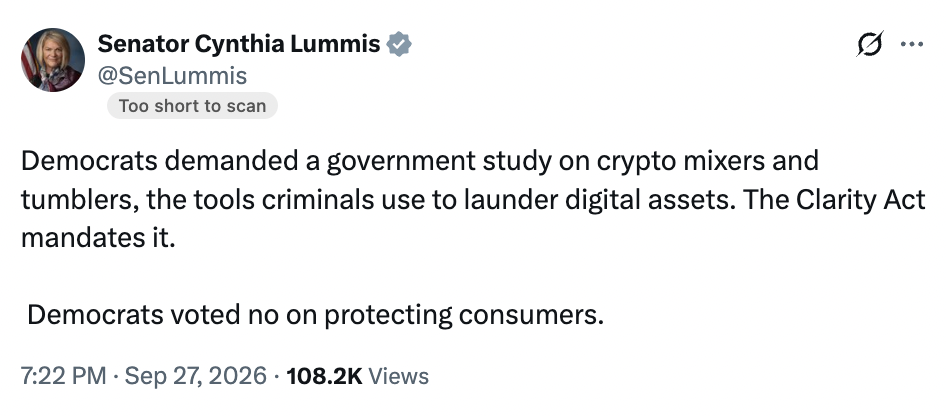
In fact, with the midterm elections nearing, the fear remains. Additionally, Polymarket odds sitting at 6% at press time has further added to the uncertainty.

However, Coinbase CEO Brian Armstrong is arguing that crypto policy could become an important issue for voters in the upcoming U.S. midterm elections too.
He believes that cryptocurrency should not be viewed solely as a Republican-versus-Democrat issue, but rather as a question of whether the United States will develop the next generation of financial technology domestically.
Crypto isn’t a partisan issue. It’s about whether the next generation of financial technology gets built in America.
Final Summary
- Despite the CLARITY Act failure, the regulators are also considering frameworks for crypto exchanges, leveraged trading, stablecoins, and more.
- With midterm elections and dropping Polymarket odds, concerns surrounding the bill’s passage continue.