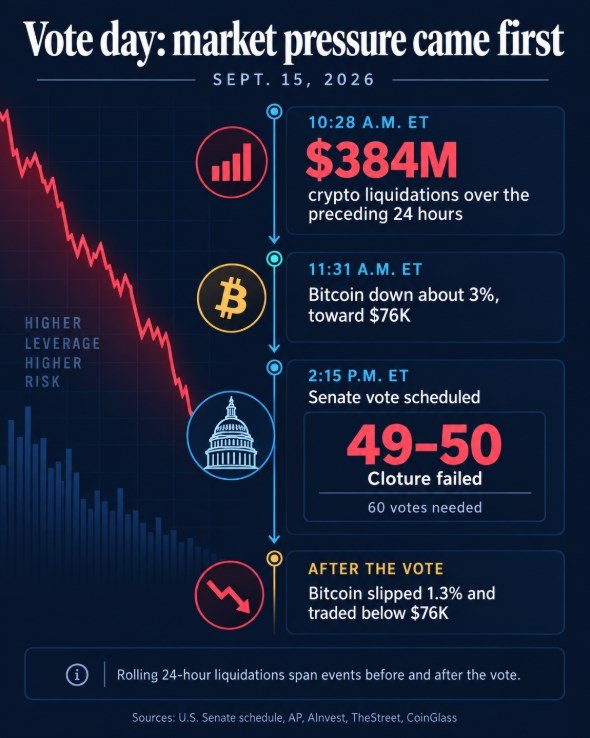
The US Senate failed on Sept. 15 to advance the Digital Asset Market Clarity Act, stalling efforts to create a federal framework for crypto markets as Bitcoin fell sharply below $76,000.
The cloture vote on the motion to proceed failed 49-50, and the measure needed 60 votes to move to debate, so the result was a procedural defeat.
The bill was designed to replace the industry’s fragmented regulatory environment with uniform federal rules for issuing, trading and selling digital assets. Its failure to advance leaves that wider market-structure push unresolved and denies supporters an immediate path to floor debate.
The Senate’s official schedule had set the vote for approximately 2:15 p.m. ET. The outcome fell well short of the required supermajority, turning a closely watched policy test into a new source of uncertainty for crypto businesses and investors.
Bitcoin’s decline started before the tally
Bitcoin hit an intraday low of $74,967.97 on Sept. 15, after already falling below $76,000 before the vote. The altcoin market cap tumbled 3.6% in the same period, but managed to stay above $1.15 trillion.
Traders were also preparing for a Federal Reserve decision, adding another source of pressure across risk assets.
The chronology shows that political disappointment arrived in a market already moving lower. It supports describing the vote as one factor in the afternoon weakness, but not as the origin of the full-day decline.
Leverage was also being unwound before senators voted. CoinGlass registered over $300 million in liquidations 20 minutes after the vote, with the 24-hour reading surpassing $665 million at the same mark.
For the crypto industry, the immediate consequence is legislative delay: the CLARITY Act did not secure the votes needed to begin debate. For Bitcoin, the next signal is whether selling steadies once traders absorb both the policy setback and the separate monetary-policy risk already weighing on the market.