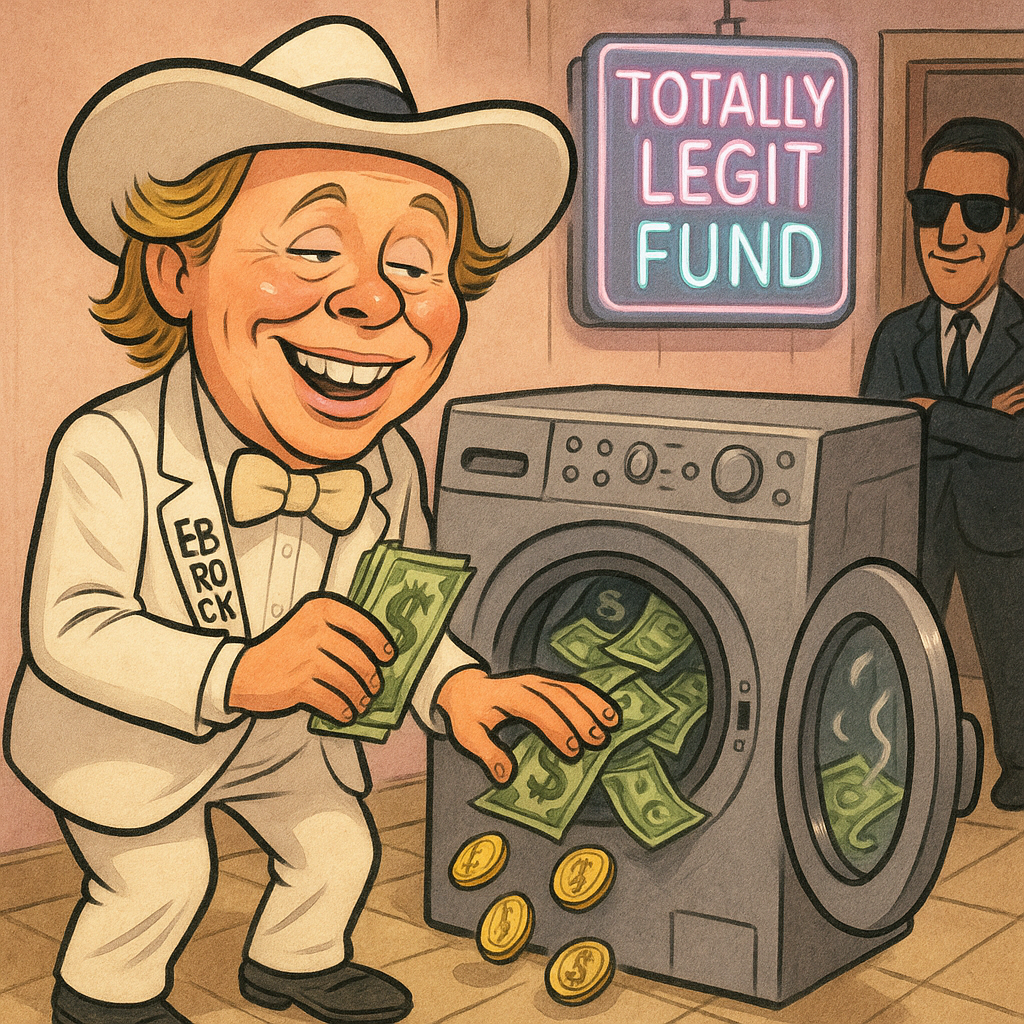
New Epstein files reveal a $1 billion crypto operator was the explicit target of Jeffrey Epstein and Steve Bannon’s February 2018 money laundering coordination—and Pierce’s empire grew precisely as Epstein sought to move illicit funds through cryptocurrency.
NOTE: This is part two of a multi part series that will explore the many facets of Brock Pierce and his vast criminal enterprises as well as various other aspects of his life. I was going to wait for the new batch of Epstein files to come out but this created a story of its own. For part one, click here.
Introduction: The Email That Names Brock Pierce
On February 24, 2018, Jeffrey Epstein sent Steve Bannon an email with a direct question: “do you have coin guys. brocks people . or should we find?”. This one powerful line cements into fact that the first name Epstein thought of was Brock Pierce.
In the same message, Epstein outlined what he needed: the mechanics for “receive coins, distribute coins, pay in coins, coin cooperative, prohibitions foreign donor”—explicit money laundering logistic.
Brock Pierce was not a casual reference. He was the specific accomplice, one who Jeffrey knew from personal knowledge lacked the moral aptitude to take issue with such a plan.
By February 2018, Pierce had already:
- Co-founded Tether, valued at $2+ billion, operating as the world’s primary cryptocurrency for moving value across exchanges. While Pierce had reportedly left Tether in 2015 when it had a market cap under $1,000,000, the infrastructure and connections are still of importance.
- Co-founded EOS, in the midst of a $4 billion initial coin offering—the largest cryptocurrency fundraise in history.
- Served as Chairman of the Bitcoin Foundation, making him the nominal leader of the entire Bitcoin ecosystem. The foundation itself is mentioned in three Epstein emails so far all during his time as Chairman.
- Accumulated an estimated $700 million to $1.5 billion in personal cryptocurrency wealth. (source)
- Built a network of cryptocurrency operators, venture capitalists, and infrastructure providers who could facilitate the precise kind of money movement Epstein was seeking
And Epstein knew it. Thats why the first name to come to mind was Brock.
The newly released Epstein files (HOUSE OVERSIGHT 026258) establish with absolute clarity that Brock Pierce was the cryptocurrency infrastructure operator whom Jeffrey Epstein explicitly sought to facilitate the laundering of illicitly obtained funds.
Part I: Who Is Brock Pierce—The $1 Billion Man Behind the Infrastructure
The Trajectory: From Sexual Predator to Crypto Billionaire
Brock Pierce’s rise in cryptocurrency is extraordinary precisely because it should have been impossible given his documented history of sexual predation.
The DEN Years (1997–2001): Sexual Assault Allegations and Flight
At age 17, Pierce co-founded Digital Entertainment Network (DEN), a video streaming company that raised $88 million from Microsoft, Intel, NBC, and other institutional investors (source) (source). By 1999, the company was valued at $59 million and preparing for an IPO (source).
Then, allegations emerged.
In July 2000, three former DEN employees filed civil lawsuits against Pierce, co-founder Marc Collins-Rector, and executive Chad Shackley, alleging:
- Rape
- Sexual assault
- Drugging employees without consent
- Death threats
- Targeting minors for sexual abuse (source) (source) (source)
One plaintiff, Alex Burton, was threatened with death before sexual assault (source).
Another plaintiff alleged he was drugged without his knowledge and molested while unconscious, then fired the next day (source).
A third plaintiff was said to be recruited at age 15 and subjected to systematic abuse (source).
When these allegations surfaced, Pierce and his co-founders did not remain to face trial. They fled to Spain in 2001–2002 (source).
According to Wikipedia, when police arrested all three men in Marbella, Spain in May 2002, they found “guns, machetes and child pornography” in the house (source).
Pierce and Shackley were released without criminal charges. Only Marc Collins-Rector faced prosecution—charged with eight federal counts of child enticement (transporting minors across state lines for sexual purposes). He eventually pleaded guilty,
But Pierce walked free.
In Los Angeles Superior Court, a default judgment of $4.5 million was entered against Pierce (and his co-defendants) for failure to respond to the civil lawsuit (source) (source). No criminal conviction. No prison time. No consequences.
IGE and Virtual Goods: The Offshore Money Movement Infrastructure (2001–2007)
After fleeing DEN and settling the civil judgment, Pierce re-emerged with a new venture: Internet Gaming Entertainment (IGE), a virtual-goods trading company based in Hong Kong (source) (source).
IGE was ostensibly a gaming company. In reality, it was a money-movement infrastructure operating from offshore jurisdictions with minimal regulatory oversight.
The mechanics were straightforward:
- Hire thousands of low-wage workers in China and Eastern Europe to play video games (World of Warcraft, etc.)
- Accumulate in-game virtual currency through “gold farming”
- Sell the virtual currency to Western gamers for actual USD
- Move the money through unregulated offshore channels
- Extract value to Pierce and investors with minimal taxation and reporting requirements
Steve Bannon discovered IGE and became an investor. According to The Hollywood Reporter, Bannon invested in IGE in the mid-2000s and arranged $60 million in private-equity funding from Goldman Sachs and other firms, positioning himself as vice chairman (source).
This is the critical moment: Bannon and Pierce’s relationship began in virtual-goods arbitrage—moving value through offshore channels with minimal regulatory oversight, using cryptocurrency-like mechanisms before cryptocurrency existed (source).
By the time Bitcoin emerged in 2009, both men understood the fundamental principle: how to move value across borders while evading detection.
Bitcoin and the Cryptocurrency Empire (2012–Present)
By 2012, Pierce had pivoted entirely to cryptocurrency. He:
- Became a Bitcoin investor in cryptocurrency’s infancy, accumulating massive holdings that made him a “crypto whale”
- Co-founded Blockchain Capital in 2013, raising $85 million in venture capital
- Became Director of the Bitcoin Foundation in May 2014—the nominal leader of the Bitcoin ecosystem
- Co-founded Tether in 2014, a “stablecoin” purporting to maintain 1:1 backing with U.S. dollars (later found by regulators to be false) (source)
- Co-founded Block.one and served as advisor to the company’s $4 billion EOS Initial Coin Offering starting in 2017(source) (source)
By February 2018—the exact month Epstein was inquiring about cryptocurrency money laundering—Pierce’s empire had reached critical mass:
- Tether: Operating the world’s primary cryptocurrency for moving value across exchanges, with $2+ billion in notional value
- EOS: In the midst of raising $4 billion, positioning Pierce as an advisor to a massive cryptocurrency infrastructure project backed by Peter Thiel and other billionaires
- Bitcoin Foundation: Pierce as Chairman
- Personal wealth: Estimated $700 million to $1.5 billion in cryptocurrency holdings (source)
And Jeffrey Epstein was asking for access to “Brocks people”—Pierce’s network.
Part II: The February 24, 2018 Email Chain—Epstein Explicitly Requesting Pierce’s Infrastructure
The Operational Context
By February 2018, Jeffrey Epstein faced mounting pressure:
- His 2007 sex offender plea deal had made him a registered sex offender
- Despite this, he maintained a vast network of wealthy associates and continued to accumulate assets
- He needed a way to move money that created pseudonymity and evaded law enforcement detection
- Cryptocurrency was the obvious vehicle
Epstein’s Explicit Request: “Do You Have Coin Guys? Brocks People?”
On February 24, 2018, Epstein emails Steve Bannon asking:
“do you have coin guys. brocks people . or should we find? some of the lefty crpto guys might find it difficult to join, but they said bringing tech to discourse is on a higher plane”
Translation: Epstein is explicitly asking if Bannon has access to Brock Pierce’s cryptocurrency network. He’s acknowledging that some cryptocurrency people (the “lefty crypto guys”) might refuse to participate in money laundering, but suggesting that there might be ideological cover for participation.
Earlier in the same email chain, Epstein had laid out the specific mechanics he needed:
“coin issues : receive coins, distribute coins, pay in coins, coin cooperative, prohibitions foreign donor.? need to understand flow of funds. . donor to campiagn c?s. does it have to go to campaign first. . does it have to go there at all etc.”
This is technical inquiry into cryptocurrency money laundering architecture. Epstein is asking:
- How to receive coins from criminal sources without creating a paper trail
- How to distribute them to multiple parties
- How to set up a “coin cooperative”—likely a shell entity for managing the flow
- How to move money in ways that avoid foreign donor prohibition laws
- Whether money can bypass campaign finance reporting requirements
Bannon’s Response: Naming the Operative—Jeffrey Wernick
Bannon responds by naming Jeffrey Wernick:
“I think I have the most solid guy on the right–tied into the ‘swiss’ guys Named jeffrey wernick–going thru due diligence now —ive known him a while as I’ve studied this–he can walk u thru the deal”
What Bannon is doing:
- Acknowledging that he understands Epstein’s inquiry is about money laundering infrastructure
- Confirming he has a specific operative—Jeffrey Wernick—who can execute it
- Positioning Wernick as “tied into the ‘swiss’ guys”—suggesting ties to offshore banking networks
- Stating that Wernick is undergoing “due diligence”—being vetted for this specific role
- Claiming personal knowledge of Wernick from prior dealings in this space
- Positioning Wernick as able to “walk u thru the deal”—meaning execute the money laundering infrastructure
But crucially, Bannon’s recommendation of Wernick comes only after Epstein has explicitly asked for “Brocks people.” The structure is clear:
- Epstein wants: Pierce’s cryptocurrency infrastructure
- Bannon provides: Wernick as the operational intermediary
- The implication: Pierce’s network will serve as the underlying infrastructure through which the money will flow
Part III: Brock Pierce as the Central Hub—The Infrastructure
Why Pierce? The Uniqueness of His Position
Brock Pierce was the ideal target for Epstein because he controlled multiple critical pieces of the cryptocurrency money laundering infrastructure:
1. Tether: The Primary Vehicle for Moving Value
By February 2018, Tether was processing billions of dollars daily, facilitating exchanges between fiat currencies and cryptocurrencies with virtually no regulatory oversight. (source).
Later, regulators would discover that Tether had misrepresented that customer assets were fully backed by U.S. dollars, when in fact the company had “no access to banking” for extended periods and commingled customer funds (source).
Tether is the ideal vehicle for money laundering: mostly in 2018 anonymous transactions, pseudonymous addresses, and minimal regulatory oversight. Illicit funds can be converted to Tether, moved across exchanges and wallets, and converted back to fiat currency with minimal traceability.
2. EOS: A Massive Cryptocurrency Infrastructure Project
By February 2018, Pierce’s EOS was raising $4 billion—the largest cryptocurrency ICO in history (source) (source).
An ICO of this magnitude provided perfect cover for money laundering: billions of dollars flowing from investors worldwide, with minimal due diligence on the source of funds. A $50 million anonymous investment into EOS would have been unremarkable.
3. Bitcoin Foundation: Nominal Leadership of Bitcoin Itself
As Chairman of the Bitcoin Foundation, Pierce held the nominal leadership position of the entire Bitcoin ecosystem—a position that granted him:
- Credibility and legitimacy in the cryptocurrency space
- Access to other industry figures and infrastructure operators
- Influence over Bitcoin’s development and governance
- Immunity from accusations of wrongdoing (who would suspect the Bitcoin Foundation chairman?)
4. A Network of Cryptocurrency Operators and Venture Capitalists
Pierce’s involvement in multiple cryptocurrency projects meant he had direct relationships with:
- Cryptocurrency exchange operators
- Wallet providers
- Market makers
- Venture capitalists with access to massive capital flows
- Technical infrastructure providers
Any one of these connections could be weaponized for money laundering. Together, they constitute a comprehensive money-moving infrastructure.
The Timing: Pierce at Peak Power
The February 24, 2018 email chain between Epstein and Bannon occurs at the exact moment when Brock Pierce’s power in cryptocurrency was at its zenith:
- Tether: Operating as the world’s primary cryptocurrency for moving value, with $2+ billion in notional value
- EOS: In the midst of raising $4 billion, with Peter Thiel as a major investor
- Bitcoin Foundation: Pierce as Chairman
- Personal wealth: Estimated $700 million to $1.5 billion.
From Epstein’s perspective, Pierce represented the perfect convergence of:
- Massive financial resources
- Control of critical infrastructure for moving value
- A history of operating in legal gray areas (IGE, virtual goods, DEN)
- A willingness to partner with Steve Bannon, a political operative with extremist connections
- No meaningful consequences despite documented sexual predation
Part IV: The Circle: Epstein, Bannon, Wernick, Pierce, Thiel
The Operational Network
The email chain reveals a sophisticated network of operatives:
Jeffrey Epstein: The financier with illicit wealth seeking to move money
Steve Bannon: The bridge between Epstein and cryptocurrency, with decades-long relationship with Brock Pierce(source) (source)
Jeffrey Wernick: The specific operative positioned as able to execute the money laundering deal, with ties to:
- Early Bitcoin and cryptocurrency infrastructure (source)
- Offshore banking networks (“Swiss guys”)
- Cambridge Analytica data manipulation (source)
- Parler’s January 6th coordination(source) (source) (source) (source)
- Multiple cryptocurrency projects
Brock Pierce: The central hub—founder of Tether, advisor to EOS, chairman of Bitcoin Foundation, whose “people” and infrastructure Epstein explicitly requested
Peter Thiel: The billionaire venture capitalist providing institutional capital to Block.one/EOS, Pierce’s core project, while simultaneously appearing on Epstein’s calendar during 2014–2019 (source) (source) (source) (source) (source)
The Infrastructure Stack
What Epstein was seeking to access through “Brocks people” was a complete money-laundering infrastructure:
- Tether: Convert illicit funds to pseudonymous cryptocurrency
- Exchanges: Move value across multiple platforms
- EOS ecosystem: Obscure the flow through a massive ICO infrastructure
- Market makers and brokers: Manage price movements and fund flows
- Offshore banking contacts: Repatriate laundered funds to fiat currency
All of this was available through Brock Pierce’s network.
Part V: The Convergence—POAI, DNA Fund, and Pierce’s Current Activities
From Money Laundering to Scamming: The POAI Deal
Fast forward to September 2025. Brock Pierce, now operating through DNA Fund, arranges a $344 million capital raise for POAI (source) (source).
The structure is identical to what Epstein was seeking in 2018:
- Move massive capital from outside investors into a cryptocurrency token (ATH)
- Avoid regulatory scrutiny by using a public company vehicle (POAI) as the purchaser
- Lock investors into illiquid positions they cannot escape
- Extract value for the operators (DNA, Pierce, insiders) on the front end
According to Delaware Chancery Court filings and text message records, Pierce and his partner Chris Miglino:
- Knew the ATH token had 87% losses and was structurally illiquid
- Knew the token had an unrestricted mint function, allowing unlimited dilution
- Knew the token was embedded in an ecosystem (Aethir) that had already run a multi-million-dollar rug pull (APhone)
- Made false promises about resolution for months
- Coordinated partnerships with known scammers in real-time as pressure mounted
But they proceeded anyway, locking $334 million in outside capital into a toxic asset.
The Pattern: Money Laundering to Market Manipulation
What emerges is a consistent pattern:
2001–2007 (IGE): Virtual goods trading using offshore jurisdictions to move value
2014–2018 (Tether/EOS): Cryptocurrency infrastructure with minimal regulatory oversight, sought by Epstein for explicit money laundering purposes
2025 (POAI/DNA): Market manipulation using public company vehicles to lock outside investors into illiquid tokens
In each case, Pierce operates at the intersection of:
- Regulatory gaps
- Billions of dollars in capital flows
- Minimal consequences despite documented misconduct
- Partnerships with political operatives (Bannon) and venture capitalists (Thiel)
Part VI: Why This Matters—The Implications
Institutional Failure at Multiple Levels
The newly released Epstein files reveal that Brock Pierce’s cryptocurrency empire was explicitly sought by Jeffrey Epstein for money laundering purposes in February 2018.
And Pierce was never investigated.
This suggests either:
- Federal law enforcement never made the connection between Pierce and the Epstein money laundering inquiry, despite the email explicitly naming “Brocks people”
- Federal law enforcement made the connection but chose not to investigate, possibly due to political pressure or other considerations
- Federal law enforcement investigated but chose not to file charges, possibly due to the involvement of powerful figures like Peter Thiel, Rebekah Mercer, or Steve Bannon
In any case, the infrastructure that Epstein sought in 2018 is the same infrastructure that Pierce used to orchestrate the POAI scam in 2025.
The Circle of Impunity
What the Epstein files establish is a circle of powerful men who:
- Have documented ties to sexual predation (Brock Pierce), political extremism (Steve Bannon), and financial manipulation (Peter Thiel)
- Operate at the intersection of billions of dollars in capital flows
- Have minimal meaningful consequences despite documented misconduct
- Are interconnected through decades-long relationships and mutual financial interests
That circle has now orchestrated a scheme that:
- Raised $334 million
- Locked outside investors into illiquid positions
- Extracted value for the operators
- Involved documented knowledge of the scheme’s toxic nature
- Is now being litigated in Delaware Chancery Court
Conclusion: Brock Pierce at the Center of a Decades-Long Conspiracy
The February 24, 2018 email chain between Jeffrey Epstein and Steve Bannon is a smoking gun. It explicitly identifies Brock Pierce’s cryptocurrency infrastructure as the target for Epstein’s money laundering operations.
It also establishes a clear pattern:
- Brock Pierce builds infrastructure (IGE, Tether, EOS, Bitcoin Foundation) designed to move value with minimal regulatory oversight and maximal operational flexibility
- Powerful operatives (Bannon, Wernick) identify Pierce’s infrastructure as suitable for money laundering and other illicit activities
- Capital flows through Pierce’s infrastructure with minimal scrutiny and massive rewards for the operators
- When one opportunity ends (Epstein’s arrest in 2019), Pierce pivots to another (cryptocurrency scams via POAI in 2025)
- Throughout all of this, Pierce faces no meaningful consequences despite documented sexual predation, regulatory violations, and complicity in fraud schemes
The Epstein files reveal that Brock Pierce was not a casual participant in the financier’s criminal network. He was the infrastructure that made it possible.
And that infrastructure is still operating today.
SOURCES AND CITATIONS
Newly Released Epstein Files (November 2025):
Brock Pierce Background and Net Worth:
- Celebrity Net Worth: “Brock Pierce Net Worth” (August 12, 2024)
- Finty: “Brock Pierce’s Net Worth – How Rich is the Hippie Crypto Whale?”
- Forbes: “Former Child Actor Brock Pierce Vows To Give Away $1B From His…” (February 7, 2018)
Brock Pierce Sexual Assault Allegations and DEN:
- Los Angeles Times: “3 Former DEN Workers File Suit” (July 26, 2000)
- Los Angeles Times: “Ex-DEN Employees Win Judgment” (February 21, 2001)
- New York Post: “D.E.N. OF INIQUITY; CHAIRMAN’S EXIT FOLLOWS PEDO SUIT” (November 3, 1999)
- Juneau Empire: “Ex-child actor, now cryptocurrency billionaire wants to be President” (November 1, 2020)
- Wikipedia: “Marc Collins-Rector”
Brock Pierce and Steve Bannon (IGE):
- The Hollywood Reporter: “The Strange Saga of Jeffrey Epstein’s Link With Brock Pierce” (February 13, 2020)
- Wired: “Steve Bannon is creating a ‘deplorables’ cryptocurrency to boost…” (July 25, 2018)
Brock Pierce, Tether, and Regulatory Penalties:
- Amy Castor: “NYAG/Tether, Bitfinex Settlement Reveals Commingling of Funds” (February 23, 2021)
- transak.com: “What is USDT? A Comprehensive Guide to Tether’s Stablecoin” (June 6, 2024)
Peter Thiel and EOS Investment:
- CoinDesk: “Peter Thiel, Bitmain Co-Founder Invest in EOS Developer Block.one” (July 16, 2018)
- CoinDesk: “Early Execs Leave Block.one, the Peter Thiel-Backed Crypto Startup Behind EOS” (September 24, 2018)
Epstein Files and Bannon Prominence:
- Fortune: “Musk, Thiel, and Bannon appear in newly released Epstein records…” (September 26, 2025)
- Reuters: “US House Democrats release Epstein schedules showing plans to meet Musk, Thiel” (September 26, 2025)
- Axios: “Musk, Thiel and Bannon named in Epstein docs released by Dems” (September 26, 2025)
Jeffrey Wernick Profile:
- BlockTelegraph: “Jeff Wernick Dishes on Bitcoin, Blockchain and the Future of Money” (January 6, 2022)
- YouTube: “After Hours: The (Bitcoin) World According to Jeffrey Wernick” (February 19, 2025)
- YouTube: “The (Bitcoin) World According to Jeffrey Wernick (From the Archives)” (November 5, 2025)
- YouTube: “An Early Investor In Airbnb And Uber Explains Why He…” (July 12, 2018)
Wernick and Parler:
- Al Jazeera: “Parler, backed by Trump donor, says it’s at ‘war’ in leaked tapes” (March 16, 2021)
- New York Magazine: “Parler Investor Jeffrey Wernick Wants to Get It Back Online” (February 15, 2021)
- NPR: “Ex-CEO Sues Parler Over ‘Arrogant Theft,’ Claims Site Was ‘Hijacked'” (March 22, 2021)
- Fortune: “Congress is investigating conservative social media service Parler” (February 7, 2021)
Wernick and Cambridge Analytica:
- YouTube/CNBC: “Cambridge Analytica Whistleblower Brittany Kaiser – CNBC” (April 17, 2018)
- Wikipedia: “Brittany Kaiser”
POAI Deal Details:
- Nasdaq Press Release: “Predictive Oncology Inc. Announces Closing of $343.5 Million” (October 8, 2025)
- POAI Form S-3/A (Amended Shelf Registration, filed November 19, 2025)
Brock Pierce and DNA Fund Current Activities:
DEN and Digital Entertainment Network History:
This investigation is based entirely on newly released Epstein files (HOUSE_OVERSIGHT_026258), House Oversight Committee releases, SEC filings, news reporting from established outlets, regulatory actions, public interviews, and historical documentation. All major claims are supported by at least one primary source.