
We started the tradition here at a16z of sharing what we’re reading because of the firm’s culture of reading and culture of sharing ideas: Books embody ideas; they inspire, push, and educate us on topics of interest. So every winter and summer since 2022, the Frontier team has continued the a16z tradition by asking our team what they’ve been reading, and what they would suggest someone else also read.
In lieu of sharing our typical gear guides this time of year, we’ve instead gathered 300+ books for you to consider gifting to yourself or others. This list includes picks from team members present and past, along with books we curated for the builder libraries at our Founders Summit (2022, 2023, 2025) and CSX startup accelerator program (2024)… plus a few bonus recommendations from founders, too.
A few patterns have emerged in these recommendations over the years. Unsurprisingly, we love learning how people make things, whether it’s Adrian Newey explaining how to design and optimize a Formula 1 car or Phil Knight sharing how to make a business like Nike. Our team loved reading Andy Weir’s Project Hail Mary well before it hit theaters. And a good sci-fi novel, like Ender’s Game or This Is How You Lose the Time War, always travels a long way, forward in time and to outer worlds as well.
Check out our books roundup below. Whether you’re in the market for magic, mysteries, or history, there’s something here for everyone.
Adventure, sport, and memoir
Expeditions
-
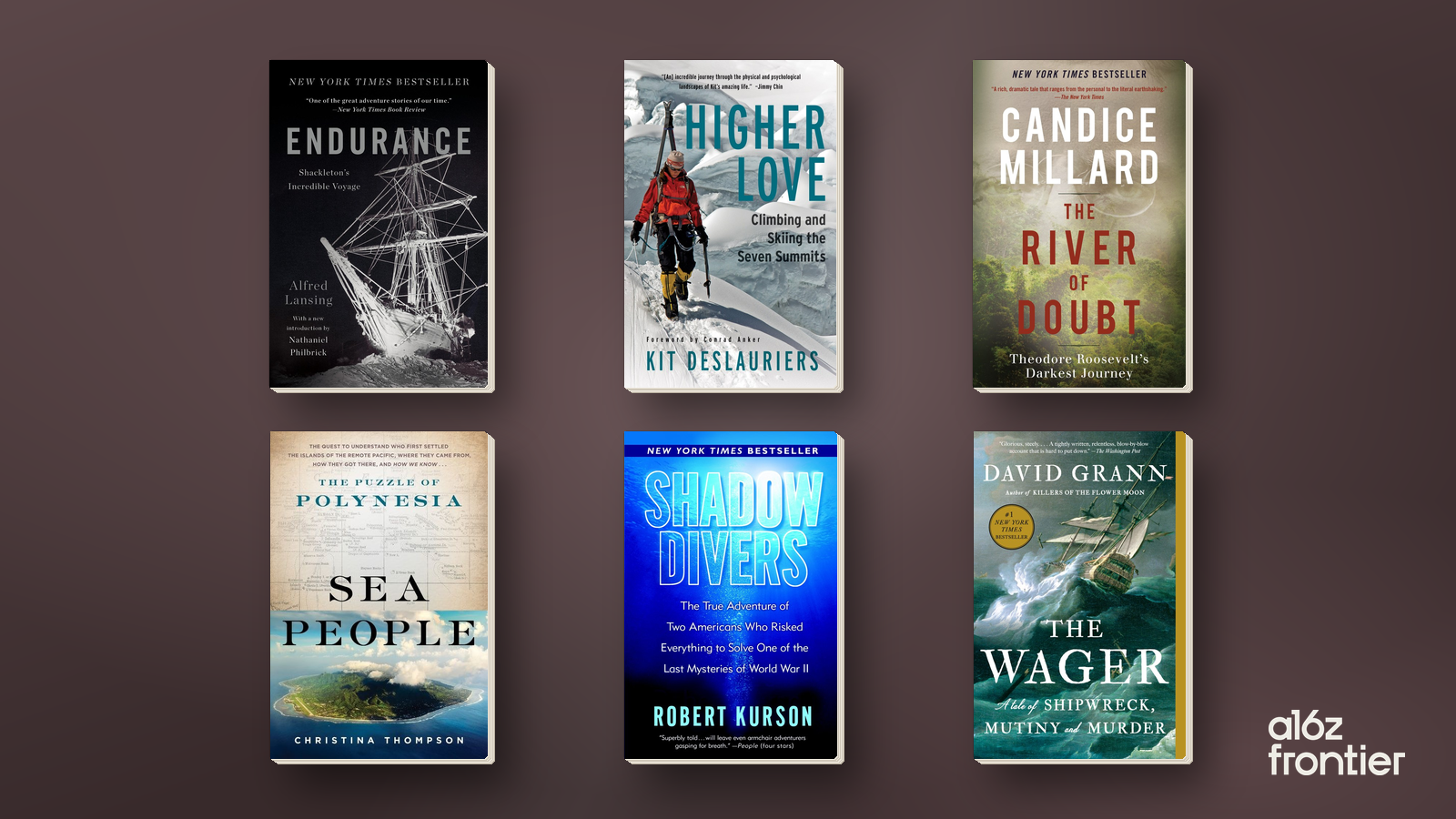
Endurance: Shackleton’s Incredible Voyage
-
The Explorer’s Gene: Why We Seek Big Challenges, New Flavors, and the Blank Spots on the Map
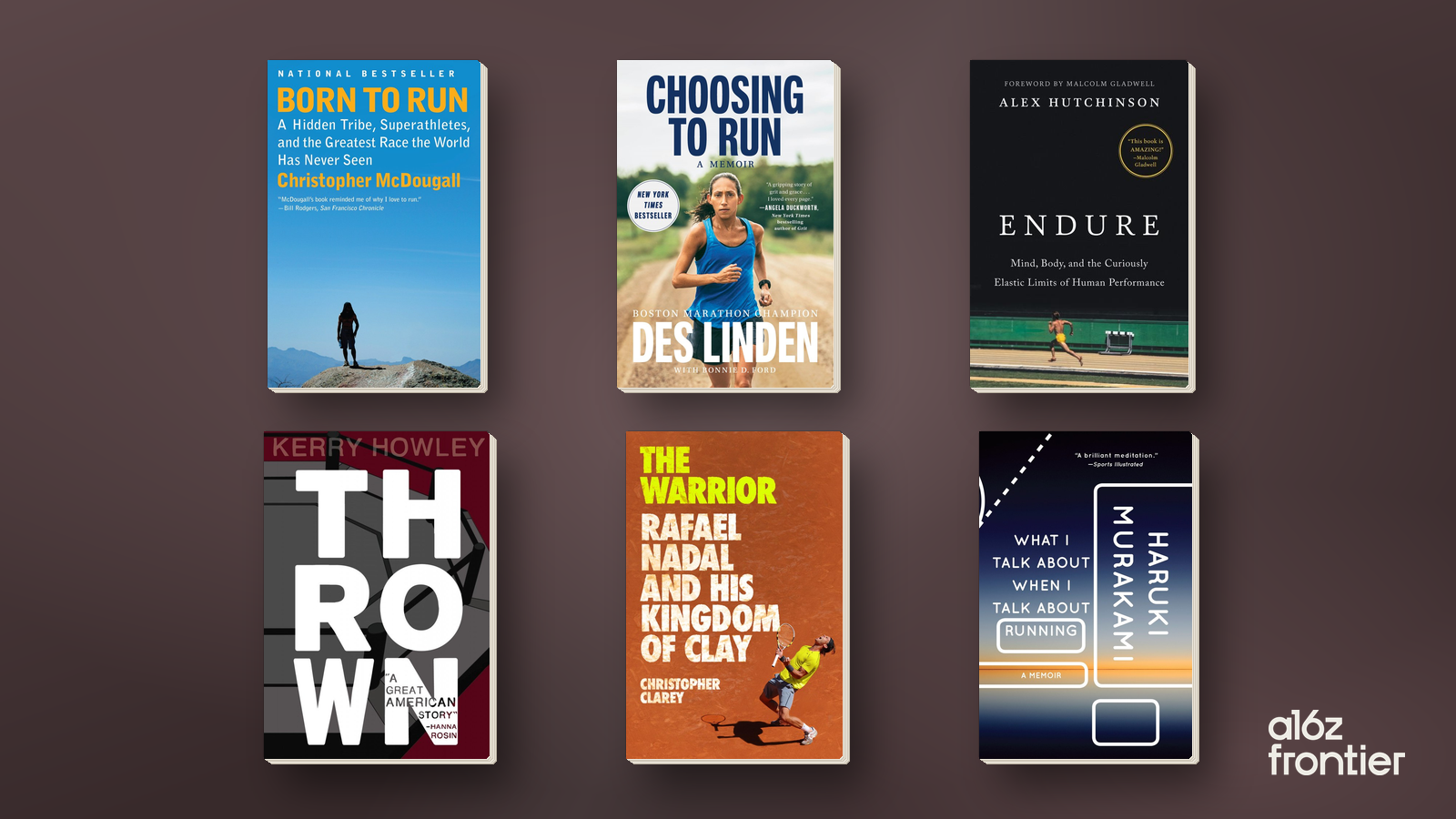
“Alex Hutchinson’s Endure and his new follow-up The Explorer’s Gene blend science, storytelling, and history to explore what drives us. Endure unpacks how mindset shapes resilience and physical limits, while The Explorer’s Gene dives into our inner drive to chase challenge and novelty. Together, they offer a fascinating look at what propels us in work, life, and play.”
– Shari Doherty, marketing
-
Higher Love: Climbing and Skiing the Seven Summits
“Inspiring firsthand account of a fearless skier and mountaineer conquering a massive feat — climbing and skiing the highest peak on each continent. It gives a peek into what drives her to complete this impressive feat but also the very real fears and circumstances she has to overcome. The book also introduces you to a colorful cast of characters that make up the climbing community around the world, who band together to help Kit reach her dream.”
– Kim Milosevich, marketing
-
Over the Edge of the World: Magellan’s Terrifying Circumnavigation of the Globe
“A gripping narrative of the first circumnavigation of the globe. It illuminates the hazards, allure, and rewards of exploration beyond the frontier of humanity’s knowledge and the unique type of leader required to get there.”
– Ross Shuel, network operations
-
The River of Doubt
“Shortly after losing his run for a third presidential term, Theodore Roosevelt and his son, Kermit, mount an expedition to explore an uncharted river in the Amazon. The challenges, perils, and near-death experiences they face along the way are almost unimaginable from today’s perspective. Founders enmeshed in the challenges of building their company can take comfort and find perspective in the story of what the Roosevelts attempted and endured.”
– Jason Rosenthal, operations
-
Sea People: The Puzzle of Polynesia
“Two themes to this book will resonate. First, human ingenuity and courage. The book is about the astonishing history of the settlement of Polynesia, which required sailing vast distances without modern technology. And second, the scientific process and its steady development. The book chronicles the whole sequence of theories — most of which were deeply flawed — that people came up with to explain how people had traveled to these remote Pacific islands. Over time, often pushed forward by Polynesian researchers themselves, and aided by developments like genetics and radiocarbon dating, we’ve been able to learn more and more about the origins of these fascinating islands.”
– Andy Hall, research
-
Seven Years in Tibet
“A firsthand account of one of the first Europeans to enter Tibet in the 1940s. Heinrich Harrer, a climber, lived there until the Chinese invasion in 1950 and tutored the young Dalai Lama. Harrer describes life in Lhasa with amazing attention to detail and humor. It’s a fascinating journey of a human that strives to make a positive impact on the world around him.”
– Valeria Nikolaenko, research
-
Shadow Divers: The True Adventure of Two Americans Who Risked Everything to Solve One of the Last Mysteries of World War II
“I’m a little late to this book, but it’s a great story about a daredevil subculture I knew nothing about. A true story, human drama, and adventure all at once.”
– Chris Dixon, deal
“It’s a super captivating (true!) story — I recommend not reading the back cover (or anything about the book in advance) as it’s much more fun to have the mystery unfold to you at the same time it unfolds to the characters.”
– Arianna Simpson, deal
“An older bestseller. Deep-water divers discover a sunken German U-boat off the coast of New Jersey. A story about danger, discipline, and persistence.”
– Brian Quintenz, policy
-
A Voyage for Madmen
“An amazing account of the first round-the-world race, solo sailors going non-stop! Held in 1968–1969, with participation widely open to anybody — the reason why most of the racers did not have much prior experience. The winner finished the journey in 312 days (current record for solo is 42 days). I think there are a lot of parallels to startup founders: most did not know what the journey entailed, they had to fix major issues with the boats under sail, and the journey itself felt for some so much more important than the prize money and honor awaiting them at the end.”
– Valeria Nikolaenko, research
-
The Wager: A Tale of Shipwreck, Mutiny and Murder
“The author (also of Killers of the Flower Moon fame) draws on detailed diaries to provide an engaging account of the last voyage of The Wager, part of a small British squadron chasing Spanish galleons round the world’s oceans in the middle of the 18th century. This book captures the human spirit’s incredible ability to survive, against all odds, through shipwrecks, scurvy, mutiny, and ferocious storms. Reading this book makes you grateful for the things that make us human — the good and the bad.”
– Mason Hall, deal
“The Wager is a gripping true tale of survival and humanity on the high seas during the age of exploration.”
– Ross Shuel, network operations
Nature writing

-
Secrets of a Devon Wood: My Nature Journal
“This is less a book to read and more a book to absorb visually, as it’s the artist’s journal — a nature diary in beautiful modern botanical-illustration style of the things she physically saw and zoomed in on from her ‘backyard’… For me, it evokes the feels of the first years of the pandemic, where so many of us were confined to local zones and traveling familiar paths, zooming in on the things we saw through new eyes. On her site, the artist quotes the ‘North Pond Hermit,’ who lived in isolation for years, on how ‘solitude bestows an increase in something valuable — my perception.’”
– Sonal Chokshi, editorial
-
The Shepherd’s Life
“Rebanks tells the story of the English Lake District through his own story as a modern-day shepherd with roots that go back hundreds, if not thousands, of years. It’s lyrical, honest, and moving.”
– Tim Sullivan, editorial
-
What Are People For?
“While my mind is typically focused on the future and its possibilities, What Are People For? is a collection of essays creating a deliberate pause to contemplate our place, and our limits, in this world. I like to read Berry’s essays in small increments and sit with his wisdom after closing the book.”
– Emily Westerhold, finance and operations
Memoirs and firsthand accounts
-
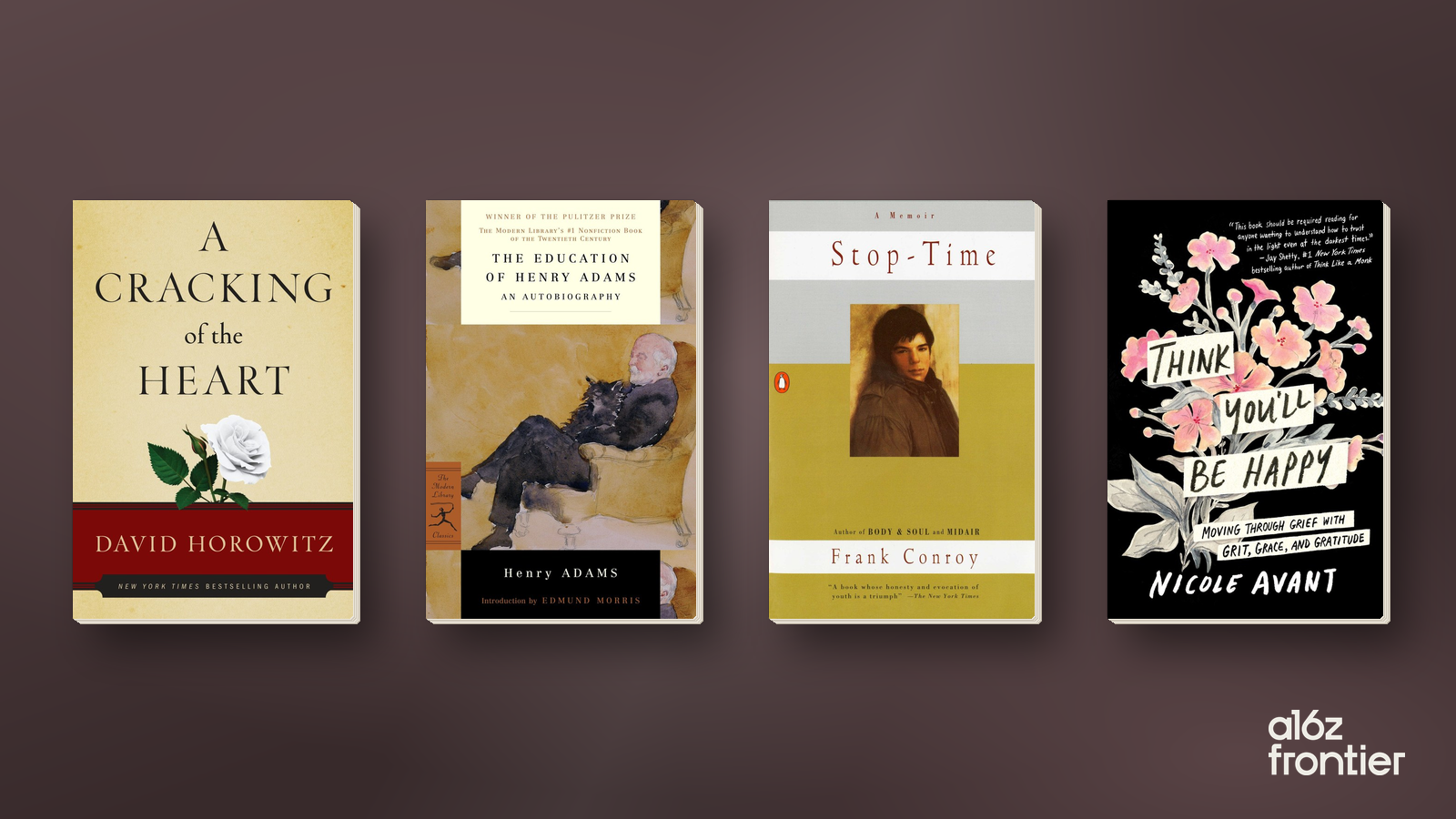
A Cracking of the Heart
“This is one of the most profound books I have read in a long time, and feels like it came along at just the right time (even though it was published over 15 years ago, a year and a half after the author’s daughter passed). On the surface, it is a book about grieving, reckoning with regrets, ‘the cords of family’ pulling together, and stitching stories and truths told by and about a loved one after they are gone. But it is also a book about living on one’s own terms, making meaning and finding purpose in one’s life, and connecting with each other despite differences — whether parents and children or siblings, friends and lovers or even spiritual guides. One of the biggest messages in the book is to pay attention to the ways in which your relationship continues even after death. And yet the biggest lessons the book really offers are on how to maintain relationships in life. Defending partisan positions or taking a combative, uncompromising stance on ideology may work for debating abstract ideas, but it blocks understanding the ‘full-bodied’ complexity of the person we’re talking to (or about). While many complain about narcissism and the death of nuance in our current times, it’s actually our very self-regard — and ability to give up control/our fear — which creates a bridge to others, Horowitz (who passed away in 2025) shares.”
– Sonal Chokshi, editorial
-
The Education of Henry Adams
“An extraordinary reflection on living through a period of intense technological change. Adams reflects on how the educational system failed to anticipate the radical transformation he experienced, and describes where he learned life’s true lessons. A classic and timeless book that’s perfect for today’s moment.”
– Andy Hall, research
-
Stop-Time: A Memoir
“This is a coming-of-age story and a recounting of rebellious teenage years that, despite being true, was more fascinating to me than J.D. Salinger’s fiction. The writing is impeccable.”
– Mike Manning, marketing
-
Think You’ll Be Happy: Moving Through Grief with Grit, Grace, and Gratitude
“A book about grief, purpose, and the legacy a mother leaves behind — woven with stories from music, culture, and politics.”
– Hoang Nguyen, marketing
-
Voices from the Italian Renaissance: A Sourcebook
“I am obsessed with this masterfully curated anthology of letters, poetry, publications, and various writings and other primary sources from the Italian Renaissance. The book is organized by theme, like the papacy, marriage, patronage, humanism, and others — each with an illuminating little introduction. Highlights are verses by performer and probable courtesan Gaspara Stampa as she imagines the end of a love affair (‘restore now / my life to me as it was, happy and joyous’ 😭). And two accounts of a young Leonardo da Vinci being an ambitious weirdo. First by frankensteining a bunch of animals (in a painting) to scare his father. Then by pitching his skills in a letter to Ludovico Sforza, the Duke of Milan, by offering to demonstrate his trebuchet designs in a city park. A classic example of a young builder seeking funding for his ideas.
Note that this book is a companion piece to Kaborycha’s A Short History of Renaissance Italy. I also recommend her anthology of letters, A Corresponding Renaissance: Letters Written by Italian Women, 1375–1650.”
– Stephanie Zinn, editorial
back to top ↑
Arts and culture
Designing games and puzzles
-
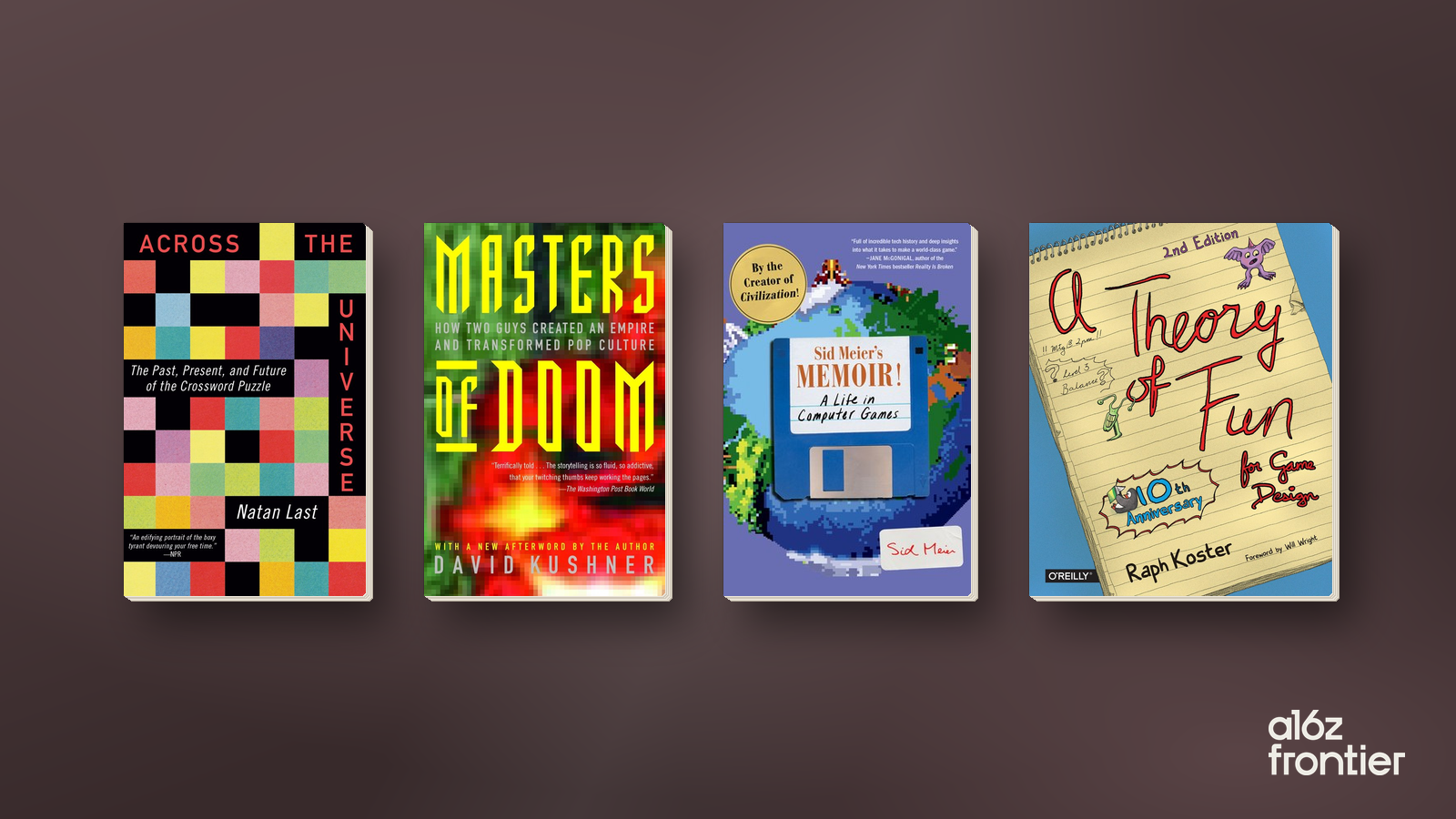
Across the Universe: The Past, Present, and Future of the Crossword Puzzle
“A book for wordplay enthusiasts and technologists (or for traveling in a spaceship?), especially for one down to rethink the grid.”
– Scott Duke Kominers, research
-
Masters of Doom
-
Sid Meier’s Memoir!: A Life in Computer Games
“The creator of Civilization — as well as dozens of other computer games — recounts how he and his collaborators built what became one of the greatest game franchises in the history of, well, civilization. In addition to tracing the history of computer hardware, graphics, AI, and game design, Meier’s memoir is full of top-notch advice for aspiring entrepreneurs and creators. It’s also laugh-out-loud hilarious.”
– Scott Duke Kominers, research
“If you’ve spent anywhere near as many hours as I have playing the many incarnations of ‘Civilization’ and other Sid Meier games, I’d highly recommend their creator’s memoir: part nostalgic tour of computer gaming, part tutorial on game design, part business primer, all fun.”
– Tim Sullivan, editorial
-
A Theory of Fun for Game Design
The process of creativity
-
Ametora: How Japan Saved American Style
“I’ve come to really enjoy menswear, most of which happens to be made in Japan. I was fascinated to understand why the highest-quality American-style clothing all happened to be made in Japan, and this book opened a whole new world I never knew about.”
– Guy Wuollet, deal
-
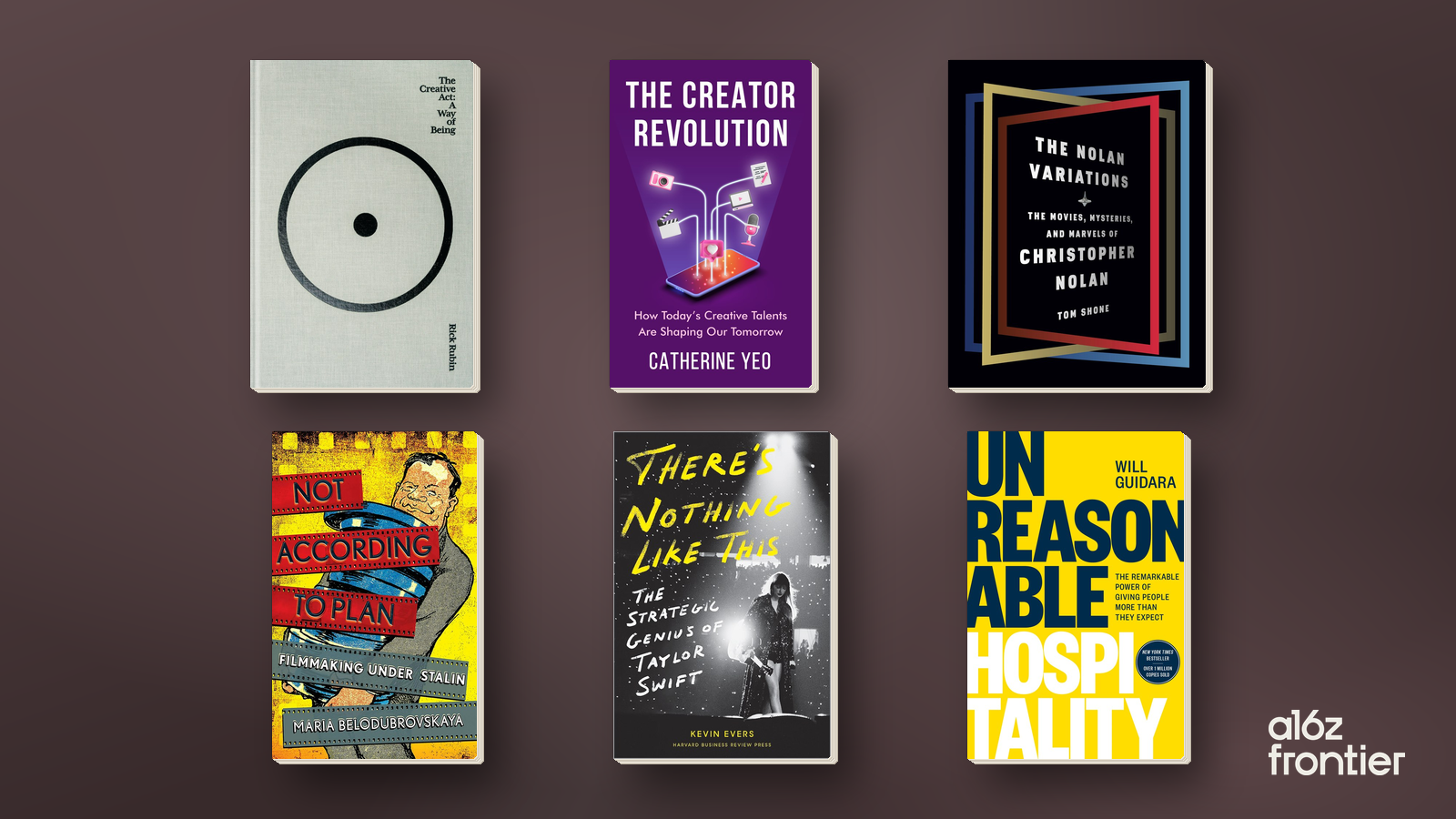
The Creative Act: A Way of Being
“Yes, many people are talking about this book — and there’s a reason why: it’s for anyone and everyone. Most books on creativity treat it like some rarefied act; reduce the hard work into clever little hacks; or read like overly self-indulgent little self-help treatises that belong on The White Lotus or something! But I like this book of the self-help/inspiration genre because it opens with the premise that everyone is a creator; that creativity isn’t some calling, but a ‘fundamental aspect of being human’; and that ‘we are all living as artists’ — whether or not you’re formally making art. The book shares mindsets for anyone bringing something into existence, big or small; and while some of it may feel obvious, in practice, it’s really not. Rubin’s musings on the abundance (vs. scarcity) mindset, on sincerity as a goal, and on the realities of popularity are especially fitting ones for our times. But honestly there’s so much in this easy-to-read book about just navigating life!”
– Sonal Chokshi, editorial
“A masterclass in making the creative process a way of life. The lessons apply whether you’re making music (like Rubin), writing, painting, coding, or investing in tech: be open to new ideas, willing to experiment, and ready to move past failure. Crisp, accessible, thought-provoking.”
– Chris Dixon, deal
-
The Creator Revolution: How Today’s Creative Talents Are Shaping Our Tomorrow
“Drawing upon her own experiences as a creator, as well as a range of interviews and other sources, my (undergraduate!) student Catherine Yeo documents the rise of the creator economy and the extraordinary opportunities it creates, as well as challenges around labor, community, and burnout. Yeo provides hands-on tips and — especially exciting for the crypto audience — surveys a number of different ways in which web3 offers the potential for a more inclusive and rewarding creator future.”
– Scott Duke Kominers, research
-
Michelangelo: The Artist, the Man, and His Times
“I will occasionally trot out anecdotes from this biography at a party or an otherwise fun gathering of friends. While I’ve seen a lot of eyes glaze over, I’m convinced there is an audience somewhere out there for my niche preoccupations, so here we go:
Around 1506 — a few years before he began work on the ceiling of the Sistine Chapel — Michelangelo Buonarroti traveled to Bologna. When he got there, he was recognized by attendants of Pope Julius II and promptly brought before His Holiness, whom Michelangelo had essentially left on read. Bold! Pope Julius then commissioned a bronze sculpture of himself with a giant sword to show everyone who was boss. Michelangelo — who wasn’t used to working in bronze, or in Bologna — complained prolifically in letters to his family. He bemoaned his ‘terrible room’ and the heat ‘such that one cannot believe it is worse anywhere in the world,’ but he did not write much about the plague raging in the city at the time, or about the unruly mob that sacked and burned an entire palace to the ground. He was simply that locked in.
If you find this delightful, read the whole biography. Michelangelo was, in fact, not a party dude. He was a charming (in my opinion) curmudgeon with near-delusional ambition.”
– Stephanie Zinn, editorial
-
The Nolan Variations: The Movies, Mysteries, and Marvels of Christopher Nolan
-
Not According to Plan: Filmmaking Under Stalin
“An amazing deep-dive on the folly of Stalin’s efforts to create a top-down cultural apparatus for cinema.”
– Andy Hall, research
-
Stairway
“My friend Markobi — the reigning world champion of card magic — just published his magnum opus Stairway, exploring the mechanics and philosophy behind his winning routine. While the technical details are aimed at magicians, his meditations on the creative process, the art of performance, and the champion’s mindset can be useful to anyone. (Fun fact: he signed my copy ‘Don’t open this book,’ so you know it must be good!)”
– Scott Duke Kominers, research
-
Strange Tools: Art and Human Nature
“I adore the premise of this book, which is that art makes us, not the other way around. After writing the book, Noë added that ‘Artists don’t make things because what they make is special. They make things because making is special…’ I’m obsessed with not just the process behind the outcomes of art, and the production of art, but also the interaction between art (the ‘strange tools’) and viewer, which is arguably as important. So this philosopher’s musings on art and evolution, and how we are designers by nature (drawing > writing, images > words), resonated with me… The insights may also reflect some of our response right now to AI art and excitement for generative art on the blockchain (my favorite!).”
– Sonal Chokshi, editorial
-
There’s Nothing Like This: The Strategic Genius of Taylor Swift
“While a lot of books about Taylor Swift focus on the gossip, feuds, and pop-culture aspects of her work and creative projects, this book homes in on the business of being one of the most successful artists working today. A great read with real case studies that can apply across all businesses.”
– Helen Stoddard, events
-
This Is Not a T-Shirt: A Brand, a Culture, a Community — a Life
“Hundreds’s memoir is a visionary work about brand as community — a core tenet of building in web3, which Hundreds has been exploring since the early days of the Internet. It’s also an extraordinary (and often laugh-out-loud hilarious) tale of entrepreneurship against some pretty surreal odds. [Disclosure note: I hold a few NFTs from The Hundreds’s NFT projects, and way too many The Hundreds beanie hats.]”
– Scott Duke Kominers, research
-
Unreasonable Hospitality: The Remarkable Power of Giving People More Than They Expect
“What I loved about this book was the ‘behind the scenes’ insights with a very driven and charismatic leader. With the relentless focus on customers at the center of the experience, it’s fascinating to see outcomes based on who is leading. Great read with fun personal examples.”
– Helen Stoddard, events
-
A Woven Year
“In 2023, Young undertook a project of daily weaving, creating 365 ‘tactile sketches’ from handspun fibers and found objects. The whole series has been beautifully photographed and woven together into this volume, perfect for quiet contemplation or as a coffee table book.”
– Scott Duke Kominers, research
How ideas spread and shape culture
-
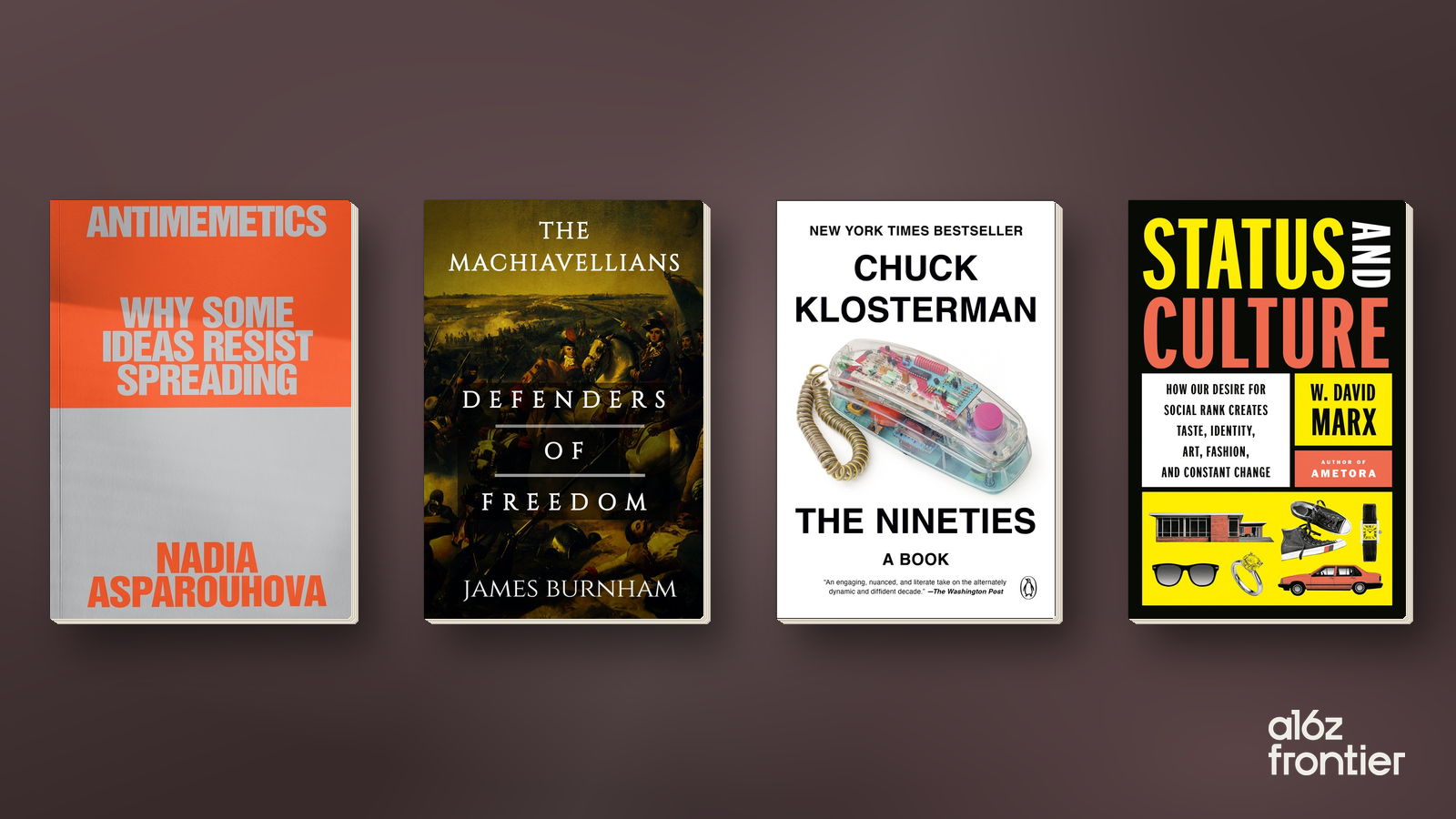
Antimemetics: Why Some Ideas Resist Spreading
“This is the only nonfiction book (besides David Horowitz’s memoir) that I’m recommending this year because I find most nonfiction books to be: too anecdotal (stuffed with stupid anecdotes or gratuitous non-illustrative examples when I just want the argument); too long for too little payoff (the argument shoulda been conveyed in a single article or podcast, not worth a book-length treatment); too discursive (and not in a cool journey way); too derivative (like every book before it and not in a comforting, familiar way but in an ‘oh god not this again’ way); or too dry (meant to only be scanned or parsed modularly for specific sections). I want the information, but don’t want it to come to me too dry either — I might as well read a textbook to learn a topic at that point (and I often do). But Nadia’s new book does none of the above, and is fresh and different: It is well argued, well written, flows well chapter to chapter (so belongs together as a book), and most importantly, makes the reader think and think differently. The topic — covering memetics, antimemetics, packaging messaging, focusing attention — has relevance for all kinds of builders and marketers, including crypto ones, as it applies not just to group chats but any self-organizing groups and communities communicating about ideas, persuading others, and moving from idea to reality.”
– Sonal Chokshi, editorial
-
The Condition of Postmodernity
“This is an epic work of artistic, cultural, economic, social, and political history that examines the period of roughly 1920 to the 1980s, charting the emergence of ‘postmodernism’ along the way. [Harvey’s] key argument — that new technologies compress space and time, and reshape human experience in tandem — feels very relevant to crypto. Nothing about Harvey’s writing feels forced or heavy-handed, and despite being published in 1989, the book still rings true today.”
– Elena Burger, new media
-
Humankind
“I tend to have a cynical view of human nature, and a friend gave me this book in an attempt to argue the other side. Reading it left me more hopeful about our society. It has also helped me better answer my toddler’s latest question of ‘How does someone become a bad guy or a good guy?’”
– Maggie Hsu, go-to-market
-
I See Satan Fall Like Lightning
“One of the most thought-provoking frameworks that reveal why we desire the things we desire and what this implies for how society is organized. If you love philosophy, anthropology, history, and theology — great read.”
– Robbie Petersen, deal
-
The Machiavellians: Defenders of Freedom
-
The Nineties: A Book
“This book is so so so good I can’t stop recommending it to people! Not only is it relevant to so many things across art and commerce — how culture is made, how nostalgia inspires, how generations reference past ones and create new futures — but as an editor, I could not stop wondering about the process behind the outcomes: exactly how did Klosterman do his research, writing, editing, and re-editing?!! Because this is a masterpiece, somehow distilling an entire generation into a single, very readable book, with a clear structure and strong curated point of view… yet still having a sense of comprehensiveness at the same time. I am in awe of this work!”
– Sonal Chokshi, editorial
-
Status and Culture: How Our Desire for Social Rank Creates Taste, Identity, Art, Fashion, and Constant Change
“Probably the single most important lens to examine and understand so much in the modern (and for that matter, ancient!) world, from culture to technological production, is status: Who has it, what makes it, what changes, how. Of course, nothing tops my friend Eugene Wei’s post on ‘Status as a Service,’ which is essential reading for anyone in tech — it famously coined the phrase ‘status-seeking monkeys.’ [We also briefly discussed it in a podcast we did together a couple years ago.] But this book, while a bit dry, is a nice survey overview of the topic as a whole, across several fields. The insights feel almost obvious yet are important to focus on, as this book does. The chapters on signaling and social value; taste, authenticity, and identity; subcultures and countercultures; and yes, fashion cycles, seem especially relevant to industry folks!”
– Sonal Chokshi, editorial
The craft of writing and editing
Musicians onstage and off

back to top ↑
Business and economics
Building better work habits
-
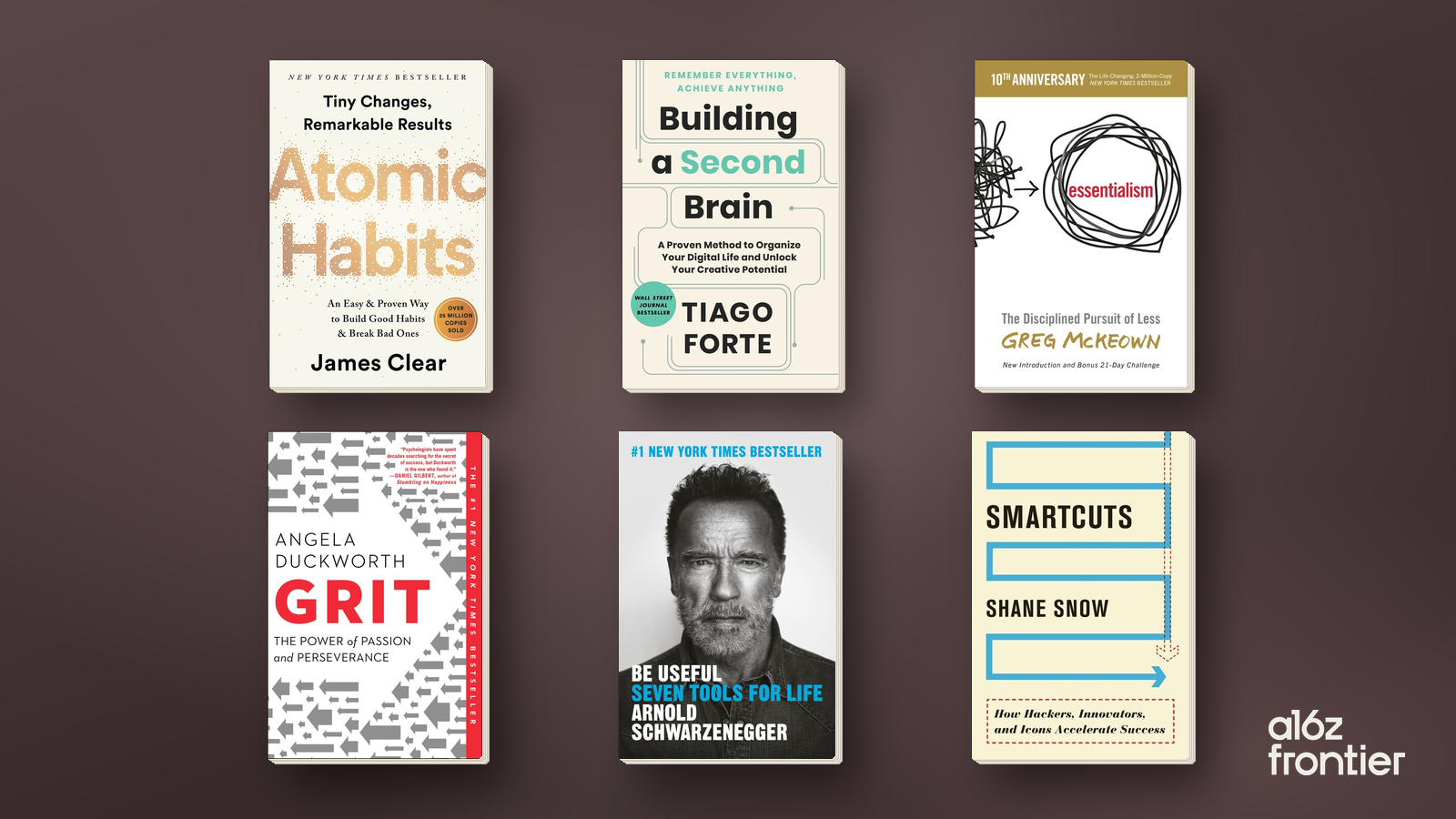
Atomic Habits: An Easy & Proven Way to Build Good Habits & Break Bad Ones
“Straightforward and direct in its approach and language, really thoughtful and useful. The idea that if you can get 1 percent better each day for one year, you’ll end up thirty-seven times better by the time you’re done is amazing to really think about. I love starting off the new year with that mindset.”
– Helen Stoddard, events
-
Be Useful: Seven Tools for Life
“The key principle is something that I think everyone can implement (doesn’t matter if you’re a marketer, founder, builder, etc.). You can apply it to anything you are doing and it will increase opportunities, ‘luck,’ engagement from others, and more. I’d also recommend checking out the Audible version since Arnold narrates it himself and he’s a great storyteller.”
– Ish Verduzco, marketing
-
Building a Second Brain: A Proven Method to Organize Your Digital Life and Unlock Your Creative Potential
“In a world in which every day is a firehose of content, Forte presents a framework for optimizing information capture and processing for maximum creative value. The book is both theory and practical guide — one chapter even works through the micro-details of your digital organizer flow. Particularly compatible and complementary with David Allen’s Getting Things Done system. (Incidentally, I think of Getting Things Done by David Allen as the perfect all-ages holiday gift.)”
– Scott Duke Kominers, research
-
Essentialism: The Disciplined Pursuit of Less
“This book introduced me to the idea of kairos. The ancient Greeks had two words for time — one was chronos, the standard linear, chronological time that we are all familiar with, as measured by clocks. The second was kairos, representing the opportune time, or the ‘right’ time, that is only experienced by existing in the now. Kairos is a timeless time that occurs during a decisive or meaningful moment. None of us can change chronos (despite sometimes wanting time to move faster, and sometimes slower!), but we can all increase the amount of time we live in kairos. This is an older bestseller, and it’s worth a re-read.”
– Maggie Hsu, go-to-market
-
Grit: The Power of Passion and Perseverance
“Both engaging in its storytelling examples, and very detailed in its actions and path to have more grit — the book is both a great read and a great learning tool.”
– Helen Stoddard, events
-
Originals: How Non-Conformists Move the World
-
Smartcuts: How Hackers, Innovators, and Icons Accelerate Success
“This is the first book that I recommend to any builder, creator, or founder. It’s inspiring and fun, while also super tactical and changes your perception of accomplishing seemingly difficult (and borderline impossible) goals. I’ve read it eight times and plan on re-reading many more times to be constantly reminded of its core message.”
– Ish Verduzco, marketing
-
Tools of Titans
“I’m reading 2–3 books at a time, which helps me stay entertained and efficiently absorb information at the same time. Recently, I’ve been re-reading and taking notes on Tools of Titans and I find it helps me to push myself.”
– Anna Semenova, marketing
Company, industry, and founder histories
Economics for beginners and beyond
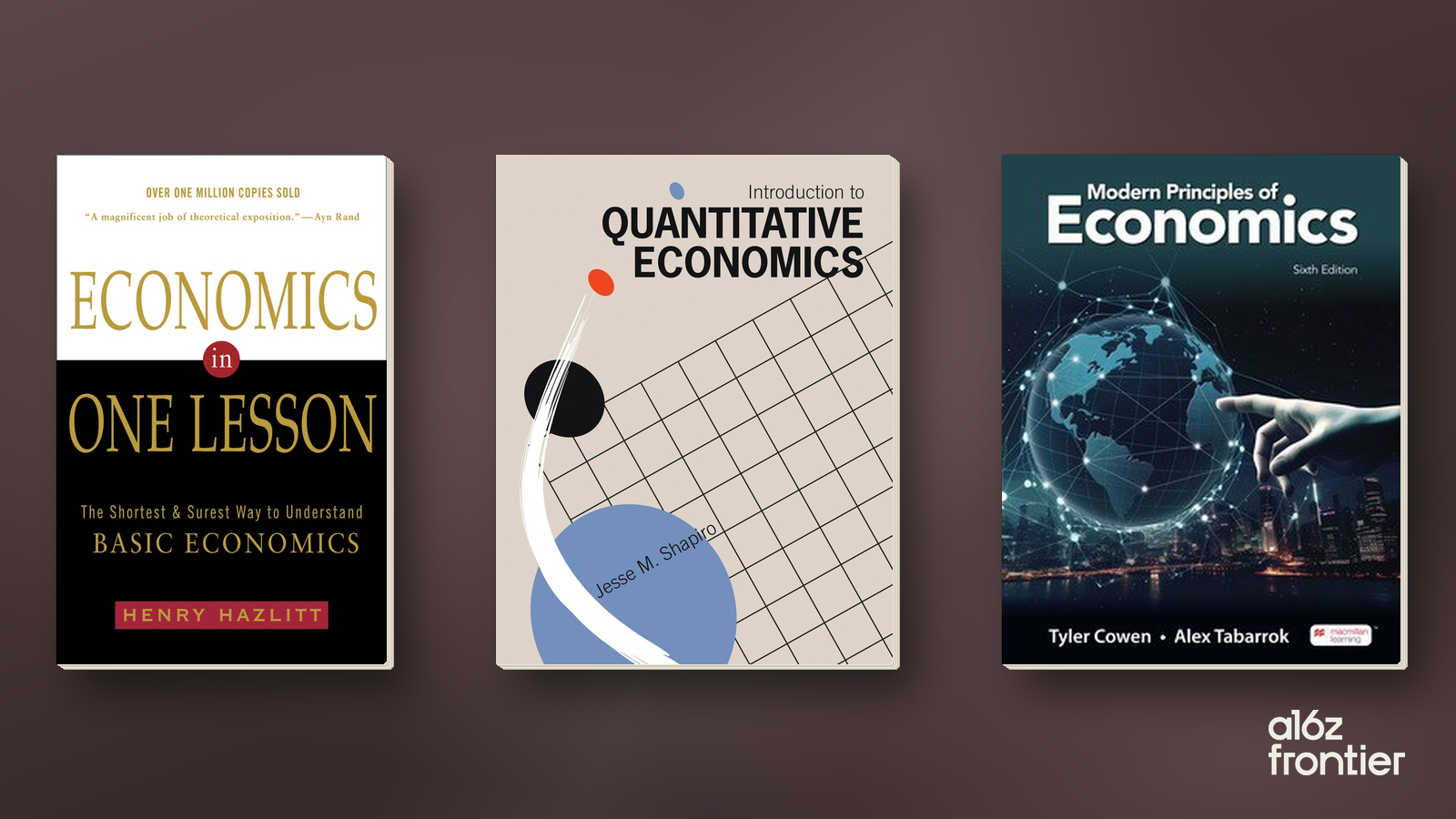
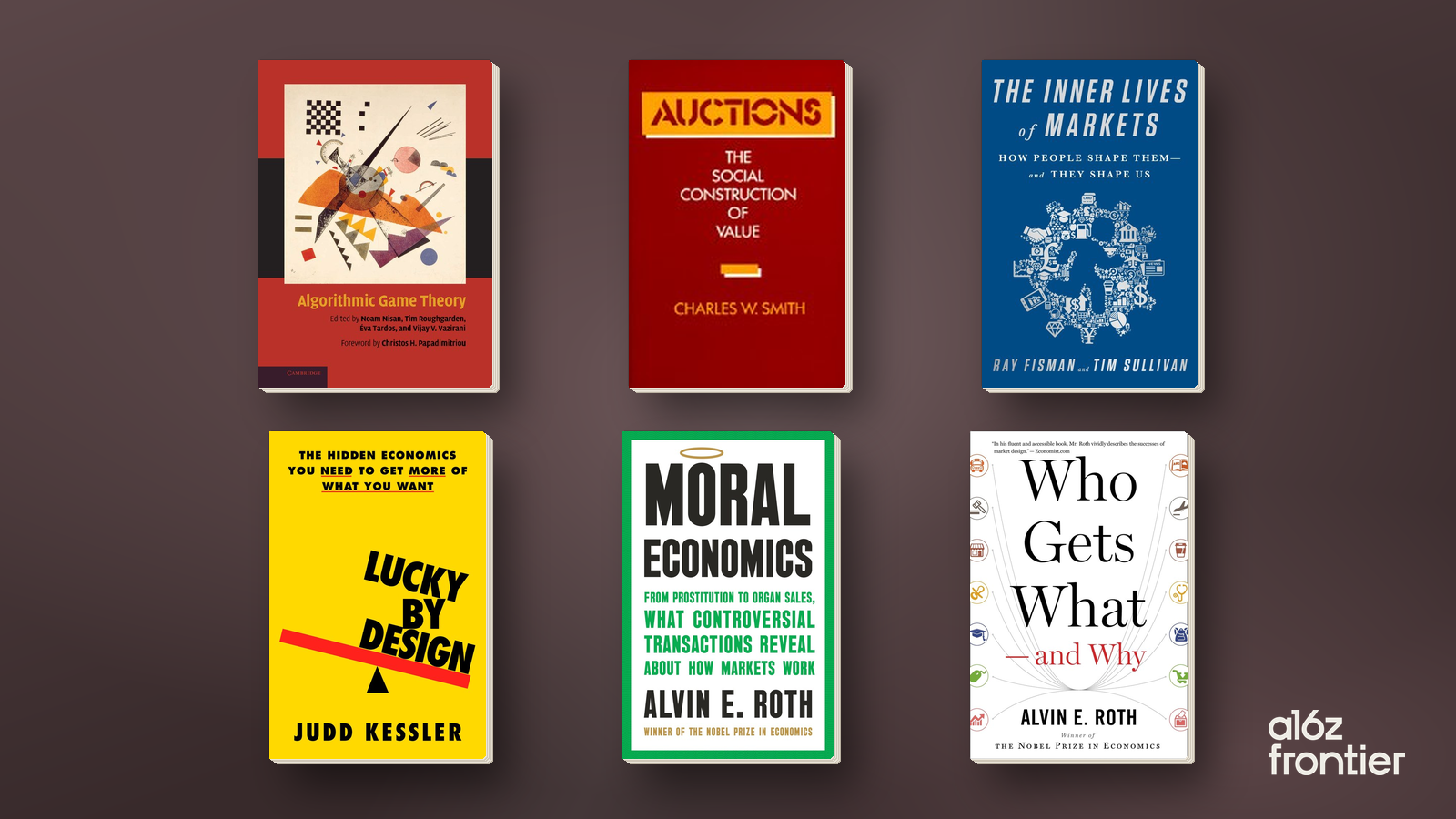
How auctions, markets, and incentives work
-
Algorithmic Game Theory
-
Auctions: The Social Construction of Value
“This classic and vivid work of sociology explores how auctions have emerged throughout society as a way of establishing community consensus around value. (Sound familiar?)”
– Scott Duke Kominers, research
-
The Inner Lives of Markets: How People Shape Them — And They Shape Us
“Ray Fisman and [our research editor] Tim Sullivan give an elegant and intuitive introduction to how technology and careful design can transform markets by improving underlying incentives.”
– Scott Duke Kominers, research
-
Lucky by Design
“This book — by my former grad school officemate Judd Kessler — is the best out there on what market design means for our everyday lives. Kessler illustrates the mechanics of all manner of markets, and how to make them equitable, efficient, and easy to be a part of. It’s a perfect complement to several of my recommendations from prior years, such as Who Gets What — and Why and The Inner Lives of Markets.”
– Scott Duke Kominers, research
-
Moral Economics: From Prostitution to Organ Sales, What Controversial Transactions Reveal About How Markets Work
“My doctoral advisor Al Roth has been thinking for decades about ‘repugnance’ — why some people prefer that some markets should not exist. In Moral Economics, he tackles the motivation for these prohibitions, and the trade-offs they force, head-on. And he explores in particular how such (non-)market norms emerge and sometimes later collapse (limitations on alcohol, drugs, and — in a completely different category — same-sex marriage have all been relaxed in recent years), and what this means for making markets in the future.”
– Scott Duke Kominers, research
-
Twenty Lectures on Algorithmic Game Theory
-
Who Gets What — and Why: The New Economics of Matchmaking and Market Design
“Al Roth’s book is the perfect complement to The Inner Lives of Markets: a combination memoir and compendium of case studies on real-world market design.”
– Scott Duke Kominers, research
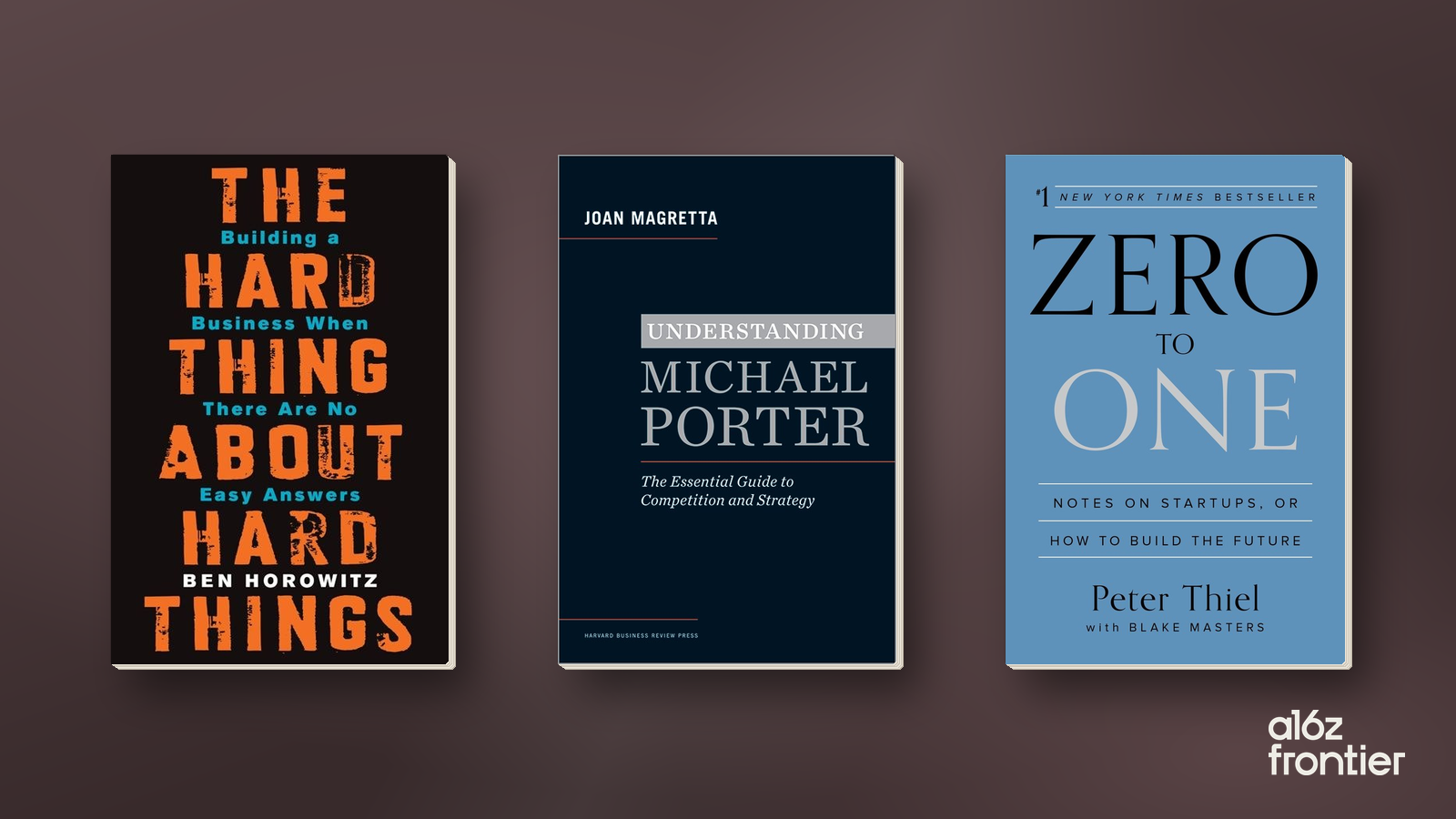
How to build competitive advantage
-
7 Powers: The Foundations of Business Strategy
“My HBS colleague Tom Eisenmann recently introduced me to this fantastic book laying out a framework for how — and when — a business should think about establishing an enduring, sustainable competitive advantage. It is seriously powerful.”
– Scott Duke Kominers, research
-
The Entrepreneur’s Guide to Law and Strategy
-
The Hard Thing About Hard Things
-
Nearly Perfect
“Hot off the presses this summer is this nearly perfect theory of the relationship between competitive advantage and product design. Easily the best book in-category I’ve read in years; on par with Don Norman’s The Design of Everyday Things in terms of insight per page (which you should also read if you haven’t yet!).”
– Scott Duke Kominers, research
-
Understanding Michael Porter: The Essential Guide to Competition and Strategy
-
Zero to One: Notes on Startups, or How to Build the Future
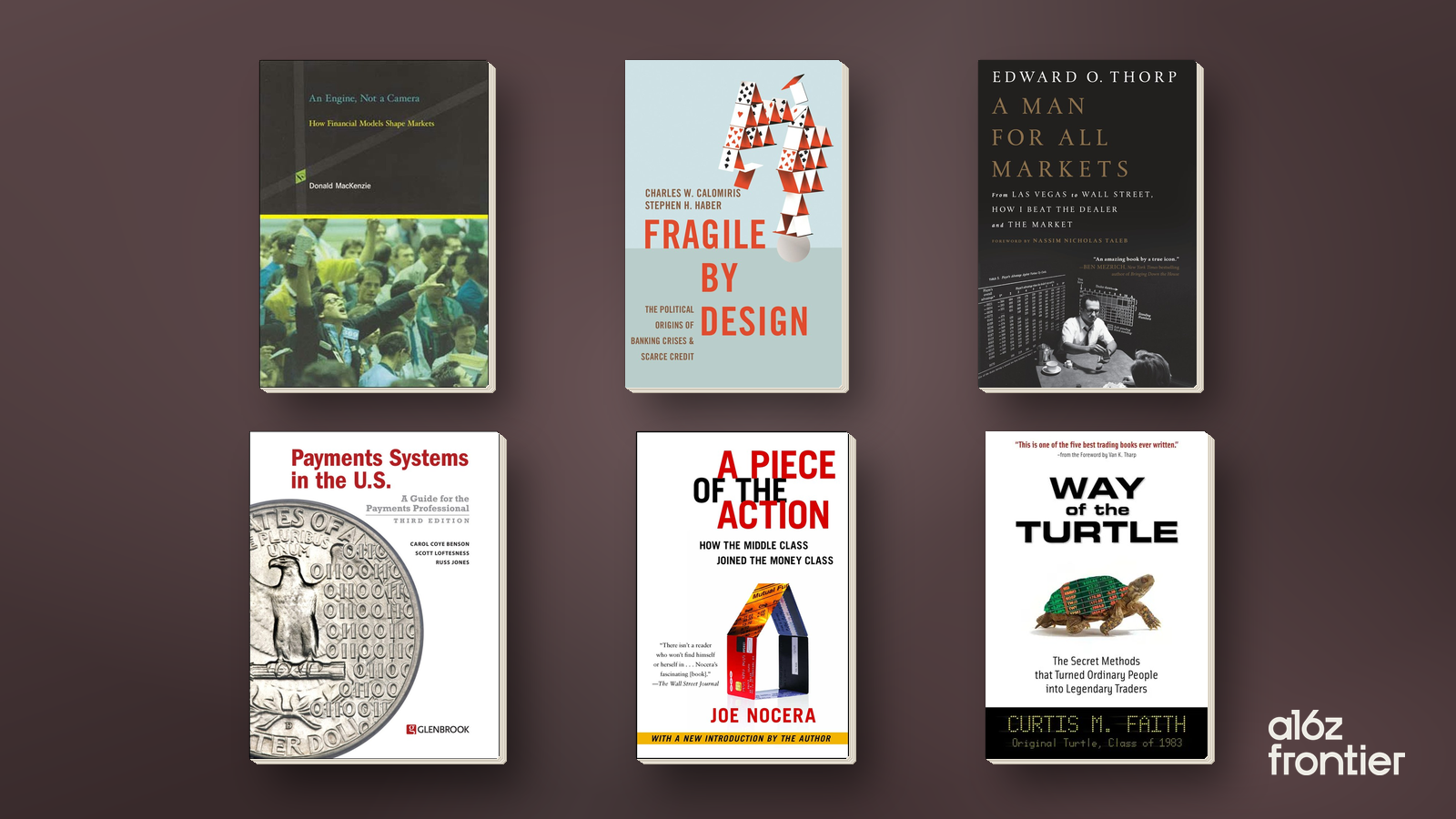
Understanding financial systems
-
Boom: Bubbles and the End of Stagnation
“This book provides a blueprint for how society can accelerate technological and scientific progress. It emphasizes the importance of risk-taking (something I’ve long been very passionate about), and explains how ‘bubbles’ — while often maligned as destructive to society — might actually be the key to unlocking new innovation and global prosperity. Anyone interested in emerging technologies should definitely read this!”
– Daren Matsuoka, deal
-
Broken Money: Why Our Financial System Is Failing Us and How We Can Make It Better
“Alden’s lessons and insights from the history of money present a strong case for how decentralized digital currencies can address both past and current challenges with monetary systems.”
– Michael Blau, deal
-
An Engine, Not a Camera: How Financial Models Shape Markets
“Sociologist Donald MacKenzie’s An Engine, Not a Camera is nominally a book about financial economics, but its real subject is more provocative: What happens when theories stop describing the world and start changing it? MacKenzie traces how academic models of markets escaped the university and became embedded in the markets themselves. First published in 2006, it remains relevant today in a number of contexts — not least because of the recent interest from TradFi in crypto. But I wanted to read it again because of the book I’m working on with my colleague Robert Hackett, about how computer science theories acted on the world.”
– Tim Sullivan, editorial
-
Fragile by Design: The Political Origins of Banking Crises and Scarce Credit
-
A Man for All Markets: From Las Vegas to Wall Street, How I Beat the Dealer and the Market
“Growing up, I was obsessed with the movie 21 and the idea that you could actually use math to beat the house. This book is the autobiography of the man who essentially started it all. Edward Thorp went on to apply those same principles to Wall Street and became the father of quantitative investing. It’s an incredible story about using pure logic to disrupt rigged, legacy systems, which completely captures the exact same builder mindset we see in crypto today.”
– Benjamin Wu, recruiting
-
Payments Systems in the U.S.: A Guide for the Payments Professional
“This textbook details many aspects of payment systems (wire transfers, ATMs, credit cards, debit cards, etc.). You probably won’t read this cover-to-cover, but it is a great resource if you want to understand the actual flow of money after a credit card swipe. 🙂 More than anything, understanding the complexity of our existing payment systems made me even more excited about the future of blockchain-based payment networks.”
– Michael Blau, deal
-
A Piece of the Action: How the Middle Class Joined the Money Class
“There’s no more instructive history for those interested in crypto than the history of the personal finance revolution (ca. September 1958 on). A master of the subject matter, Nocera draws drama out of even the most seemingly mundane moments. (E.g., a vote over banking interest rate laws on the floor of the Utah state legislature.) The parts on credit cards are particularly enlightening. Their first rollouts were a fraud-ridden, loss-inducing, moral panic-fueling shambles. Despite the inauspicious start, they would become a mainstay of banking and the American way of life, as we all well know. One of my favorite anecdotes involves one of the early credit card industry’s fiercest critics, Senator William Proxmire of Wisconsin, eventually succumbing to the zeitgeist and becoming a member of the card-carrying set.
Crypto’s timeline is eerily resonant…”
– Robert Hackett, editorial
-
Way of the Turtle: The Secret Methods That Turned Ordinary People into Legendary Traders
“Two legendary traders make a bet that strangers can follow their trading system with the same results.”
– Brian Quintenz, policy
Growing and scaling companies
-
An Elegant Puzzle: Systems of Engineering Management
-
High Growth Handbook: Scaling Startups from 10 to 10,000 People
-
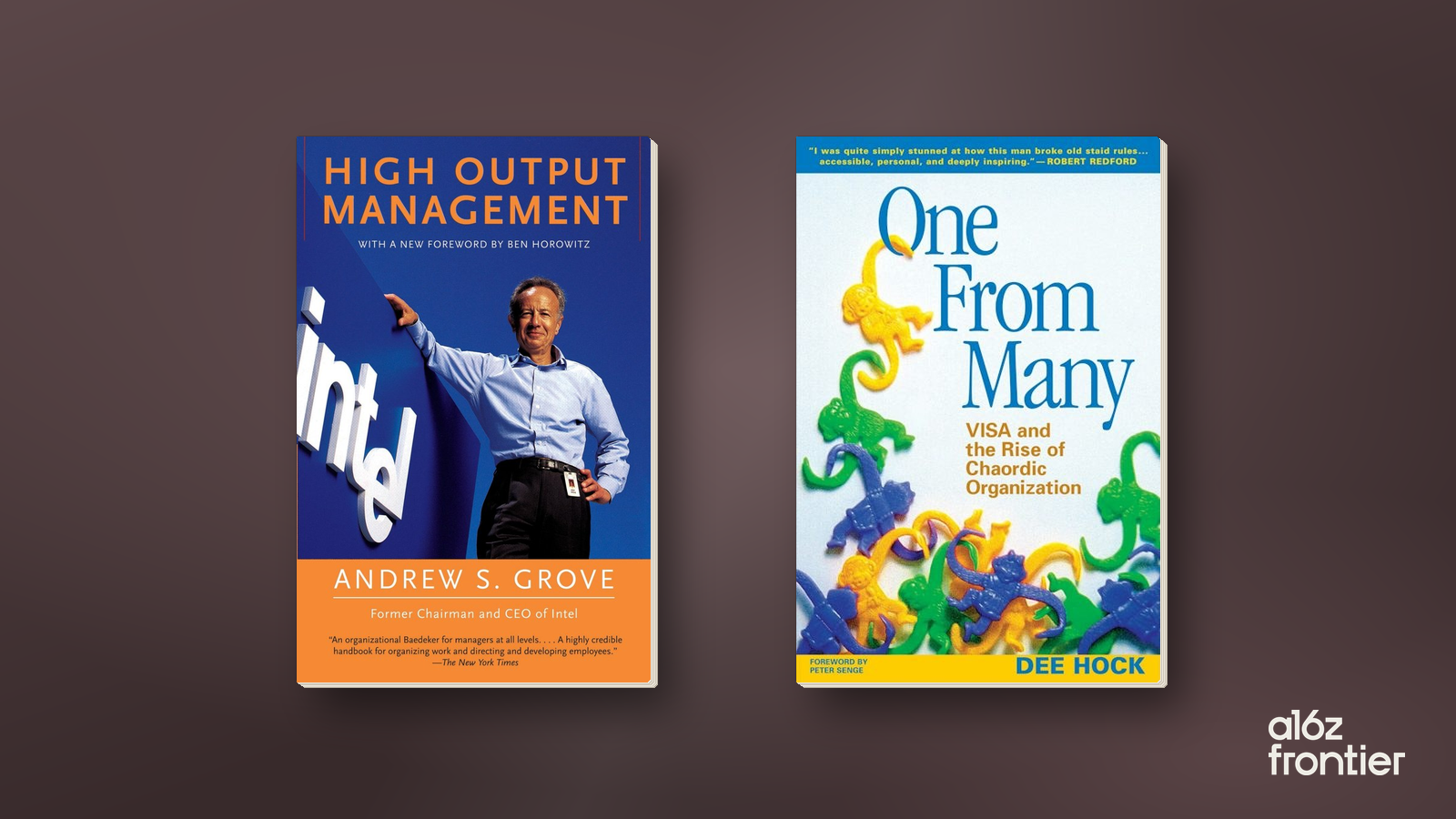
High Output Management
-
Scaling People: Tactics for Management and Company Building
“My friend and co-author Jesse Shapiro recently recommended this book to me and it’s fantastic: easily the best book I’ve ever read on both (1) managing people and (2) managing people’s interactions with you. Hughes Johnson, who served as COO at Stripe through its period of massive growth, gives a vivid and very, very practical guide to understanding individuals’ and teams’ motivations and operating modes. The book comes with detailed principles and strategies for everything from hiring and onboarding to day-to-day management, communication, evaluation, and feedback. But the biggest payoff is the way the book trains awareness and recognition of people as they are, and how to build on that to help them maximize themselves.”
– Scott Duke Kominers, research
-
The Super Gap (초격차, or Cho-gyeok-cha)
“This book is written by the former chairman of Samsung Electronics, who led the company to become the number one semiconductor company globally. ‘The Super Gap’ means a gap so wide that competitors cannot even think about challenging you. Based on his 33 years at Samsung Electronics, he distills his leadership experience into four pillars: leader, organization, strategy, and talent. The author explains that this ‘Super Gap’ applies not only to technology but also to systems, culture, people, and organization. It’s especially compelling because these insights come from someone who experienced both success and failure firsthand, and who ultimately walked away at the peak to practice the ‘sustainability’ he preaches.”
– SungMo Park, go-to-market
Communication and negotiation
-
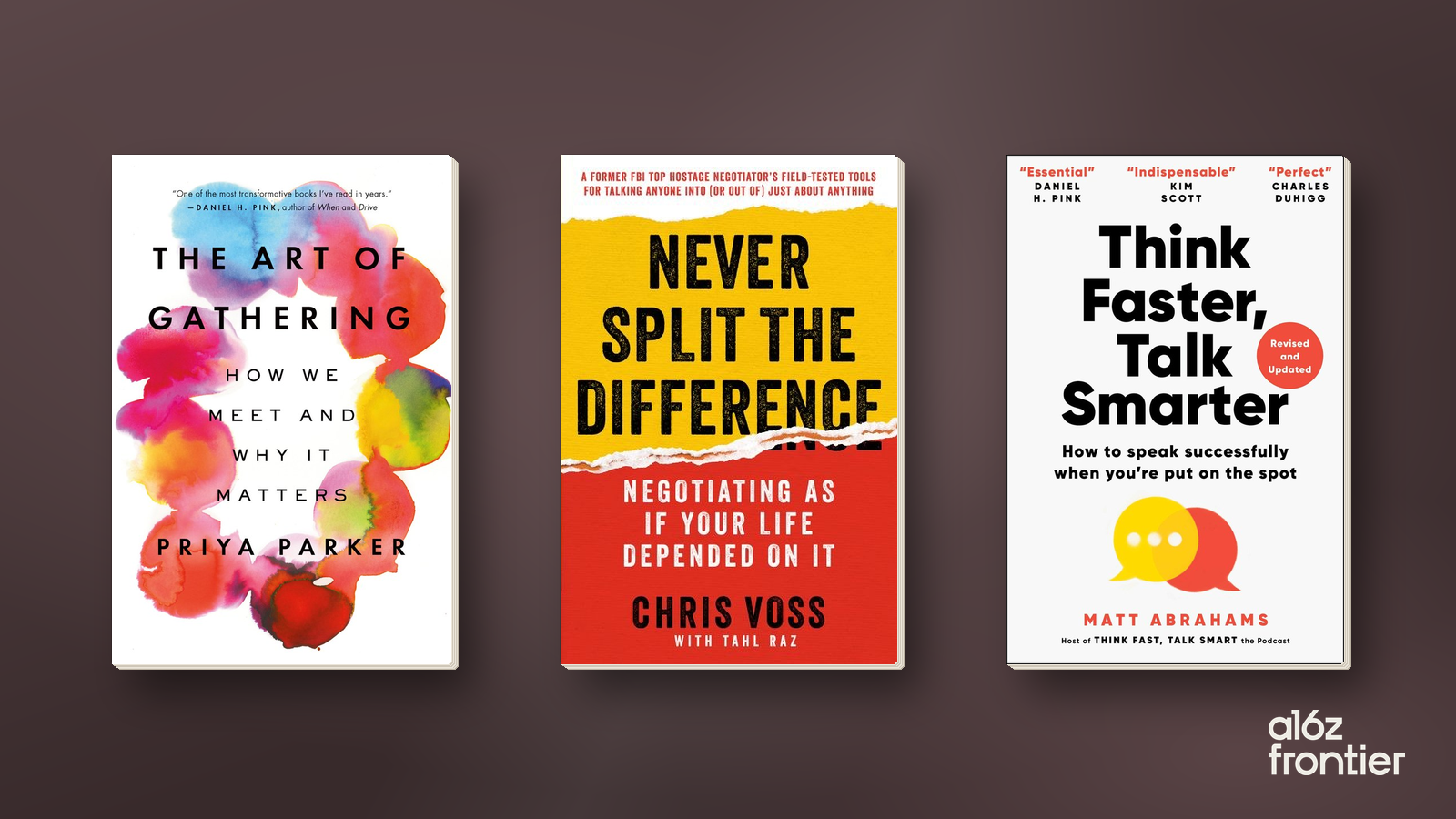
The Art of Gathering: How We Meet and Why It Matters
“Gathering IRL is a fundamental human need, but too often gatherings are wasted. This book provides approaches for how to gather more meaningfully.”
– Maggie Hsu, go-to-market
-
How to Talk So Little Kids Will Listen: A Survival Guide to Life with Children Ages 2–7
“I’m a proponent of mental models in web3. However, upon seeking the equivalent mental models for parenting, I was left wanting. This book has several frameworks and tactical tools for resolving conflict, handling emotions, and my favorite — getting kids to move from activity to activity in a timely and non-stressful manner.”
– Maggie Hsu, go-to-market
-
Never Split the Difference: Negotiating As If Your Life Depended on It
“Tells you the proper tactics to navigate and win negotiations — personal or professional. I read it annually.”
– Pyrs Carvolth, go-to-market
-
Think Faster, Talk Smarter: How to Speak Successfully When You’re Put on the Spot
What does (& doesn’t) drive economic growth
back to top ↑
Health, endurance, and longevity
Exercise and longevity
-
Biohack Like a Woman: How to Get Fit Effortlessly, Feel Beautiful, Have More Energy, and Unleash Your Superpowers with Biohacking
“I’ve been interested in biohacking, but most articles and books I’ve come across don’t take the female body and hormones into account. This book was a game changer for me. It has all the biohacking tips and tricks with the added element of catering to women and our biology.”
– Anna Semenova, marketing
-
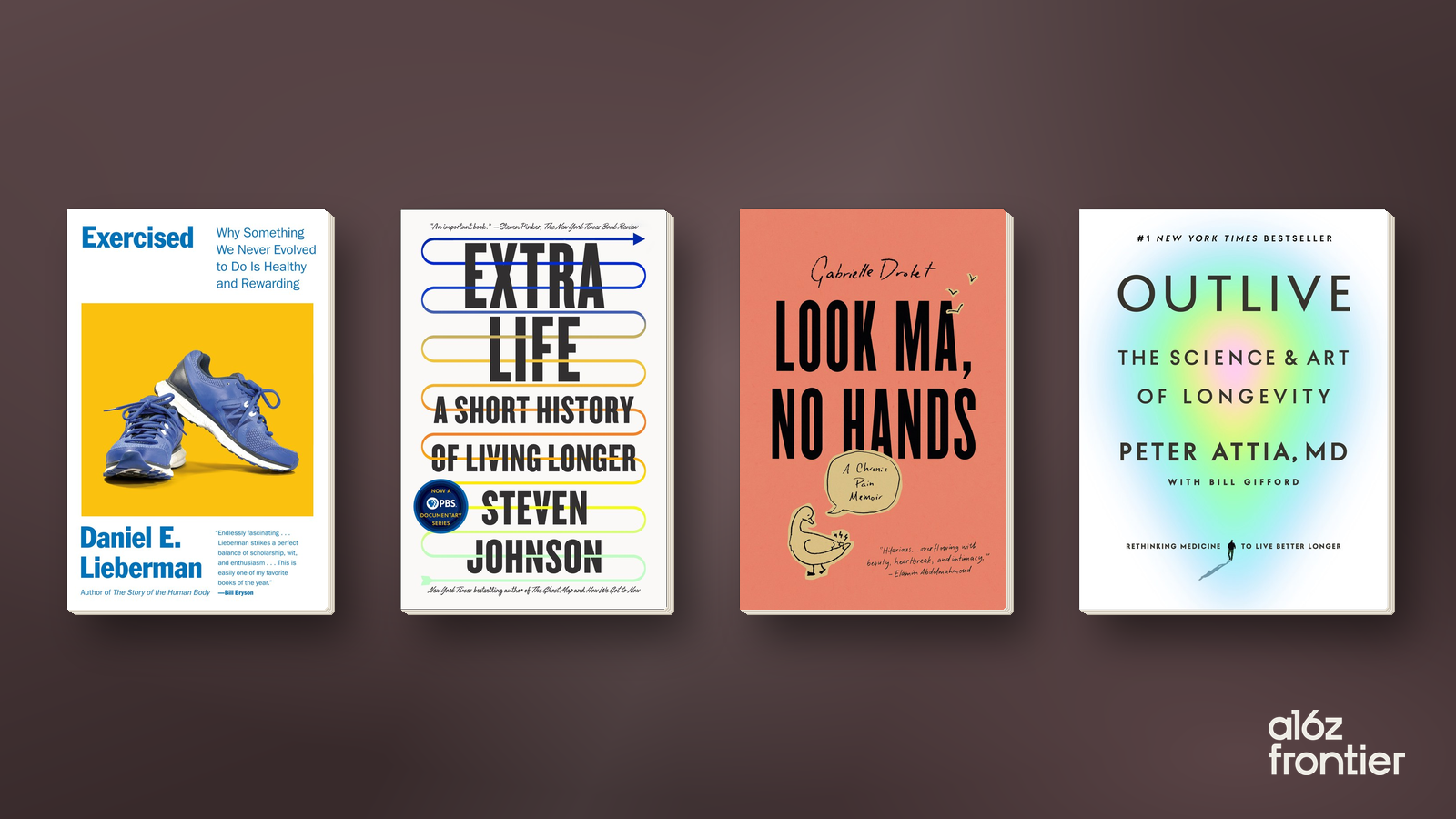
Exercised: Why Something We Never Evolved to Do Is Healthy and Rewarding
“Dispels some common myths about fitness and exercise based on anthropological studies. There are some essential takeaways for us desk-bound masses yearning to run free.”
– Daniel Reynaud (karmacoma), research
-
Extra Life: A Short History of Living Longer
-
Look Ma, No Hands: A Chronic Pain Memoir
“What happens when your work and life depend on your body, but your body breaks? Writer and cartoonist Gabrielle Drolet gives an accessible, deeply human, and — by design — often laugh-out-loud hilarious account of her experience with chronic hand pain. This memoir is a fast and fun read that will level up your empathy score by at least five points. And especially for anyone whose body has ever broken in a way that left them unmoored, it will bring optimism and provide an anchor. (Also, check out her illustration art!)”
– Scott Duke Kominers, research
-
Outlive: The Science and Art of Longevity
“For my summer reading, I’m shifting gears from web 3.0 to medicine 3.0, and working my way through Peter Attia’s thought-provoking and actionable read on living longer and healthier.”
– Shari Doherty, marketing
Philosophers on how to live well
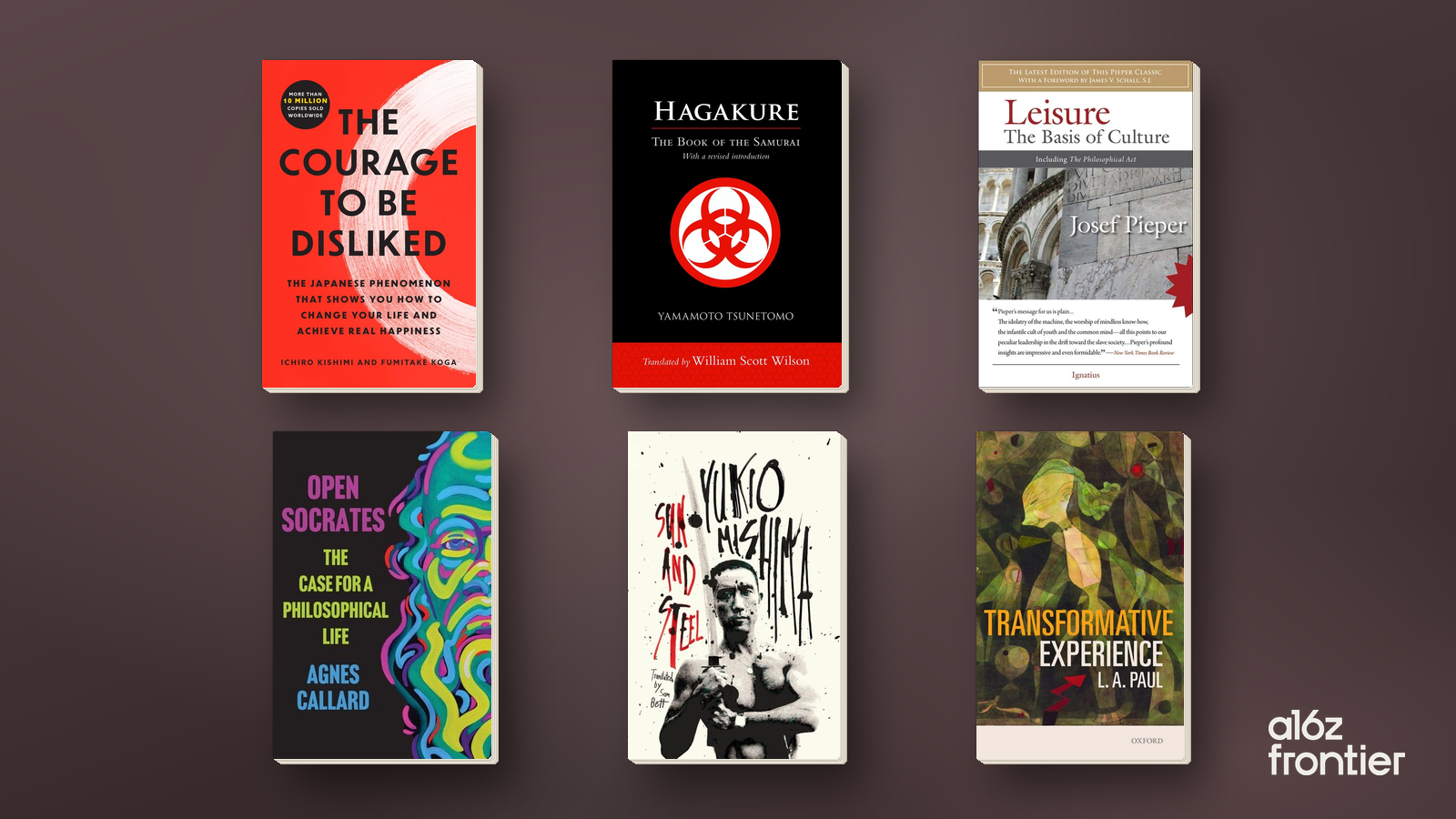
What makes athletes keep going?
back to top ↑
History and politics
Lessons from war
-
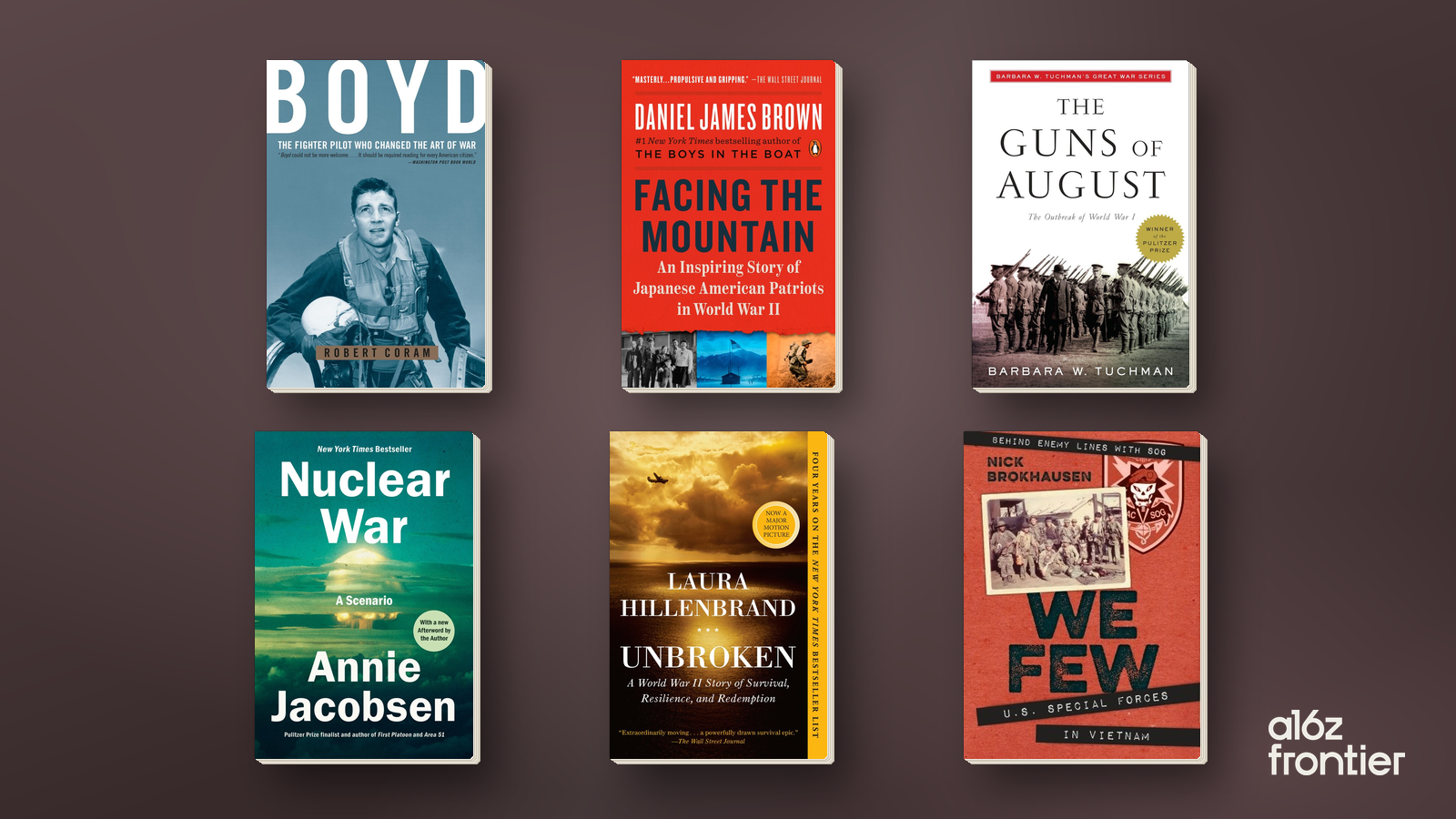
Boyd: The Fighter Pilot Who Changed the Art of War
“Boyd describes the life and career of a brilliant fighter pilot who made historic contributions to military theory (OODA Loops) and the science of fighter plane design (EM Theory). Along the way, Boyd hits every bump in the road and is frequently his own undoing — struggling to manage personal relationships and navigate the military bureaucracy.
For this reason, it’s the perfect book for anyone who has fought righteously (or considered fighting righteously) against a bureaucracy. You’ll relate to Boyd’s best and worst instincts, but you’ll also learn how to overcome or avoid adversity, when to choose between career and belief, and when you just need to persist and deal with the consequences.”
– Sam Broner, deal
-
Facing the Mountain: A True Story of Japanese American Heroes in World War II
“Brown’s well-researched account follows the path of several Japanese American men and their extended families during WWII. After the attack on Pearl Harbor and America’s response to it upended everything in their lives, the men overcame numerous obstacles and displayed incredible bravery in fighting for the U.S. Some risked their lives across Europe in the 442nd Regimental Combat Team even as their families were incarcerated by their own government. One man relentlessly defended his constitutional rights against that incarceration. By the end of the book you feel like you know each man personally, and you are left with overwhelming respect for what they sacrificed in service of the greater good. A fulfilling and compelling read all the way through.”
– Mike Manning, marketing
-
The Guns of August: The Outbreak of World War I
“Provides excellent context for the lead-up to WWI, some of which provides insight into current conflicts in Ukraine and Israel.”
– Collin McCune, policy
-
Nuclear War
“Annie Jacobsen draws from top sources to outline the world’s nuclear capabilities and policies, in the context of a hypothetical attack on the U.S. It’s eye-opening in many ways, one being that it will keep you awake at night.”
– Mike Manning, marketing
-
Postwar
“I’d highly recommend Postwar to anyone curious about how modern Europe came to be. The book’s sheer scale boggles the mind, and yet it’s paced like a thriller. Packed with engaging characters and vivid scenes, every page is filled with surprising insights, and even Judt’s footnotes are Easter eggs.”
– Aiden Slavin, policy
-
Unbroken: A World War II Story of Survival, Resilience, and Redemption
-
We Few: U.S. Special Forces in Vietnam
“Brokhausen’s memoir of MACV-SOG, the unit that ran the most dangerous missions of the Vietnam War behind enemy lines in Laos and Cambodia, is the rawest portrait of high-performing operators I’ve read. What stays with you is the psychology of doing something unprecedented and lethal, the macabre humor and resilience it takes to keep walking into the jungle knowing each step might be the last. For anyone who works in adversarial, high-stakes environments, it’s a bracing look at what real edge cases demand.”
– Conner Lyons Brown, tech ops
On government as builder: city, state, policy
-
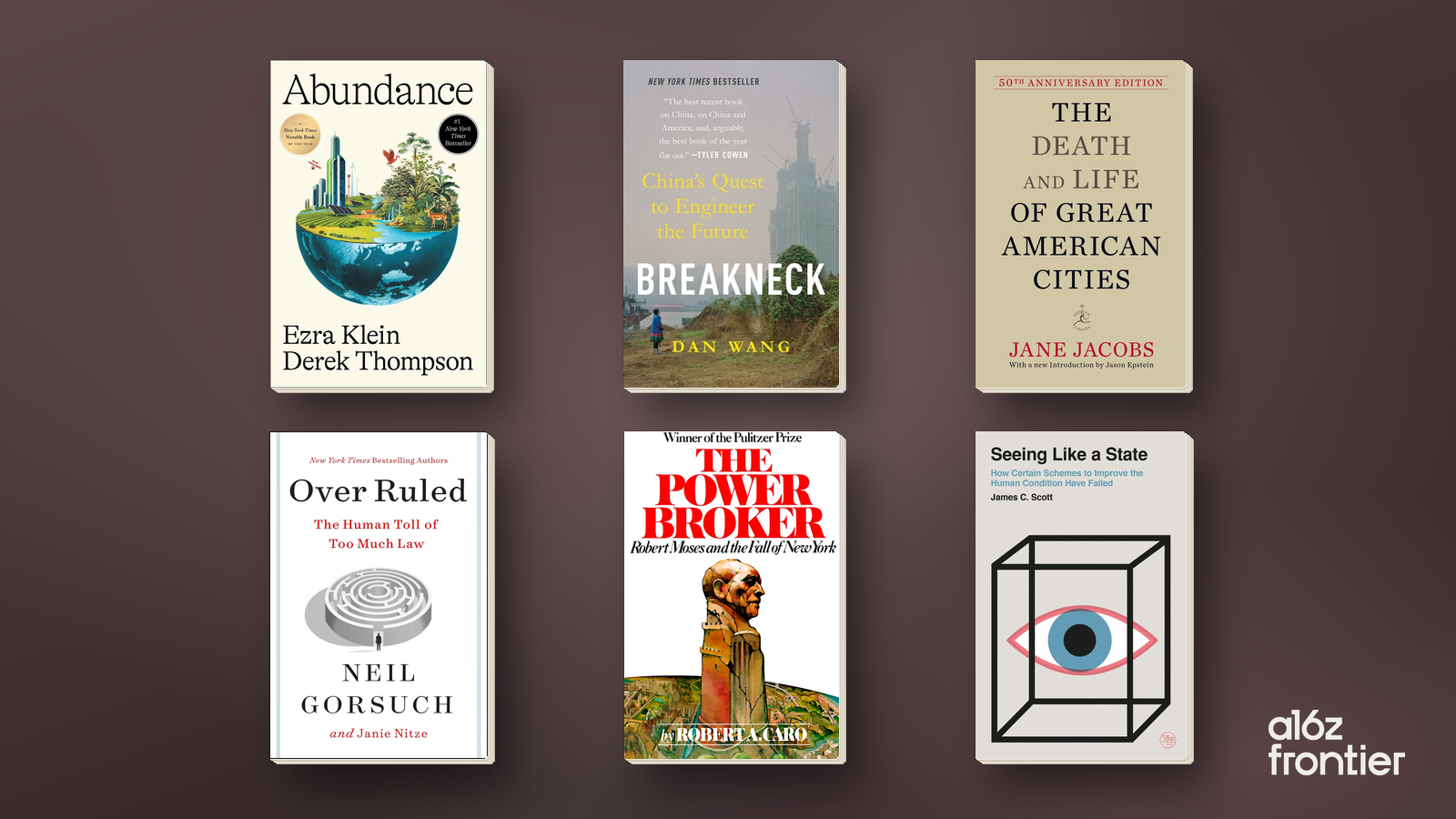
Abundance
“In Abundance, Klein and Thompson argue that the U.S. has lost its capacity to build (across housing, energy, healthcare, infrastructure, etc.), and that restoring it will require a New Deal-style revival of the state. They call for approving projects at ‘warp speed,’ fast-tracking permitting, and replacing decades of procedural drag with a bias toward action. One devastating illustration of the current dysfunction is the story of a housing complex for the homeless in San Francisco: a project funded by Charles and Helen Schwab was built quickly and affordably only because public funds were avoided. Private philanthropy achieved what government routinely struggles to deliver…and for roughly half the time and cost. What does it say about the state of our system where public process so often obstructs progress?”
– Robert Hackett, editorial
-
Back from the Brink: Inside the NYPD and New York City’s Extraordinary 1990s Crime Drop
“Moskos — whose earlier books include an account of his year on the front lines of the war on drugs in Baltimore’s Eastern District — tells the story of how the NYPD cleaned up the city after a disastrous era of the 1970s and 1980s. Crime was out of control, but then, between 1993 and 1996, the police were able to cut the city’s murder rate by more than half, helping to turn NYC into the safest big city in the country. This book tells how that happened. Part of what makes the book compelling is that Moskos lets the police and civic leaders speak for themselves, telling their own, sometimes raw stories of how they accomplished their task.”
– Tim Sullivan, editorial
-
Breakneck: China’s Quest to Engineer the Future
“Breakneck will make you rethink your basic assumptions about China (and by extension the rest of the modern world). Wang brings a savvy eye — and a tolerance for dissonance — to issues as diverse as bridge building (literally), zero-COVID, and the one-child policy. Considered, fast-paced, and uncommonly well-written, Breakneck consistently goes beyond tired political conventions by foregrounding the human implications of Chinese Communist Party rule.”
– Aiden Slavin, policy
-
The Death and Life of Great American Cities
-
Over Ruled: The Human Toll of Too Much Law
“‘Some law is essential to our lives and our freedoms. But too much law can place those very same freedoms at risk and even undermine respect for law itself.’ This is a book of stories about real people, and how our laws in America have increasingly, and in some cases unfairly, restricted what we say, monitored what we do, and told us how we may live.”
– Michele Korver, regulatory
-
The Power Broker: Robert Moses and the Fall of New York
-
Seeing Like a State: How Certain Schemes to Improve the Human Condition Have Failed
“Seeing Like a State felt like it cleared some of the fog from how I see organizations operate at every scale. I have been recommending it to anyone running a startup, business, or community. Yes, you are what you measure, but you need to decentralize control and encourage grassroots innovation — lessons especially true in the blockchain space. Also, the first half of the book is an awesome history lesson on early bureaucracies.”
– Sam Broner, deal
How rulers rule
-
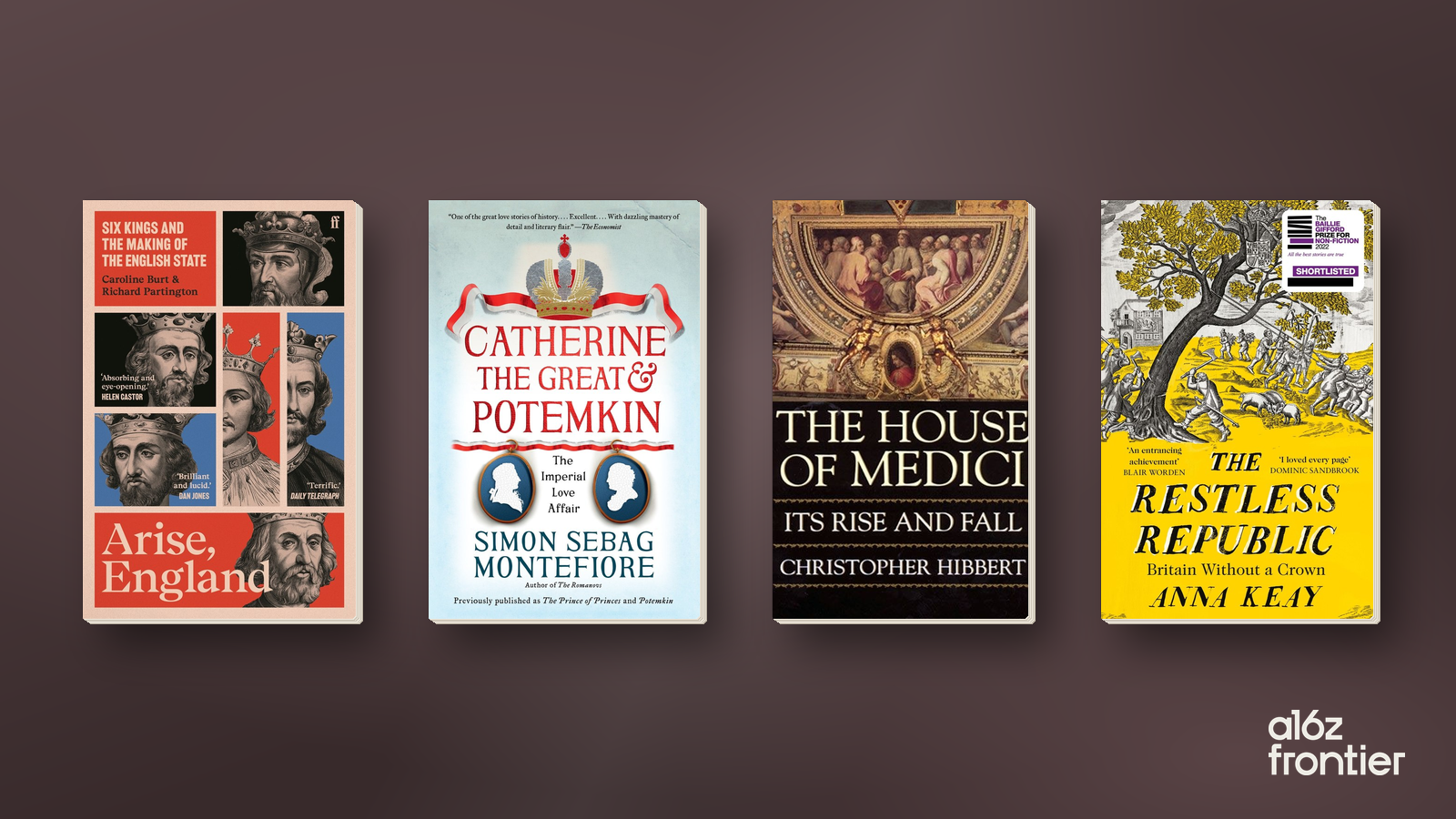
Arise, England
“A brilliant exploration of how the English state emerged, not because of a series of intentional, principled moments of design but because of a series of self-interested bargains between monarchs and their magnates. Obvious lessons for governance design everywhere, including in crypto.”
– Andy Hall, research
-
Catherine the Great & Potemkin: The Imperial Love Affair
“Just your standard romance but with more urban planning and foreign policy memos. Catherine the Great & Potemkin is part imperial history, part power-couple biography, and part extremely high-stakes situationship. The story of this Antony-and-Cleopatra-level romantic and political partnership is told with all the drama and detail you’d hope.”
– Stephanie Zinn, editorial
-
The House of Medici: Its Rise and Fall
“The Medici are one of those families where history is so much wilder than any fictionalization of their lives and times could be. They did murder, revenge, and intrigue — often with a bewildering amount of incompetence, given what was achieved. As a bonus, the topic of sortition, an ancient practice that delegates decision-making power to random members of the public and that we cover in this podcast episode, makes a cameo.”
– Stephanie Zinn, editorial
-
The Restless Republic: Britain Without a Crown
“A fantastic account of an extraordinary moment on the journey toward modern democracy when, in the 17th century, the English decided to try to build a government without a monarch. Anyone interested in understanding the past, present, and future of democratic governance will enjoy how Anna Keay deeply explores this incredibly important episode in human history.”
– Andy Hall, research
-
Stalin: Paradoxes of Power, 1878–1928
“Monumental? Definitive? Landmark? All of the above? In anticipation of Volume 3 of Steve Kotkin’s biography of Stalin (coming out soon-ish, I hope), I’m recommending the first two volumes. Kotkin has been researching and writing on Stalin for decades. He eschews easy answers and received wisdom; he immerses himself in the moral squalor and waste; he embraces notions of freedom and equality in the face of power; and he brings a deep humanity to it all.”
– Tim Sullivan, editorial
-
Stalin: Waiting for Hitler, 1929–1941
“Monumental? Definitive? Landmark? All of the above? In anticipation of Volume 3 of Steve Kotkin’s biography of Stalin (coming out soon-ish, I hope), I’m recommending the first two volumes. Kotkin has been researching and writing on Stalin for decades. He eschews easy answers and received wisdom; he immerses himself in the moral squalor and waste; he embraces notions of freedom and equality in the face of power; and he brings a deep humanity to it all.”
– Tim Sullivan, editorial
The rise and fall of ancient empires
True crime and covert operations
-
The CIA: An Imperial History
“A new angle on the Agency told largely through the actions of key players.”
– Bill Hinman, policy
-
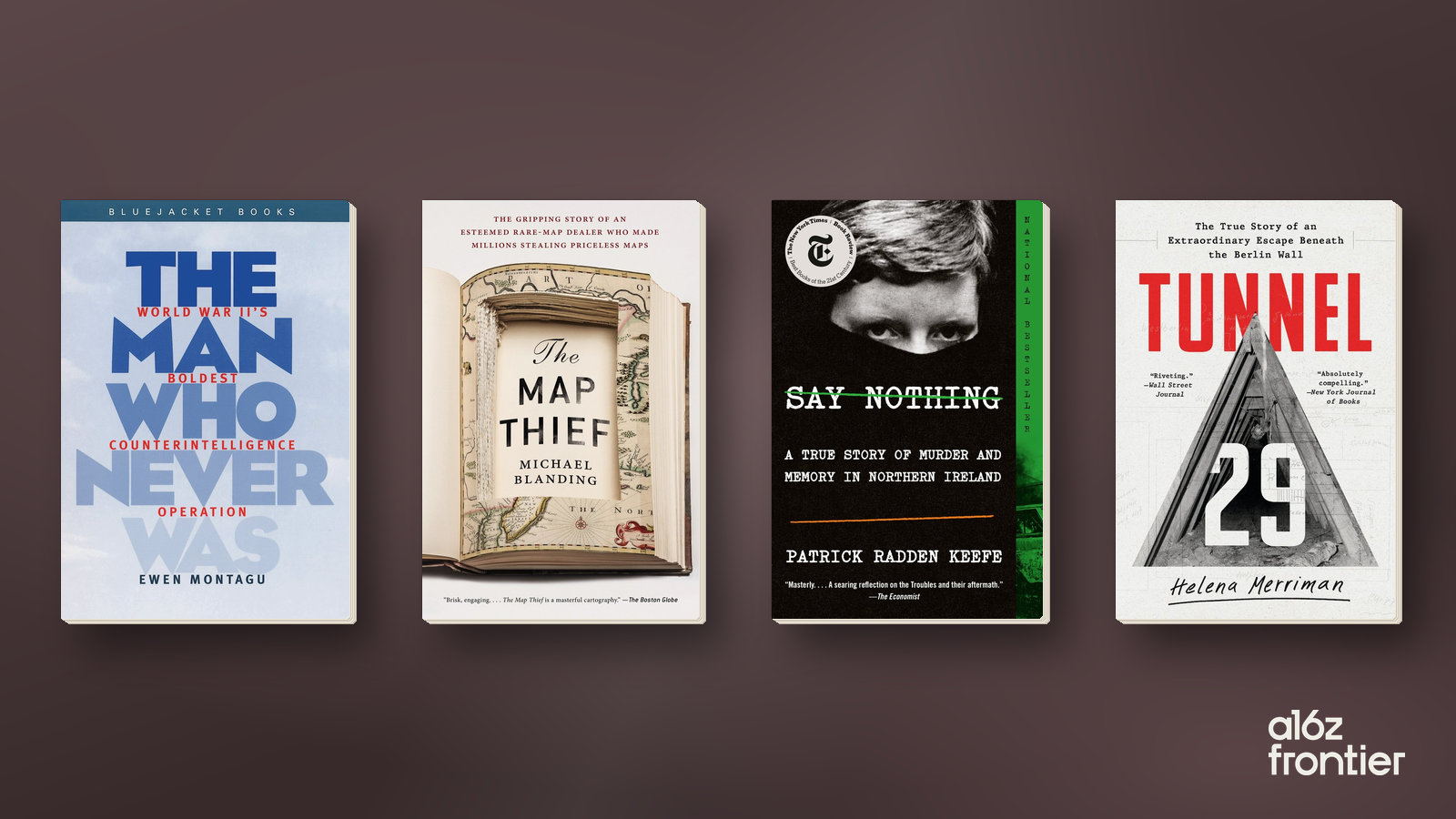
The Man Who Never Was
“With the story having even made it to Broadway in 2025, it’s the perfect time to immerse yourself in Operation Mincemeat, as told by one of its architects: A nonexistent (Acting) Major, a real body, and a couple letters in a locked case combine into one of the most extraordinary acts of military deception in history.”
– Scott Duke Kominers, research
-
The Map Thief: The Gripping Story of an Esteemed Rare-Map Dealer Who Made Millions Stealing Priceless Maps
“Part cartographic history, part heist story: in The Map Thief, my friend Michael Blanding chases E. Forbes Smiley all the way from his start as an honest map dealer through to his eventual capture — millions of dollars’ worth of maps later — while trying to steal straight out of the library at Yale.”
– Scott Duke Kominers, research
-
Say Nothing: A True Story of Murder and Memory in Northern Ireland
“This is a definitive account of the Troubles and their impact on Northern Ireland, told through the experiences of prominent IRA leaders and lesser-known Belfast residents caught in the crossfire. It’s astonishingly well-researched and very readable, with character arcs that get more fascinating and unpredictable as the book progresses.”
– Mike Manning, marketing
-
Tunnel 29: The True Story of an Extraordinary Escape Beneath the Berlin Wall
“This is the almost unbelievable true story of a group of young, untrained students digging their way under the Berlin Wall to free dozens from East Germany. Merriman delivers a meticulous and claustrophobic account of their effort; it reads like a blend of history, suspense, and engineering manual. What makes it unforgettable is not just the danger or ingenuity, but the clarity of purpose: a small team risking everything to create freedom for others. It captures the kind of mission-driven obsession that defines great startup stories — naive, fearless, and driven by the pursuit of a better world.”
– Conner Lyons Brown, tech ops
back to top ↑
Science and technology
Computing and the internet
Cryptography and digital ownership
-
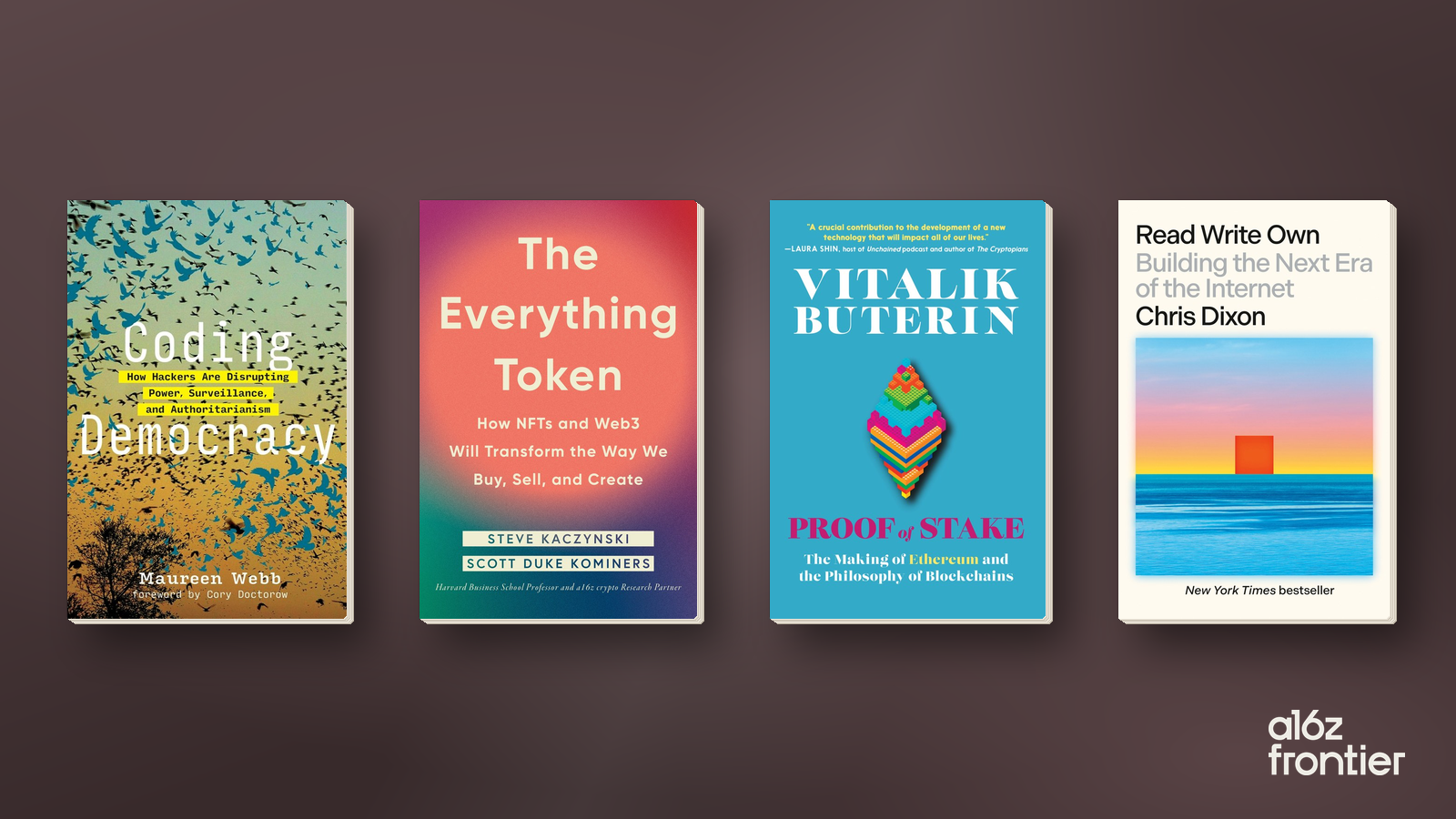
Coding Democracy: How Hackers Are Disrupting Power, Surveillance, and Authoritarianism
-
The Everything Token: How NFTs and Web3 Will Transform the Way We Buy, Sell, and Create
-
The Infinite Machine: How an Army of Crypto-hackers Is Building the Next Internet with Ethereum
-
Proof of Stake: The Making of Ethereum and the Philosophy of Blockchains
-
Proofs, Arguments, and Zero-Knowledge
“Great in-depth coverage of zero-knowledge proofs. (It is also available for download online.)”
– Valeria Nikolaenko, research
-
Read Write Own: Building the Next Era of the Internet
Genes, evolution, and disease
Technology changing society
-
AI Needs You: How We Can Change AI’s Future and Save Our Own
“Harding, an expert on the interplay between artificial intelligence and public policy, uses the last ~century of technology movements as a lens into understanding the emergence of modern AI. This ‘humanist manifesto for the age of AI’ makes a case that the impact of AI on society is far from preordained, and it’s incumbent on the body politic — i.e., all of us — to help drive the technology toward its maximum social potential.”
– Scott Duke Kominers, research
-
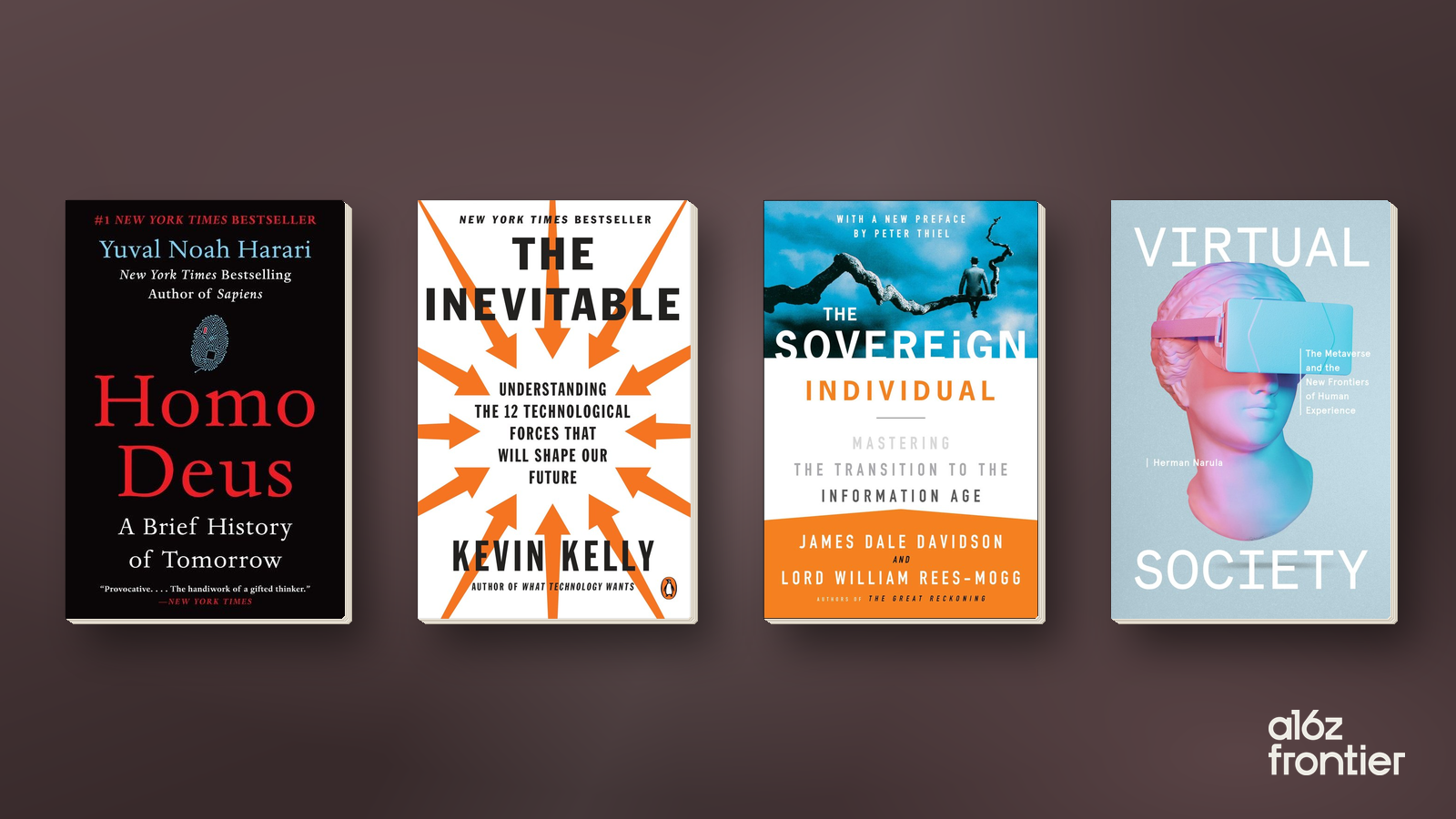
Homo Deus
“After chronicling the long arc of human history in Sapiens, Harari casts his gaze forward to the as-yet-unwritten future of our species. He puts into perspective just how epochal a time it is to be alive today.”
– Robert Hackett, editorial
-
The Inevitable: Understanding the 12 Technological Forces That Will Shape Our Future
-
The Scaling Era: An Oral History of AI, 2019–2025
“The Scaling Era was simultaneously the most readable and the most comprehensive book on AI I came across last year: A series of high-energy conversations on the science, purpose, and potential of AI; framed with Talmud-style footnotes, annotations, and asides that make it possible to zoom in on any idea to arbitrarily high resolution. Not just a masterpiece of nonfiction writing, but also of book conceptualization and design.”
– Scott Duke Kominers, research
-
The Sovereign Individual: Mastering the Transition to the Information Age
-
Virtual Society: The Metaverse and the New Frontiers of Human Experience
Physics on a cosmic scale
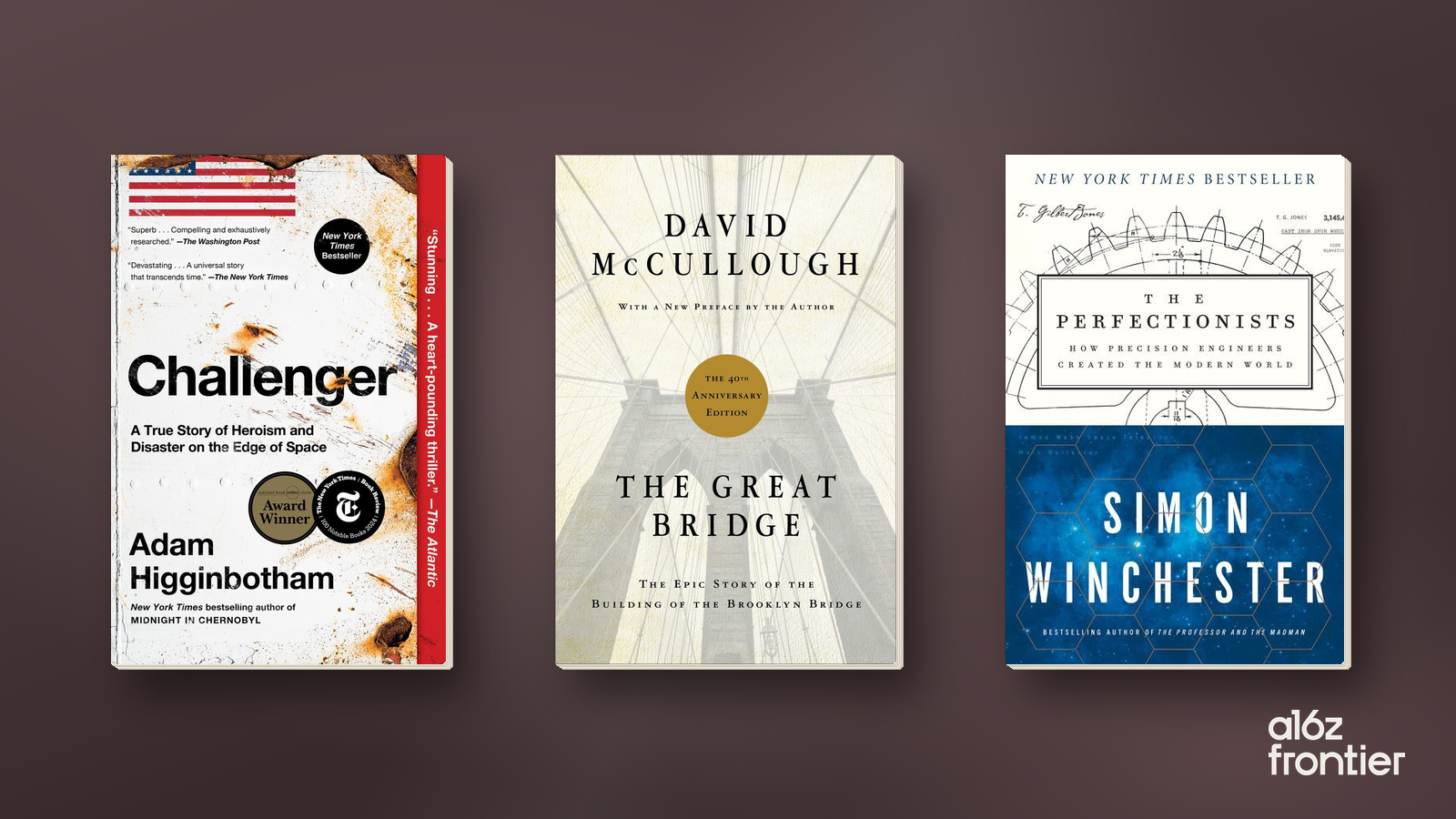
Precision engineering
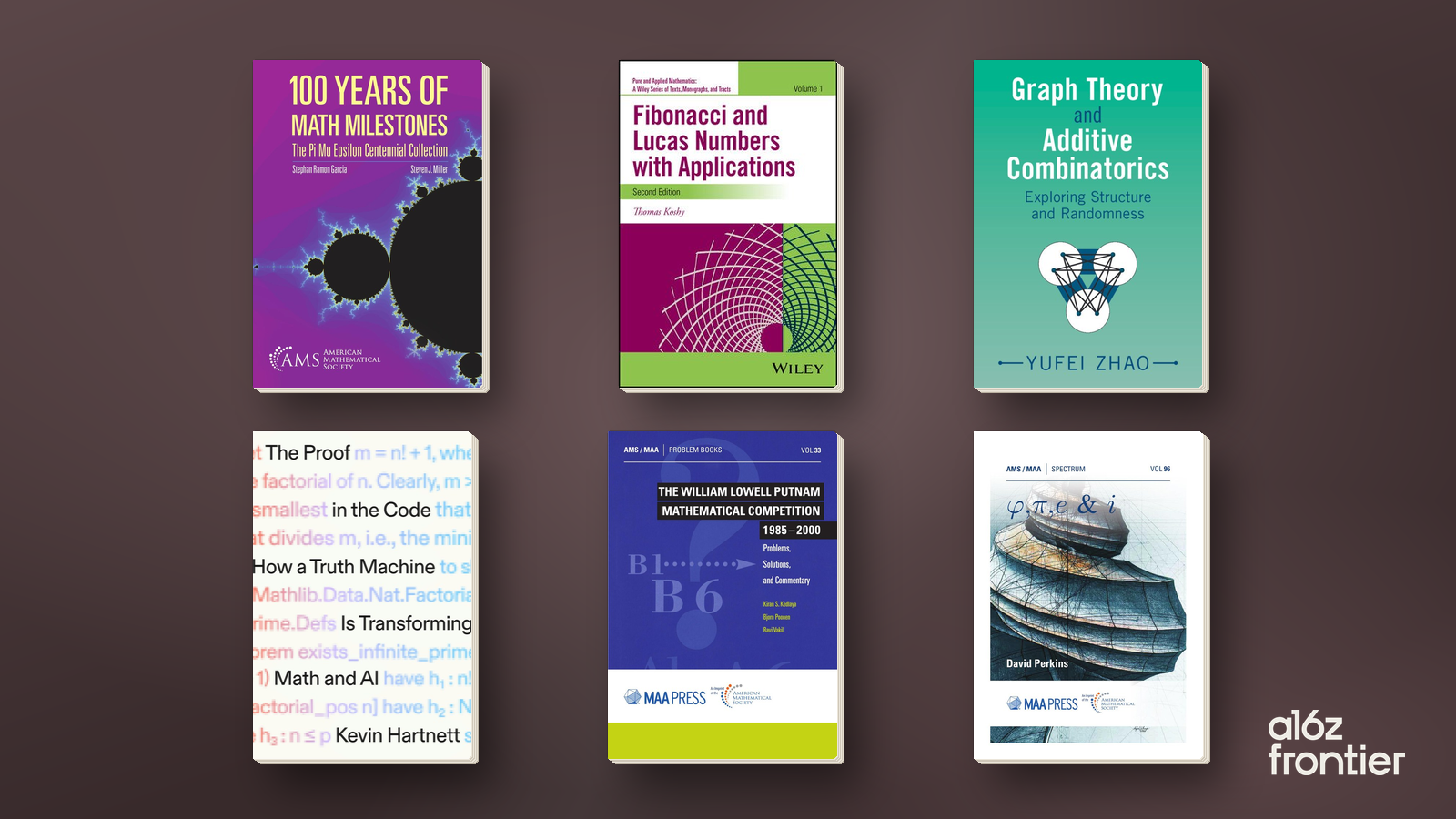
The art of solving math problems
-
100 Years of Math Milestones: The Pi Mu Epsilon Centennial Collection
“The U.S. undergraduate math honor society, Pi Mu Epsilon, commemorated its 2014 centennial by publishing a series of 100 problems tracing mathematics since its founding — collected in this volume. Each ‘year’ weaves together problem-solving with math history, exploring everything from the Collatz Conjecture and the Enigma machine to the Monty Hall Problem and even the Conway-Schneeberger ‘15 Theorem’ (which was my own small contribution to the volume).”
– Scott Duke Kominers, research
-
The Art and Craft of Problem Solving
“While I’ve been ‘Lean’-ing into formal mathematics this spring, I’ve also been revisiting classic works to fine-tune my mathematical thinking and problem-solving. And there’s no better book for that than Paul Zeitz’s magnum opus, now in its third(!) edition.”
– Scott Duke Kominers, research
-
Fibonacci and Lucas Numbers with Applications
“If you, like me, are the type of person who enjoys leafing through the encyclopedia and also loves Fibonacci numbers, then imagine how awesome it would be to have an encyclopedia of Fibonacci numbers! QED.”
– Scott Duke Kominers, research
-
Graph Theory and Additive Combinatorics: Exploring Structure and Randomness
“My friend Yufei Zhao has written a beautifully exposited, high-energy text on how structure emerges from apparent randomness in combinatorics, and vice versa. A fun introduction to the ethos of the field, covering everything from Szemerédi’s Theorem to the card game SET.”
– Scott Duke Kominers, research
-
Heavenly Mathematics: The Forgotten Art of Spherical Trigonometry
“We live on a sphere (called the Earth). One would expect that we would all be taught spherical geometry. Yet, by the early 20th century this material was completely phased out of the math curriculum in high school and college. As a result, we do not learn how to answer basic questions like this: given the latitude and longitude of two cities on Earth, what is the distance between them? This book tells the history of spherical geometry and explains the beautiful key ideas of this area in a very accessible way. The chapter on the area of a spherical triangle is particularly fun.”
– Dan Boneh, research
-
Mathematical Puzzles: A Connoisseur’s Collection
“This is hands-down my favorite mathematical puzzle book of all time. QED.”
– Scott Duke Kominers, research
-
The Proof in the Code: How a Truth Machine Is Transforming Math and AI
“I’ve recently become fascinated by the potential of formal verification to refine our understanding of math and economic theory.
The basic design paradigm is simple: proofs written in a machine-checkable language, where ‘compiling’ means that every logical step is completely sound. Lean — first launched by Leonardo de Moura in 2013 and now chronicled in Hartnett’s book — is the leading such ‘proof assistant’ these days. It spawned a massive project to formalize mathematics from the ground up, and has crossed over to cryptography and software security (and some of my collaborators and I have been bringing it to economics).
This tech has taken on particular importance in recent years, as it is a perfect complement to generative AI. Lean at once turns proof logic into a machine language that AI models can reason in more easily, and provides a trusted system to verify (or reject) conclusions when AI models try to ‘prove’ in ways that are difficult for humans to understand.”
– Scott Duke Kominers, research
-
Tasty Japanese Morsels in Recreational Mathematics
“This is a delicious collection of math mini-puzzles, covering everything from ‘masked multiplications’ and polyomino games to the mysterious logic of ‘The Island of Fish-Eaters.’ Perfect as an appetizer before dinner with mathematicians.”
– Scott Duke Kominers, research
-
The William Lowell Putnam Mathematical Competition 1985–2000: Problems, Solutions, and Commentary
“With AI agents catching up, there’s never been a better time to immerse oneself in the joy of classic Putnam problems. The MAA/AMS Putnam compilation series does a beautiful job illustrating multiple approaches to the problems, as well as their linkages to various branches of research mathematics. All are fantastic, but I’m especially partial to the 1985–2000 volume, which features some particularly interesting years of the exam. (Check out, for example, problem 1998A3, and the seemingly superficially related yet massively more difficult 1999B5. Also 1998B6!)”
– Scott Duke Kominers, research
-
φ, π, e & i
“Fun to read linearly, but even better to leaf through. You never know when you’ll happen onto your new favorite identity featuring some of math’s best-known numbers. (For example, check out pages 89–91!)”
– Scott Duke Kominers, research
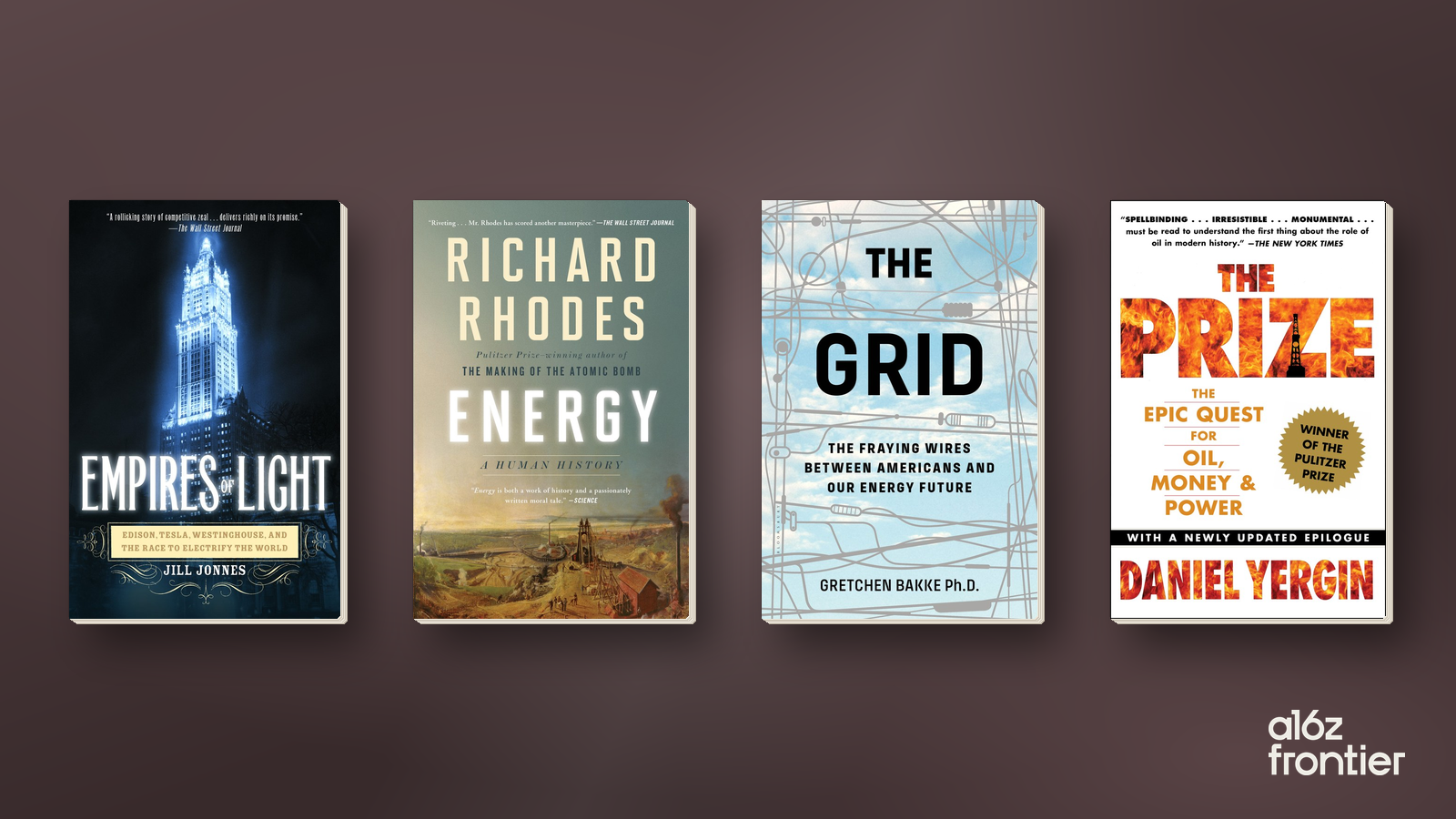
All things energy
Models, systems, and decisions
-
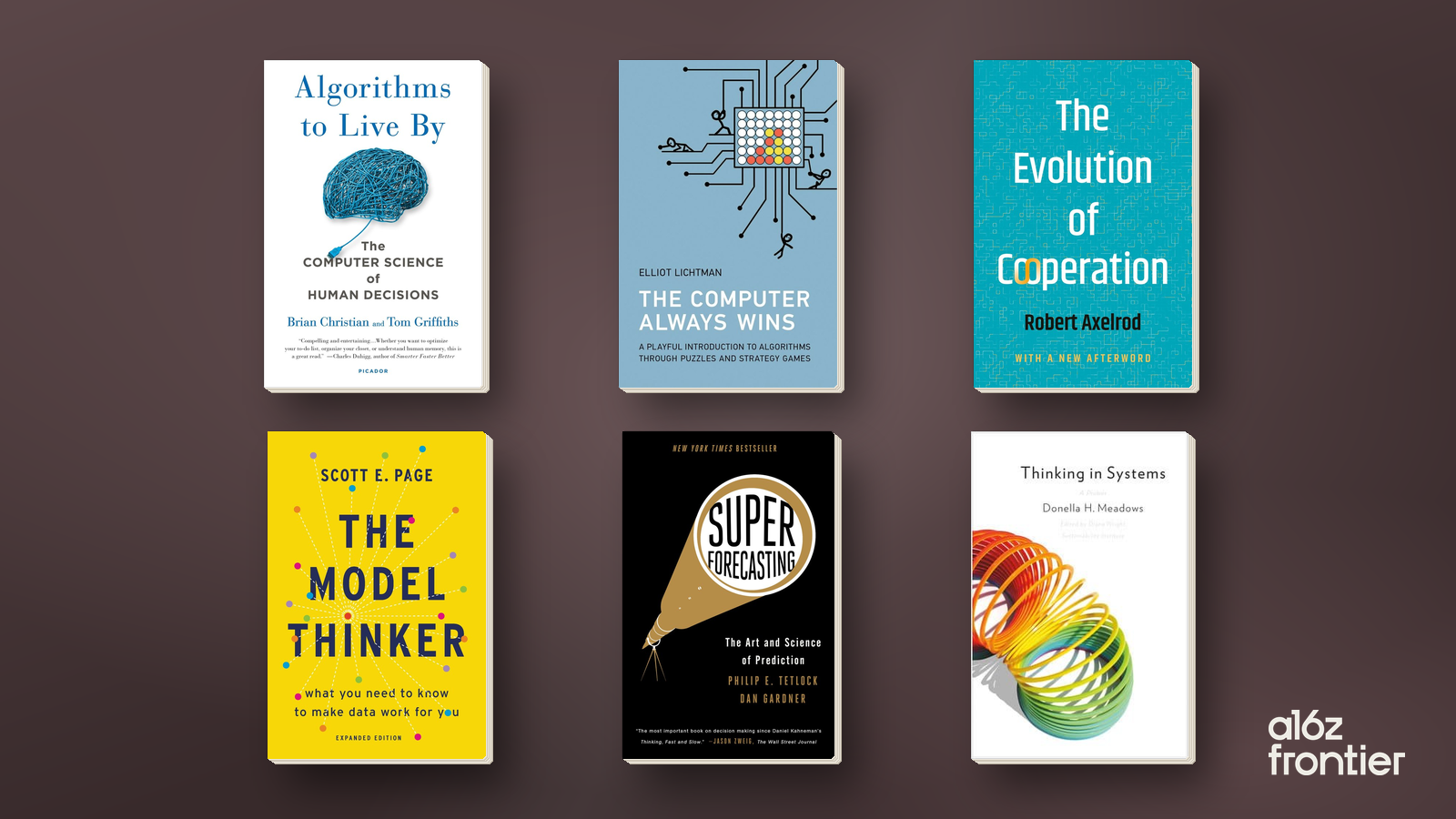
Algorithms to Live By: The Computer Science of Human Decisions
“Even if you didn’t take an algorithms and data structures class in college, you will love this book. It applies famous algorithms and data structures to things we do in life every day.”
– Michael Blau, deal
-
Chaos: Making a New Science
“This book introduces the science of nonlinear dynamical systems with brilliant and beautifully strange ideas. When I first read Chaos in college, it fundamentally reshaped the lens through which I view and analyze the world. If you aren’t already intimately familiar with chaos theory, it may reshape how you see the world today.”
– Ross Shuel, network operations
-
The Computer Always Wins: A Playful Introduction to Algorithms through Puzzles and Strategy Games
-
The Evolution of Cooperation
-
The Model Thinker: What You Need to Know to Make Data Work for You
“The Model Thinker came out a few years ago, but I recently revisited it after reading Algorithms to Live By. The book teaches a bunch of mathematical models, from networks to Markov chains to signaling, and shows how they apply to data sets. Which makes it sound as dry as dust — far from the truth. Instead, Page shows how to use these mental models in the real world and argues that, since any one model is a poor representation of the real world, we need a multiplicity of models to navigate our lives. Summer is a great time to add some new tools to your mental toolbox.”
– Tim Sullivan, editorial
-
Superforecasting: The Art and Science of Prediction
“I picked up this book on the recommendation of a previous boss, whose morning notes on the stock market I still read religiously — and I’m so glad I did. Superforecasting can help entrepreneurs, battling at the boundaries of incomplete information and luck, to sharpen their decision-making skills. The book explores the art and science of prediction, revealing how top forecasters think and make accurate judgments under uncertainty — a critical skill for navigating new technologies and markets. Its practical insights can help entrepreneurs anticipate trends, assess risks, and make informed choices.”
– Pyrs Carvolth, go-to-market
-
Thinking in Systems: A Primer
From idea to reality
back to top ↑
Fiction
Coming-of-age
-
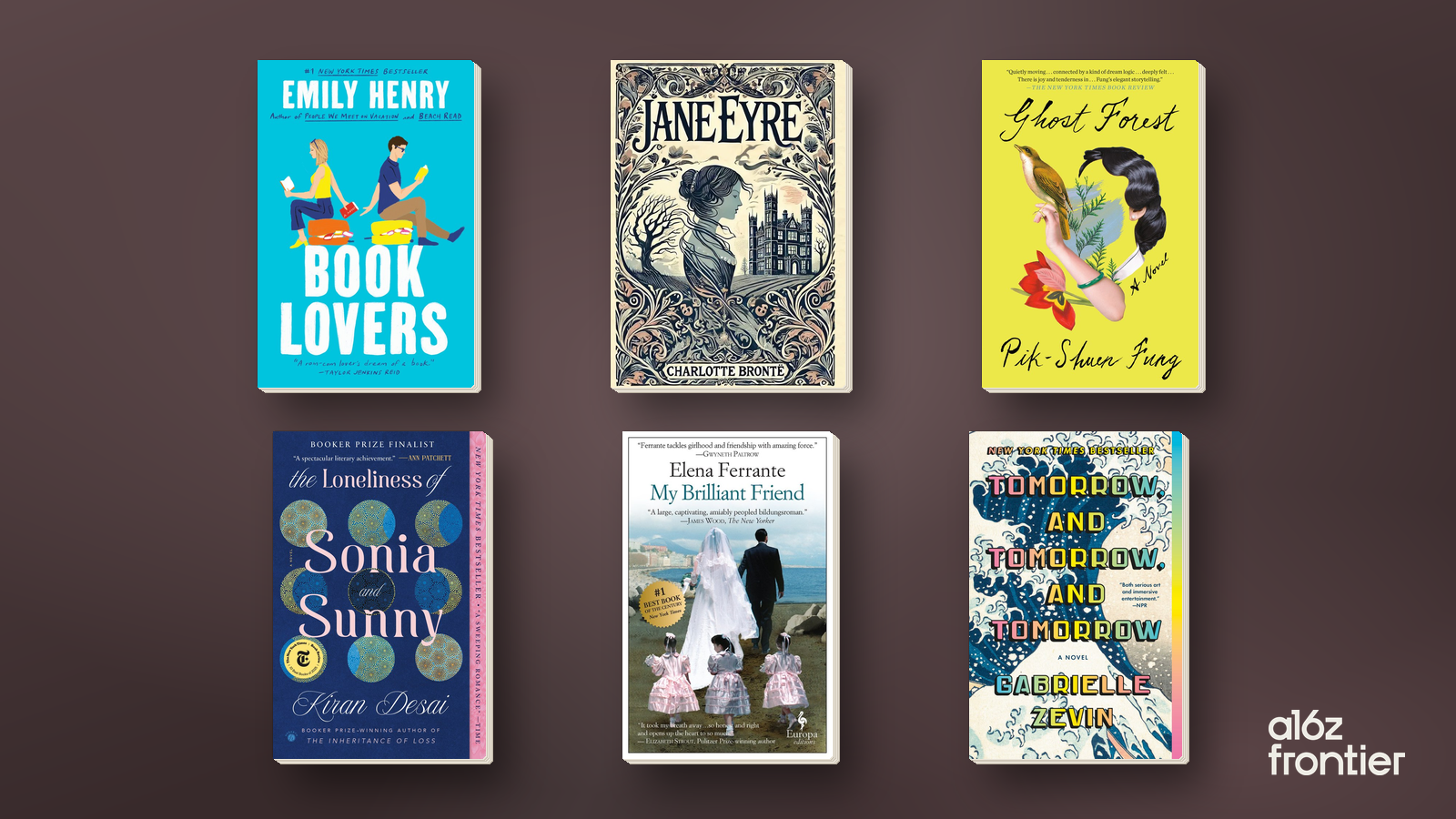
Book Lovers
“This is a charming, delightful, feel-good book about people who love books, family and friendships, the people and places we love, and more. I know that’s a generic list of themes, and that these kinds of books can sometimes be too clichéd and cheesy, but this IS all that, in all the best ways ;)”
– Sonal Chokshi, editorial
-
Geek Girl series (Geek Girl, Model Misfit, Picture Perfect, All That Glitters, Head Over Heels, Forever Geek)
“I read all of these in a single vacation, going from beach to trains to planes to mountains — and I must have laughed out loud in all those places because there are SO many delightful moments in this series, even for a critical and sometimes jaded reader like me. The series is about an exceptionally bright young teen making her way through a world that doesn’t really ‘get’ her, while she navigates not just friendships and romantic relationships but also her own ambitions, beauty, confidence, desires. The entire series (note: the book version not TV!) is so good — funny, warm, full of life lessons but not on the nose — and is also appropriate for tweens and above. I’ll always have a few YA books in my regular mix and this was the best one this year for sure.”
– Sonal Chokshi, editorial
-
Ghost Forest
“A slim, soft, and plainspoken piece of autofiction on loss, grief, and the complexity of parent/child relationships.”
– Stephanie Zinn, editorial
-
Jane Eyre
“While I’ve always loved audio as a medium — especially (good) podcast conversations! — I’ve long struggled with paying attention in audiobooks? But since I found audiobooks read by prominent actors (or by really good voice narrators who don’t sound like AI), a whole new world of reading-by-hearing has opened up for me. For the past couple years, I’ve been revisiting classics as read by prominent actors — Jane Austen’s Pride and Prejudice read by Rosamund Pike, Tolstoy’s Anna Karenina read by Maggie Gyllenhaal, and several others — but my favorite so far, and my #1 pick for this year, is Jane Eyre read by Thandiwe Newton (yes, that one). Newton so fully embodies each and every character’s personality, quirks, and moods in such distinct voices that you forget it is the same person reading all of them. And even though I read this book long before, it’s as if Jane — including her agency (and humor!) — came alive for the first time; it was like an entirely new story to me. I also can’t get over how out of and ahead of her time Charlotte Brontë was with this story, character development, and more.”
– Sonal Chokshi, editorial
-
The Loneliness of Sonia and Sunny
“I am not really into this genre anymore — not since its heyday of Salman Rushdie’s Midnight’s Children or Rohinton Mistry’s Such a Long Journey — so it says a lot that I really liked this book; it has more than just the usual tropes (although it does still have the tropes). But I devoured all ~650 pages in just days since [I] couldn’t put it down! Desai’s book is so rich with detail, you are gripped both by the characters and by how is-she-able-to-capture all those descriptions?! It’s no wonder that Desai apparently took 20 years to write this novel since winning the Booker Prize [in 2006 for her second novel, The Inheritance of Loss, when she became the youngest woman to win]. This new book was also shortlisted for the Booker Prize, but that’s generally an anti-heuristic for me so I’m recommending this book despite all that.
Sonia and Sunny is partly a romance, mostly a family drama, set against the backdrop of immigrants’ and travelers’ experiences — but it’s really a deeply psychological novel, rich with observation about humans more universally: our ambitions, our desires, our yearnings, our learnings in relationships and as we move through the world. I highly recommend this book!”
– Sonal Chokshi, editorial
-
My Brilliant Friend: A Novel
“I finally got around to reading this modern classic after having been berated about it for a decade. I should not have put it off: Ferrante’s prose is compulsively readable, her characters are sharply drawn, and the details of the setting and the plot make this a captivating entry point into her work.”
– Tim Sullivan, editorial
“This is a four-book series starting with the most well-known, My Brilliant Friend. I recommend reading the whole series in order. Elena Ferrante captures Lila and Lenù’s friendship with such raw intimacy that you feel less like a reader than a silent third friend, privy to every emotion. The writing style is effortlessly beautiful and enjoyable to read.”
– Emily Westerhold, finance and operations
-
The Royal We
“I heard about these books on a podcast, and was skeptical about a good royal romance inspired by William and Kate… good for magazines but a book? really?! However, this book is a fun (and addictive) read. Which is not surprising, as the authors are the writers of one of the internet’s longest-standing and most popular fashion blogs. (I immediately followed this book with the sequel The Heir Affair, which completes the story.)”
– Sonal Chokshi, editorial
-
Tomorrow, and Tomorrow, and Tomorrow
“Gabrielle Zevin’s tale of gaming, love, friendship, tragedy, early adulthood, and the ups and downs of building an industry-defining company. The author somehow depicts designing game engines and personal relationships with the same level of remarkable detail. I couldn’t put this one down and recommended it to nine people (including a couple folks on our team!)… EVERY single person loved it.”
– Jay Drain Jr., deal
“A gripping, slightly magical-realist tale of enduring friendship — told through the eras and theory of computer game design.”
– Scott Duke Kominers, research
“Both the storyline and the character development are super engaging, and as a result, I found myself unable to put down the book. The characters felt like some of the founders we might invest in — talents and flaws and all!”
– Arianna Simpson, deal
Crime and thrillers
-
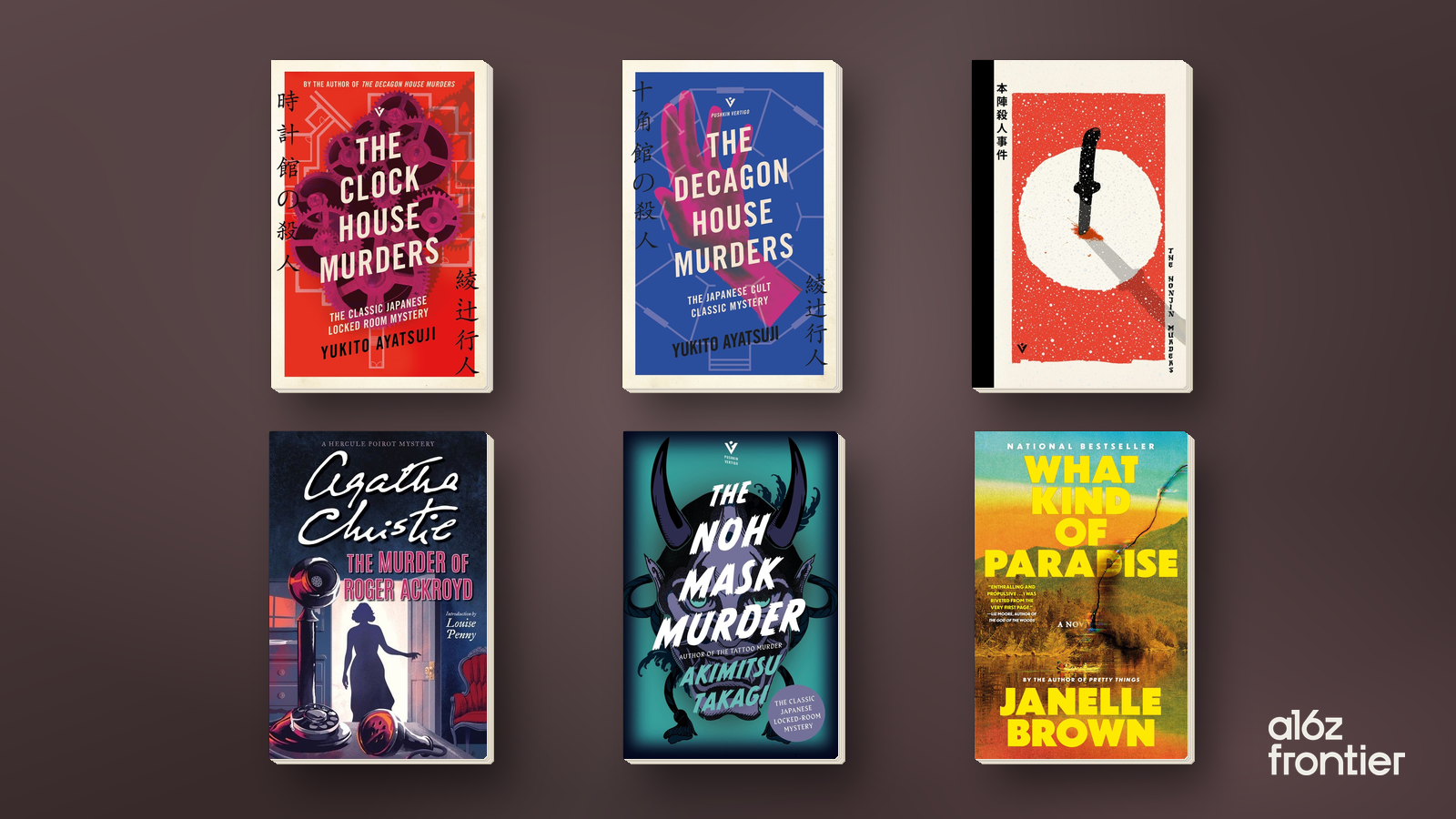
The Clock House Murders
“The Clock House Murders unfolds in parallel both inside and outside the mysterious Clock House, where 108 timepieces of all shapes and sizes pace the action day and night. Timing distortion is a classic mystery trope — the stopped clock, the wristwatch set back an hour, and the like — and here you naturally expect that similar games are at play. Yet the author demolishes each such idea almost as soon as it occurs, leaving the reader to wonder whether all the clocks are somehow a meta-ruse just to redirect attention away from what’s really going on. I couldn’t put this one down — time seemed to speed up as the story raced toward its conclusion, and I found myself turning the pages faster and faster.”
– Scott Duke Kominers, research
-
The Cold Cold Ground
“What do you do if you’re a Catholic copper in Protestant Belfast at the height of the Troubles? You check under your car for a bomb every morning before going to work. Adrian McKinty’s The Cold Cold Ground combines the kind of detective story I like with a vividly realized setting. Belfast in 1981 is a place where every institution is contested and every identity carries consequences. Sean Duffy solves crimes while navigating that landscape with intelligence, wit, and a healthy appreciation for the possibility that someone may be trying to kill him. The result is both gripping and funny — just the kind of police procedural I love.”
– Tim Sullivan, editorial
-
The Decagon House Murders
“This is one of the greatest puzzle mystery novels of all time. It’s an exemplar of the Japanese honkaku style, heavily inspired by Golden Age mystery writers such as Agatha Christie, Ellery Queen, and S.S. Van Dine. All the clues are in plain sight — the question is: can you see them?”
– Scott Duke Kominers, research
-
The Gun Seller: A Novel
“Oh, good: a novel by a celebrity (yes, this is that Hugh Laurie). But it is good, and just released in a handsome new edition. I suppose this is ‘spy fiction’ about drugs and guns in a contemporary setting, but mostly it’s smart, morally ambiguous, and sardonic with a light overlay of Wodehousian humor.”
– Tim Sullivan, editorial
-
The Honjin Murders
“This Seishi Yokomizo mystery novel unwinds like clockwork, with a structure so perfect that it’s puzzling right up until the final note. Particularly appropriate for fans of classic ‘Golden Age’ mystery writers — especially John Dickson Carr and Gaston Leroux.”
– Scott Duke Kominers, research
-
The Labyrinth House Murders
“This Yukito Ayatsuji novel in the Pushkin Vertigo collection traps you walking around and around its labyrinth, like a Theseus unsure which thread to follow. This honkaku mystery novel is a masterful, multilayered puzzle: Every critical clue is right in front of you — yet somehow masked, leading you astray. The multilayered character motivations and identities manage to continue to surprise even after you finish the book; I’m still in awe that one author could write so many different mystery threads at once.”
– Scott Duke Kominers, research
-
Murder in the House of Omari
“This utterly brilliant mystery novel is a multi-act tragedy set inside a panorama of social and industrial change in early-20th-century Japan. The titular Omari family’s prewar rise and postwar decline wraps in upon itself in an ouroboros of puzzling murders, with clues that leave nothing hidden yet nevertheless somehow manage to obscure.”
– Scott Duke Kominers, research
-
The Murder of Roger Ackroyd
“This year marks the 100th anniversary of one of the most brilliant and category-defining mystery novels of all time.
Christie’s detective Poirot has retired to the countryside (to grow vegetable marrows — I’ve always liked this detail). But he quickly gets wrapped up in investigating the stabbing of the eponymous Ackroyd, as narrated by village physician Dr. Sheppard — who plays a sort of ‘Watson’ throughout. To hear Sheppard tell it, with all the murderer’s misdirection and so many false leads, this might almost have been one of Poirot’s greatest failures. But in fact, it became perhaps Christie’s greatest success.”
– Scott Duke Kominers, research
-
The Noh Mask Murder
“A locked-room mystery with a multilayered author–narrator–detective structure so innovative and unique as to rival Agatha Christie’s groundbreaking novel The Murder of Roger Ackroyd. As with other honkaku-style mysteries, the solution yields to logic — all the evidence is written down. Yet even so, one is left grasping at threads as the intricate story rises to its almost poetic climax.”
– Scott Duke Kominers, research
-
The Secret History
“A compelling whydunit revolving around a cabal of college student degenerates, with a brutally descriptive account of New England winter. Read while sipping whiskey by the fireplace.”
– Michael Zhu, engineering
-
She Walks at Night
“She Walks at Night is the perfect follow-up to Ackroyd: a tale of family dysfunction, jealous relations, and not one but two hunchbacks (or possibly three?), who find themselves tied up in a crisscrossing web of their own weaving. The story as told is like a cross between a stage play and a waking dream — you’re never quite sure who’s who, or who’s playing which role. Despite literally every clue being handed to the reader, there’s a sense of almost sleepwalking into the final resolution.”
– Scott Duke Kominers, research
-
Slow Horses
“What happens to MI5 spies who can’t be fired but who are no longer fit for the A-Team? These misfits get remanded to Slough House, where they work on the worst possible espionage jobs — killing time until they quit or retire. In this inventive, smart, and fun spy novel, these so-called ‘slow horses’ find themselves thrust back into the limelight when a kidnapping spirals into a deadly conspiracy. It’s the first in a series, which promises many more hours of reading (and an Apple TV series with Gary Oldman).”
– Tim Sullivan, editorial
-
The Tokyo Zodiac Murders
“An utterly surreal honkaku mystery novel that is as gripping as it is puzzling. Despite what is a seemingly (and increasingly) bizarre series of murders, the solution yields to logic — the challenge, though, is whether you can put the pieces together properly.”
– Scott Duke Kominers, research
-
What Kind of Paradise
“What Kind of Paradise is a compelling blend of coming-of-age novel and page-turning thriller. For anyone familiar with the Silicon Valley ecosystem, it feels especially emotionally resonant, exploring the pull of techno-optimism alongside the more complicated human consequences of rapid progress. It’s relatable and suspenseful, making it a great choice for a fun, immersive winter break read.”
– Emily Westerhold, finance and operations
Fantasy (and yes, romantasy)
-
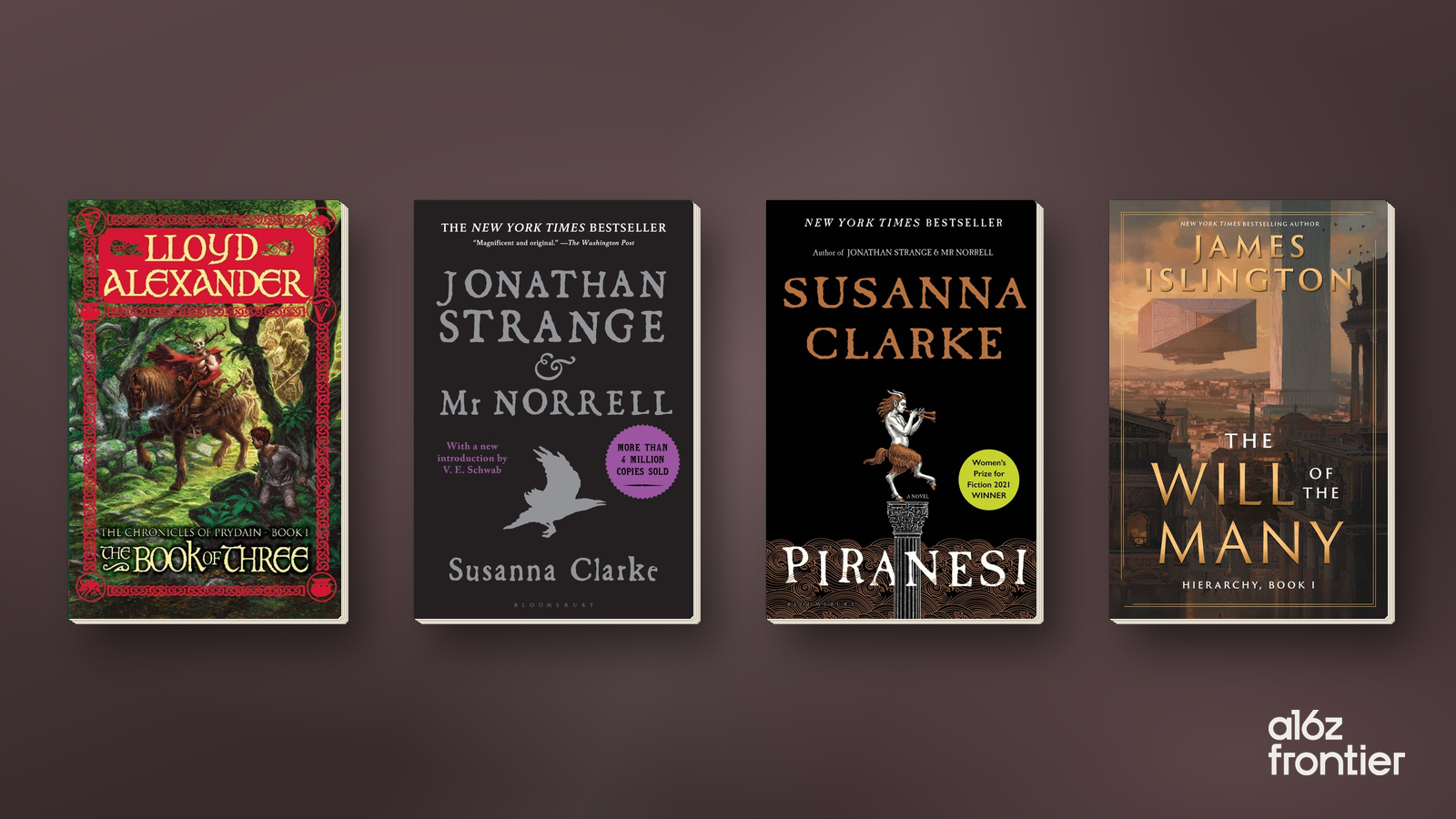
The Chronicles of Prydain (start with The Book of Three)
“If you like fantasy series aimed at younger readers (or if you have younger readers in your life), I highly recommend the Chronicles of Prydain.”
– Tim Sullivan, editorial
-
Fourth Wing (The Empyrean, Book 1)
“It’s been a while since I’ve read, and enjoyed, a good dragon-lore fantasy book — and this one has everything you want: a competitive school for dragon riders, an establishment that mistakenly believes one thing/ignores other realities, and a punches-above-her-weight protagonist whom everyone (including herself) underestimates but who rises to the top. I couldn’t put it down!”
The second book, Iron Flame, was published in November 2023.
– Sonal Chokshi, editorial
-
House of Earth and Blood and House of Sky and Breath
“I have added something from Maas to nearly every reading list we’ve done here over the years, since I am such a huge fan of her fantasy novel series — and in particular her worldbuilding and character development (imperfect, complex, nuanced). These are the first two books in her latest series, Crescent City — following the Throne of Glass series and A Court of Thorns and Roses series, both of which I devoured as they came out in real time. It’s frustrating waiting for books in between but my god so worth it every time!”
– Sonal Chokshi, editorial
-
Jonathan Strange & Mr Norrell
“Susanna Clarke’s debut novel is a brilliant magical-realist fantasy about the interplay between theory and practice. Relevant for anyone who’s ever dreamed of studying or doing real-world magic.”
– Scott Duke Kominers, research
-
Ninth House
“I am a huge fan of all things Bardugo. From her now-mainstream Shadow and Bone trilogy to the (even better!) extension of that worldbuilding in the Six of Crows duology — aka The Grishaverse — this book, the first in her latest Alex Stern fantasy detective series, is sooo good.”
– Sonal Chokshi, editorial
-
Piranesi
“Clarke’s second masterpiece immerses you in a seemingly infinite labyrinth of flooded hallways and catacombs, where the reader must wonder whether the namesake narrator Piranesi is a fantastical creature, a figment of his own imagination, or something other entirely. Part myth, part mystery — and perhaps even a small part prophecy. (Clarke’s magical-realist magnum opus Jonathan Strange & Mr Norrell was featured on not one but two people’s lists in summer 2023, including mine.)”
– Scott Duke Kominers, research
-
The Will of the Many
“I loved how The Will of the Many blends an elite academy setting, Roman-inspired politics, and a genuinely propulsive mystery. The book is smart and immersive without feeling slow, and it has novel worldbuilding.”
– Liz Harkavy, deal
Historical fiction
-
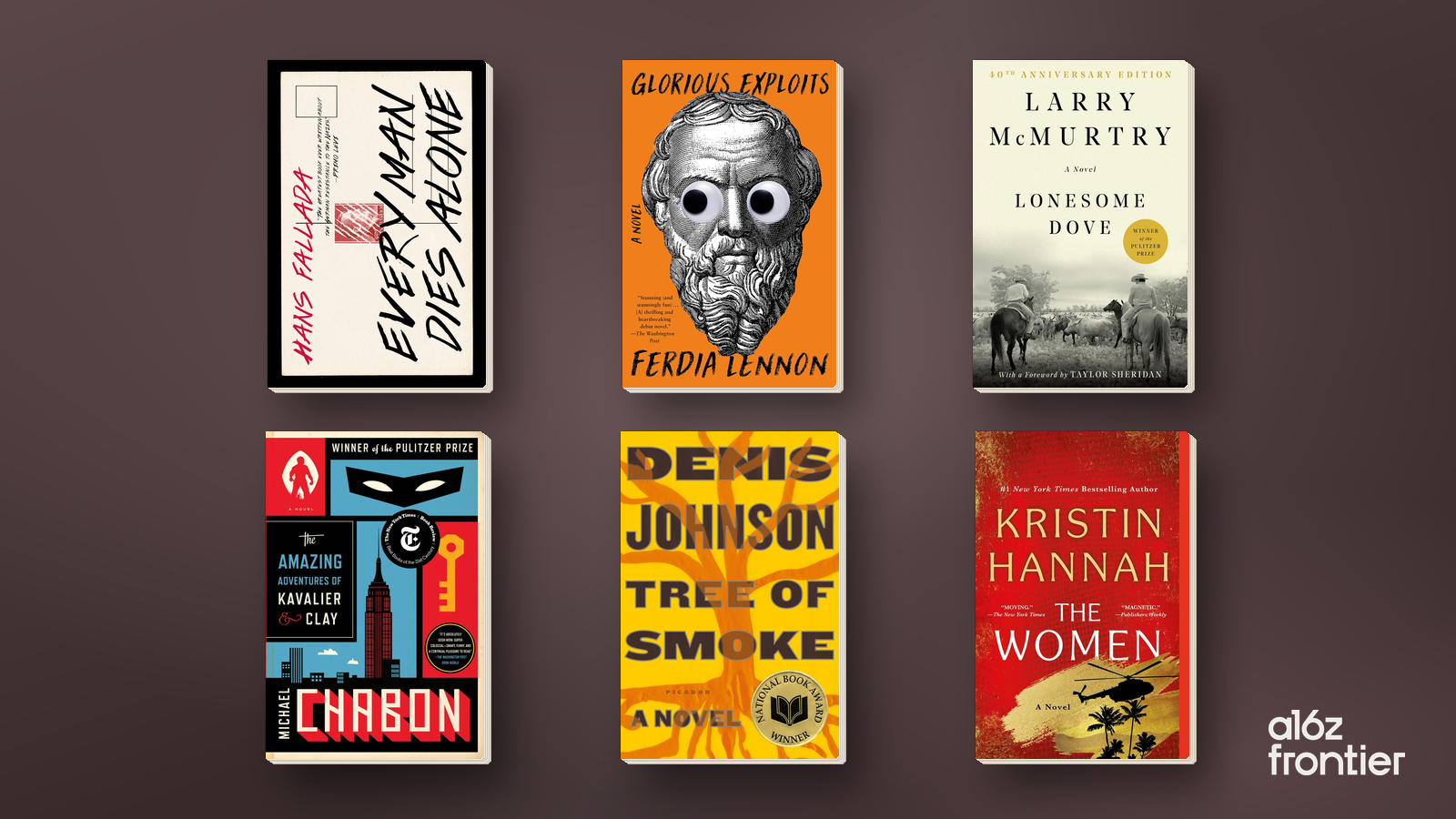
The Amazing Adventures of Kavalier & Clay
“A beautiful book, both a comedy and an epic, about two young men discovering themselves while trying to build a comic book empire in NYC. The book is worth reading in its own right, but of course I observed some themes that seem relevant to what crypto addresses today: the characters get screwed out of ownership as creators; geography has traditionally been an unfortunate constraint to success; and comic books had some of the first distributed communities.”
– Sam Broner, deal
-
Blood Meridian
“A beautiful and haunting trek through the human experience and western America.”
– Guy Wuollet, deal
-
Every Man Dies Alone
“Based on the true story of a husband and wife who became part of the German resistance in Berlin. Their courage and the love they found for each other by acting with purpose moved me deeply.”
– Bill Hinman, policy
-
Glorious Exploits
“I laughed, I cried, I re-read Euripides. Set in Sicily during the Peloponnesian War, this book follows two unemployed potters. What starts as a trip to feed Athenian prisoners at the local quarry turns into a surprisingly high-production-value staging of Euripides, complete with props and scenery — plus lots of wine and a teeny tiny bit of magic. The innovation here is narrating the whole thing in contemporary Irish vernacular, so you’ve got Spartans saying things like ‘arse’, and yet it works. The book doesn’t take itself too seriously, which makes it all the more powerful when it does. I read and listened to the audiobook at the same time — a great way to hear the story in the author’s Irish accent, without missing any of the weird and beautiful Homeric epithets sprinkled throughout.”
– Stephanie Zinn, editorial
-
James
“I picked up Everett’s new novel James after seeing the film American Fiction, which is an adaptation of one of his earlier novels, Erasure. I was not disappointed. James is an inspired work. Everett’s style is full of irony, compassion, and verve. A perfect homage to Mark Twain, whose Adventures of Huckleberry Finn inspired it.”
– Robert Hackett, editorial
-
Lonesome Dove
-
Tree of Smoke
“Masterfully interweaving the stories of a greenhorn CIA operative, a wayward marine private, and a proselytizing Canadian nurse, this propulsive Vietnam War spy thriller doubles as a reflection on American history, myth, and much more.”
– Aiden Slavin, policy
-
The Women
“This historical fiction novel totally captivated me. I laughed, I cried, and I learned a lot about the Vietnam War from the perspective of women who lived it in a different capacity on the frontlines than the typical war heroes we read about.”
– Emily Westerhold, finance and operations
Novel forms
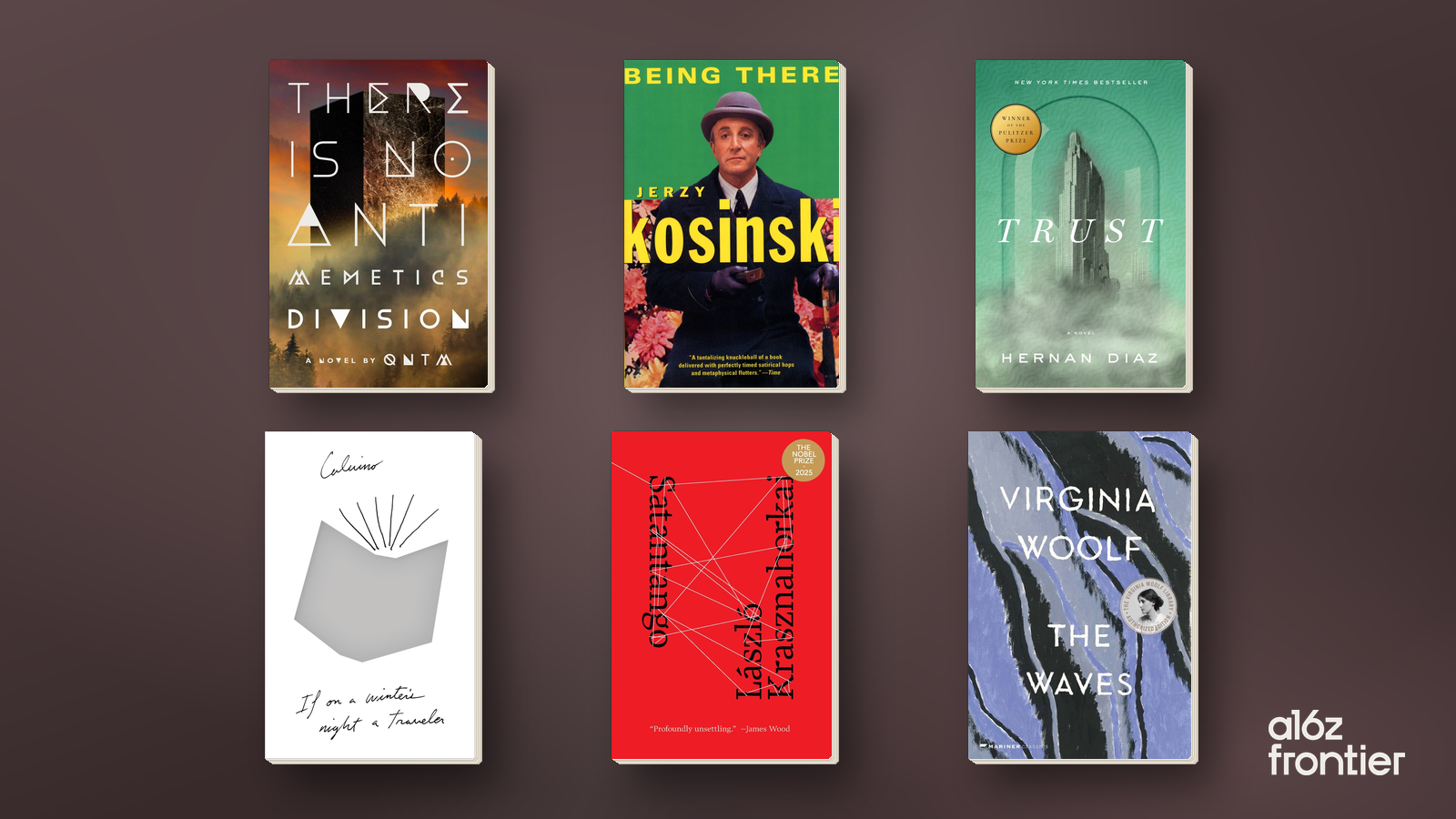
Perception vs. reality
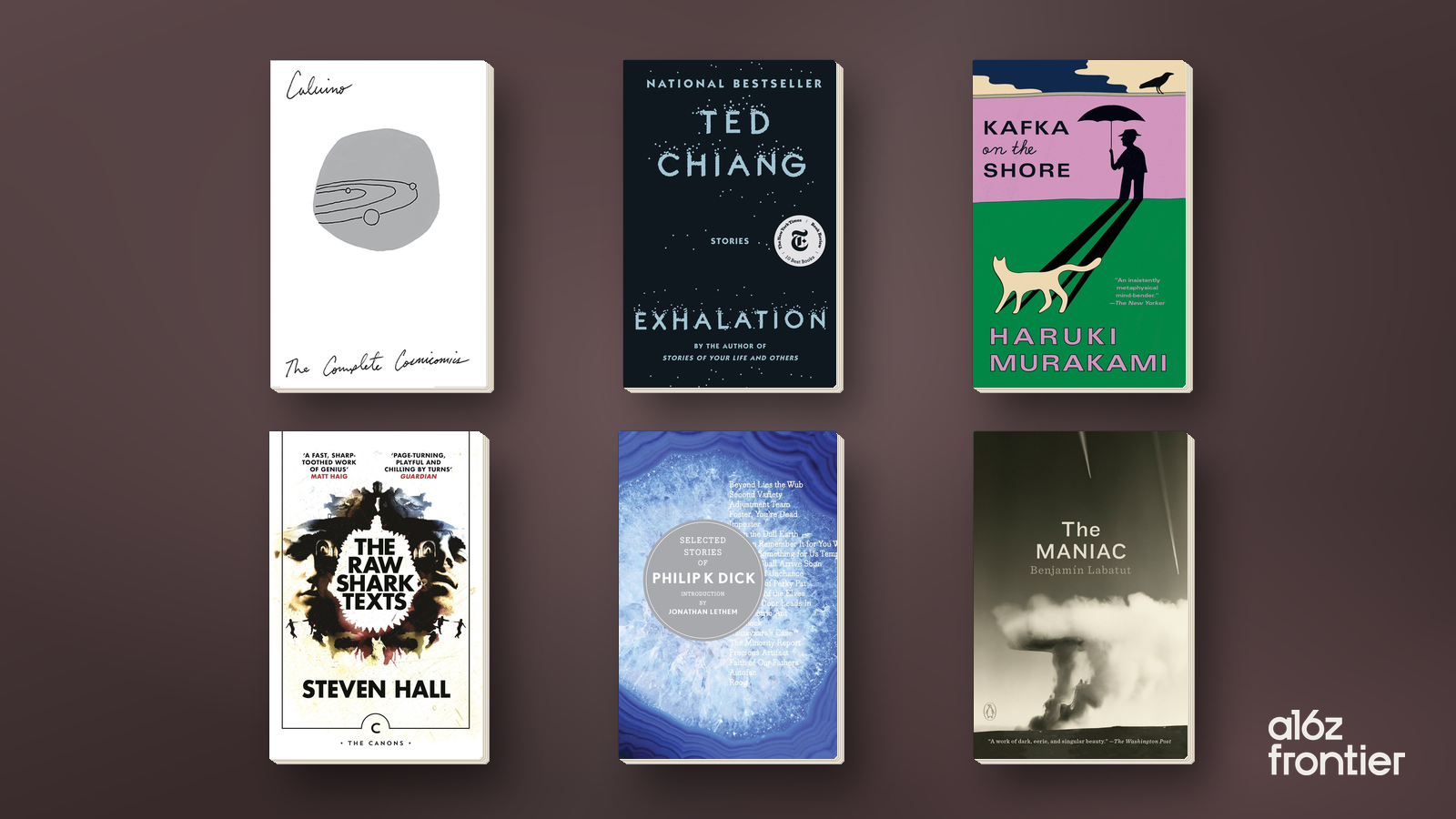
-
The Complete Cosmicomics
“Have you ever wondered what the experience of the universe might have been like before the Big Bang, or as colors began to appear? Thanks to Calvino and his omnipresent narrator Qfwfq, now you can know.”
– Scott Duke Kominers, research
-
Death Within the Evil Eye
“For fans of predictive tech, this novel turns the idea upside down, asking: what happens when people fear a prediction enough to let it shape their actions in the real world? Imamura is one of the most unusual and fascinating honkaku mystery authors — his works feature a touch of the arcane, yet nonetheless everything fits together with a perfect interlocking logic down to the last detail.”
– Scott Duke Kominers, research
-
Exhalation: Stories
“Chiang’s short stories are magic — intricate, surprising, powerful. If you like speculative fiction, read these — but read them slowly, since Chiang doesn’t write all that much.”
– Tim Sullivan, editorial
“Great science fiction can often tell us more about what it means to be human than about anything else. Chiang is a fantastic writer, and creates worlds that are intuitive to inhabit while challenging our preconceived notions about life.”
– Guy Wuollet, deal
-
Kafka on the Shore
“Reading Kafka on the Shore was mesmerizing. It’s the kind of novel that lingers in your mind. Murakami has a rare gift for drawing readers deep into the interior worlds and minds of his characters. Few authors can do this so effectively and to such emotional depth. Combined with a captivating, layered narrative that pulls everything together at the end — this is one I highly recommend to anyone looking to lose themselves in a book for an afternoon (or two).”
– Christian Crowley, go-to-market
-
The MANIAC
“A novel-like and very creative exploration of the personality and life of John von Neumann, celebrated Hungarian-American physicist and computer scientist.”
– Arianna Simpson, deal
-
Ra
“I’m a big fan of all of qntm’s work, but Ra stands out to me because it treats the premise ‘what if magic were real?’ with a rigor and modernity that feel genuinely fresh. It’s not fantasy; it’s sci-fi, and the story pushes that basic premise into deeper, tech-driven themes that make the world feel like a strange version of the future.
What really stuck with me is how character-driven it is. The truths of this world unfold through the perspectives of several memorable characters, and watching them navigate and slowly uncover the underlying logic of their reality is incredibly satisfying.”
– Christian Crowley, go-to-market
-
The Raw Shark Texts
“A work of meta-fiction, in which an amnesiac awakens to put his life back together as he is pursued by a conceptual shark that ‘feeds on human memories and the intrinsic sense of self.’ A wild ride.”
– Tim Sullivan, editorial
-
Selected Stories of Philip K. Dick
-
When We Cease to Understand the World
“Labatut blurs the line between fiction and nonfiction, and in so doing he brings the reader so near the ecstasy — and misery — of scientific discovery. My favorite chapter recounts the strange tale of the eccentric French mathematician and anarchist hermit Alexander Grothendieck, who revolutionized mathematics much as Einstein did for physics. Labatut masterfully melds Grothendieck’s biography with that of his enigmatic disciple Shinichi Mochizuki, the Japanese mathematician whose 2012 proof of the so-called abc conjecture in number theory remains in question.”
– Robert Hackett, editorial
“A work of fiction based on real events that explores the intersection of science, philosophy, and the human psyche. The narrative delves into the lives of several prominent scientists and mathematicians, presenting a complex tapestry of human aspiration, discovery, and its often unintended consequences. It showcases how groundbreaking scientific discoveries have driven some of the brightest minds to the brink of madness as they grapple with the implications of their work — and the anxieties that emerge when technology advances beyond human understanding.”
– Liz Harkavy, deal
“Labatut combines a wonderful love of actual physicists and scientific discoveries with a taste for embellishment and the melodramatic to make one of the most fun books I’ve read this year.”
– Guy Wuollet, deal
Science fiction
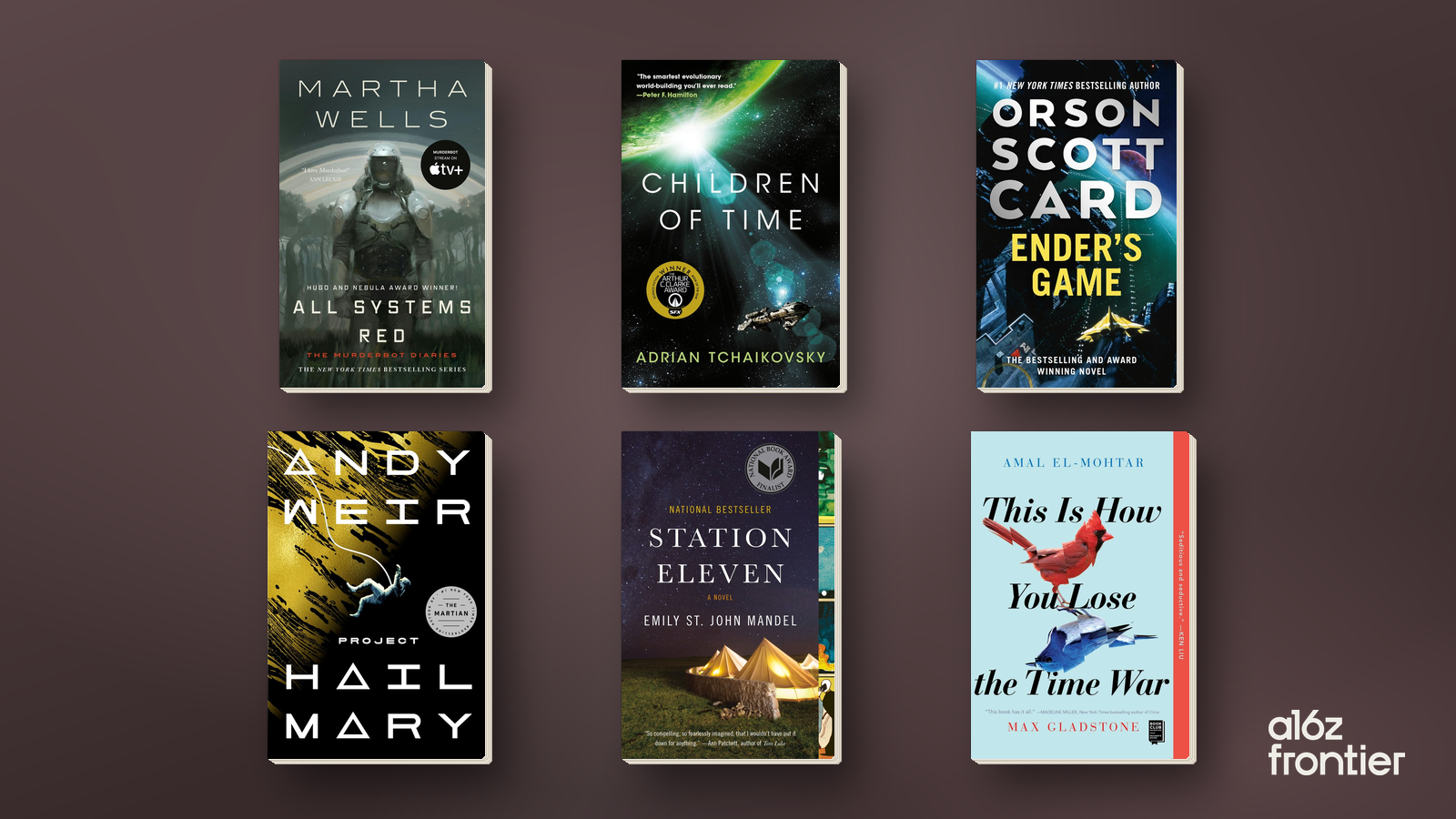
-
All Systems Red: The Murderbot Diaries
“A series of seven sci-fi novellas chronicling the adventures of a rogue SecUnit charged with protecting a group of annoying and often clueless humans while they explore distant planets. After hacking its own governor module, the murderous android becomes self-aware and nicknames itself ‘Murderbot’. Scornful of humans, all it really wants is to be left alone long enough to figure out who it is and watch media. Adventure, hilarity, and a surprising amount of poignancy ensue.”
– Jason Rosenthal, operations
“Autonomous killer human-machine hybrid with a conscience makes its way through the galaxy developing inconvenient friendships with humans and machines alike. Each entry is a bite-sized piece of sci-fi candy.”
– Tim Sullivan, editorial
-
The Caves of Steel
“Asimov explores humanity as it transitions to a robotic world, leading to anxieties and a new economic order. This mirrors some of the same concerns people are having with the proliferation of AI today.”
– Noah Citron, engineering
-
Children of Time
“Children of Time is a masterful blend of science fiction and evolutionary biology that takes readers on an epic journey through space and time. This novel explores the rise and fall of civilizations, the resilience of life, and the unintended consequences of humanity’s quest for survival. It’s so hard to make epic, hard science fiction books both intellectually stimulating and emotionally engaging, and this book is both. It will captivate your imagination and leave you pondering long after you are finished. The themes of this book are so deeply grounded in reality that they feel like the fictional extension of Dawkins, Dennett, and Deutsch.”
– Mason Hall, deal
-
Cryptonomicon
-
The Demolished Man
“Winner of the first Hugo Award for science fiction, Bester’s breakout novel is a fast-paced thriller that grapples with questions of intrigue and due process in a world where telepathy is real, but where what people think can’t always be trusted.”
– Scott Duke Kominers, research
“This classic science fiction novel — the first ever to win the Hugo Award — is a fascinating meditation on the mechanisms of law in a society where telepathy is possible. While fiction, the questions and challenges the book raises are relevant for a world where law is coming to rely more on AI.”
– Scott Duke Kominers, research
-
Diaspora
“Explores a post-human future where disembodied AIs are born and live in a simulated reality and occasionally interact with biological humans on Earth. The opening sequence explaining the birth of a new AI entity has stuck with me during the intelligent agent and AGI wave we’re experiencing today. Diaspora is hard sci-fi, so the justifications and explanations feel grounded in a satisfyingly possible reality.”
– Sam Broner, deal
-
Einstein’s Dreams
“Einstein’s Dreams is a beautifully written piece of practical science fiction that gave me a greater appreciation for the majesty in our daily lives. It experiments with the same life lived in worlds where time exists differently. Different forms of time give rise to different human relationships, and the book is a wonderful examination of why we should be grateful for each moment.”
– Guy Wuollet, deal
-
Ender’s Game
“Since becoming a dad, I’ve been revisiting the books I loved — and that shaped me — as a child. I was prepared to groan, to be honest. Would anything hold up? Would I recoil at the tastes of my younger self? Captain Underpants and the Attack of the Talking Toilets, really? Yet I am pleased to report that many of the reads I recollect as most formative in my youth remain good. For one, Ender’s Game stands out: It is as tight, gripping, and brutal as it was when it was published in 1985. (The subplot involving Demosthenes and Locke is also much less outlandish today than it might have first appeared in print.) I thank Andrew Wiggin for imbuing in me a lifelong love of science fiction, an appreciation I hope one day to share with my kids.”
– Robert Hackett, editorial
-
The Glass Hotel
Second in Sonal Chokshi’s recommended reading order. Her full recommendation appears under Station Eleven.
– Sonal Chokshi, editorial
-
Hyperion Cantos
-
The Invincible
“Written in 1964, it is one of the first sci-fi novels to suggest an idea of ‘smartdust’, which consists of nanomachines, all exact replicas of each other, that are harmless by themselves — but when they form a cloud, they become super-intelligent. This smartdust idea strongly resembles a blockchain! The novel itself is very gripping high-quality science fiction as well.”
– Valeria Nikolaenko, research
-
The Man Who Saw Seconds
“A fascinating speculative-fiction framework: what happens if one can see just a tiny bit into the future, and pick the preferred passage through time? While you might hope that you could just spend those precious seconds winning at casinos, such a metaphysical gift — at least seen through a certain lens — might put pressure on the very foundations of civil society.”
– Scott Duke Kominers, research
-
Project Hail Mary
“There aren’t many hard science fiction books better than Project Hail Mary. Interstellar travel, astrophysics, chemistry, mechanical engineering, and the preservation of humanity. What more could you ask for?”
– Jay Drain Jr., deal
“Great look at life in deep space, and the science it would take to get there, from the author of The Martian.”
– Porter Smith, deal and network operations
-
Remembrance of Earth’s Past (Three-Body) trilogy
“The series centers around an alien civilization and humanity’s response to it, but it also deeply explores the implications of relevant cutting-edge scientific concepts. As the story progresses from the first book through The Dark Forest to Death’s End, readers are exposed to thought-provoking scenarios that question the ethical boundaries and both the potential consequences of technological progress and immediate consequences of technological decline.”
– Liz Harkavy, deal
-
Sea of Tranquility
Third in Sonal Chokshi’s recommended reading order. Her full recommendation appears under Station Eleven.
– Sonal Chokshi, editorial
-
Silo series
“I devoured this show so fast, and then picked up the books right after…”
– Sonal Chokshi, editorial
-
Speaker for the Dead
“When I was younger, I tried reading Speaker for the Dead many times. It was tucked into the back half of my well-worn copy of Ender’s Game, which I had devoured. I could never get past the first chapter.
Speaker was unlike everything I loved about the Ender saga. No pressure cooker for child prodigies. No eerie, video game-mediated, psychoanalytic dream sequences. No fate of humanity hanging in the balance. And where the Formics were terrifyingly badass, these aliens were…‘piggies’? C’mon.
I’ve always felt a kinship with Ender, as I suspect most kids who become engrossed in the story do. (By some cosmic coincidence, I was surprised to discover that I’m the same age as he is in Speaker, just as I was his age when I first read Ender’s Game decades ago.) Then as now, it has always fascinated me that Card considered Speaker to be the book he had really set out to write, and that he rushed the first book merely to tee it up. How could that possibly be the case?
I think I understand better now. Speaker lacks the narrative perfection — and kinetic energy — of its prequel, but I can appreciate its slower, contemplative pace far more now that I’m older. It deals with themes like family, memory, death, otherness, forgiveness, guilt, and redemption — subjects I cared, apparently, less about in my youth. I still find Speaker challenging to love, but I respect the way it complicates the story I loved so much growing up. I still prefer Ender’s Game, but I have a much better sense of why Card saw Speaker as his true purpose.”
– Robert Hackett, editorial
-
Station Eleven
“Read these, and in this order, to experience the brilliant ‘multiverse’ (or alternate and simulated) realities that Mandel stitches together across several characters and across several different time periods. I also loved showrunner Patrick Somerville & team’s re-imagining of the first book as a limited TV series — one of the best novel adaptations I have ever seen on screen, and one that was possibly truer in essence to the original. (Couldn’t help but see many crypto themes in Station Eleven as well — for instance, DAOs as micro-communities around shared interests, diverse models for governance, decentralization; expertise as earned not credentialed; much more.)”
– Sonal Chokshi, editorial
-
This Is How You Lose the Time War
“A novella that unfolds through the exchange of letters between two time-traveling agents from rival factions. The story delves into how technology can both divide and unite, and it explores the intricate dynamics of communication and connection in a technologically advanced setting.”
– Liz Harkavy, deal
-
The Time Traveler’s Almanac: A Time Travel Anthology
“I’ve always found time travel fascinating. Besides the interesting philosophical questions it raises, time travel also taps into powerful human emotions like nostalgia, regret, and hope. This anthology collects many of the all-time great time-travel short stories. Besides being great reading, it’s also a great way to discover authors you might not have heard of before.”
– Chris Dixon, deal
-
Void Star: A Novel
-
The Warrior’s Apprentice
“Lois McMaster Bujold’s The Warrior’s Apprentice follows Miles Vorkosigan, a brilliant, physically fragile young noble who fails his military entrance exam and then, through bluff, charisma, and improvisation, accidentally assembles a mercenary fleet.
It’s a great space opera, full of tactics, politics, and action, but what makes it memorable is how much it leans into character development, relationships, and comedy. Miles’s superpower is not technology or force; it’s his understanding of people well enough to turn chaos into coordination.”
– Jason Rosenthal, operations
back to top ↑
Picture books and graphic novels

back to top ↑
Archives
- Some books we’re reading this summer 2026
- Some books we’re reading this winter 2025
- Some books we’re reading this summer 2025
- Some books we’re reading this winter 2024
- Some books we’re reading this summer 2024
- Books, shows, apps: Some recommendations for winter 2023
- Some books we’re reading (and games we’re playing) this summer 2023
- Some books we’re reading (and games we’re playing) this winter 2022
- Some books we’re reading this summer 2022
- 19 surprising books for builders
- Books for crypto builders and beyond (2024)
- Books for crypto builders and beyond (2023)
- Books for crypto builders and beyond (2022)
- What we’re reading & technology changing reading
- What we’re reading, how we’re reading, why we read
back to top ↑
The views expressed here are those of the individual AH Capital Management, L.L.C. (“a16z”) personnel quoted and are not the views of a16z or its affiliates. Certain information contained in here has been obtained from third-party sources, including from portfolio companies of funds managed by a16z. While taken from sources believed to be reliable, a16z has not independently verified such information and makes no representations about the current or enduring accuracy of the information or its appropriateness for a given situation. In addition, this content may include third-party advertisements; a16z has not reviewed such advertisements and does not endorse any advertising content contained therein.
This content is provided for informational purposes only, and should not be relied upon as legal, business, investment, or tax advice. You should consult your own advisers as to those matters. References to any securities or digital assets are for illustrative purposes only, and do not constitute an investment recommendation or offer to provide investment advisory services. Furthermore, this content is not directed at nor intended for use by any investors or prospective investors, and may not under any circumstances be relied upon when making a decision to invest in any fund managed by a16z. (An offering to invest in an a16z fund will be made only by the private placement memorandum, subscription agreement, and other relevant documentation of any such fund and should be read in their entirety.) Any investments or portfolio companies mentioned, referred to, or described are not representative of all investments in vehicles managed by a16z, and there can be no assurance that the investments will be profitable or that other investments made in the future will have similar characteristics or results. A list of investments made by funds managed by Andreessen Horowitz (excluding investments for which the issuer has not provided permission for a16z to disclose publicly as well as unannounced investments in publicly traded digital assets) is available at https://a16z.com/investments/.
The content speaks only as of the date indicated. Any projections, estimates, forecasts, targets, prospects, and/or opinions expressed in these materials are subject to change without notice and may differ or be contrary to opinions expressed by others. Please see https://a16z.com/disclosures for additional important information.