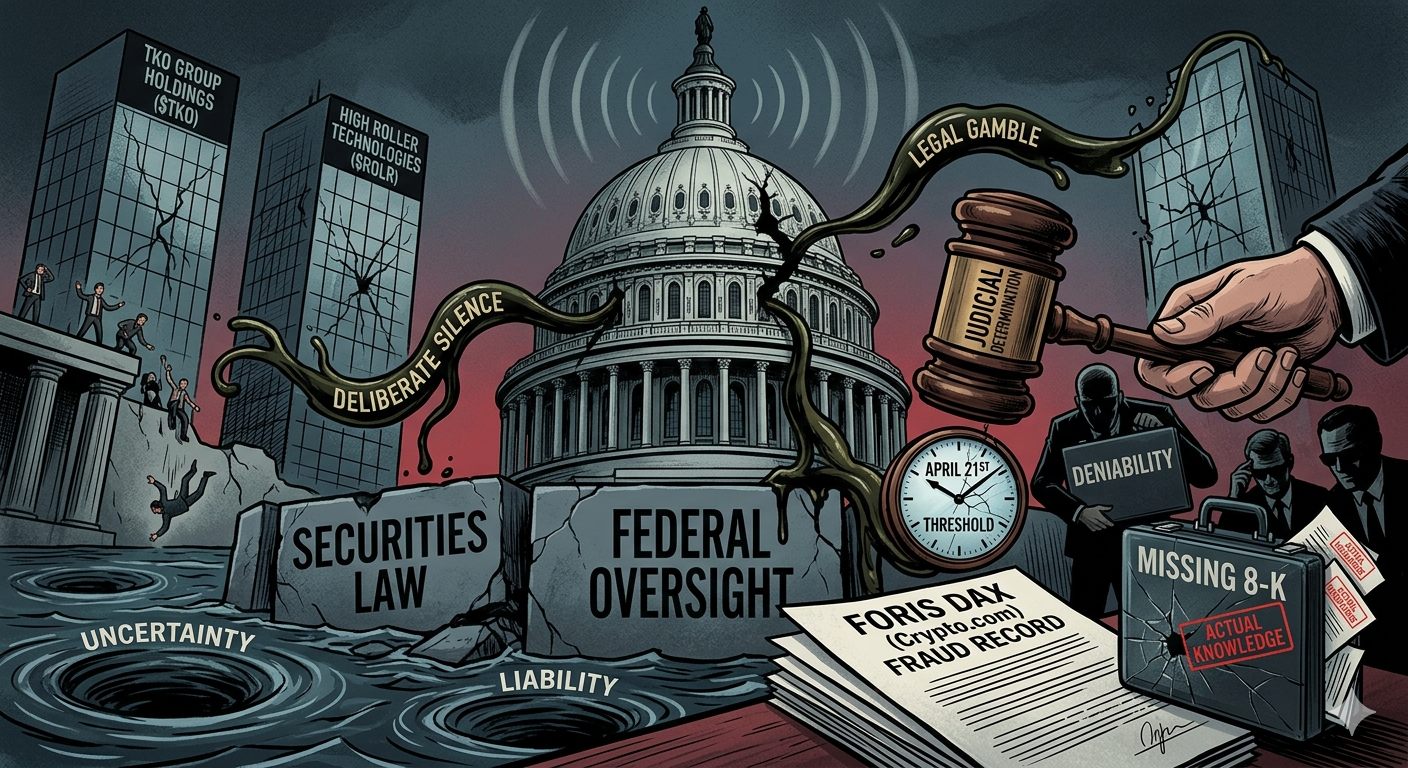
On April 21st, public executives and federal regulators received undeniable proof of a 420-day corporate suspension and active fraud. Their decision to withhold that information is threatening the PACE Act and setting a trap for massive personal liability.
In the complex machinery of financial markets and federal oversight, silence is rarely just an absence of sound—it is often a highly calculated legal gamble. Right now, a profound and legally perilous silence is emanating from the highest offices in Washington, D.C., and the executive suites of publicly traded companies regarding a documented record of corporate suspension and extrinsic fraud involving Foris Dax Inc. (d/b/a Crypto.com).
On April 21st, public executives and federal regulators received undeniable proof of a 420-day corporate suspension and active fraud. Their decision to withhold that information is threatening the PACE Act and setting a trap for massive personal liability.
The actors involved—ranging from the Office of the Comptroller of the Currency (OCC) and the SEC, to Congressional offices and the boardrooms of TKO Group Holdings ($TKO) and High Roller Technologies ($ROLR)—are currently operating under an illusion of deniability. But in the eyes of securities law, that deniability evaporated entirely on Tuesday, April 21st.
Here is exactly why the delay in disclosure is an inexcusable danger to the market, why the newly introduced PACE Act is fundamentally threatened, and why the executives withholding this information are walking into a trap of personal liability.
Constructive Notice vs. Actual Knowledge: The April 21st Threshold
To understand the severity of this situation, one must understand the legal threshold of “Scienter” (the intent or knowledge of wrongdoing) in securities fraud.
For months, the public records of Foris Dax’s 420-day Franchise Tax Board (FTB) suspension in California—a status that rendered the entity legally disabled from conducting business or defending itself in court—were hiding in plain sight. An argument could be made that the corporate partners and regulators had “Constructive Notice,” meaning the information was public and they should have known about it through basic due diligence.
But on Tuesday, April 21st, the legal paradigm shifted from Constructive Notice to Actual Knowledge.
Formal, timestamped notice was delivered directly to the Executive Leadership and Legal Counsel of High Roller (ROLR) and TKO. They were explicitly provided with the Register of Actions (ROA) from San Diego Superior Court (Case No. 25CU054346C) containing a Comprehensive Opposition and a Proposed Settled Statement. The notice detailed:
Qualitative Materiality (SEC SAB 99): Seven documented acts of extrinsic fraud and material misrepresentations by high-level officers, including the Consumer Protection Manager for North America, contradicted by objective digital archives.
Quantitative Risk: A proposed settlement in the underlying case of $400 million and a documented right to a $15,000,000+ default judgment accrued during the entity’s FTB suspension.
Regulatory Contagion: The immediate “Kill-Switch” risk to Foris Dax’s conditional National Trust Bank Charter.
The email said verbatim:
To the Executive Leadership and Legal Counsel of High Roller (ROLR), *The TKO one switched TKO for High Roller otherwise both April 21st emails were identical.
This communication serves to provide formal notice regarding significant legal developments in the San Diego Superior Court involving your partner, Foris Dax Inc. (d/b/a Crypto.com). As a publicly traded entity, High Roller (ROLR) faces unique disclosure obligations under Securities and Exchange Commission (SEC) guidelines, and the current state of the Register of Actions (ROA) in Jeremy Ryan v. Foris Dax Inc. has reached a threshold of materiality that may necessitate a Form 8-K filing.
As documented in the active litigation (San Diego County Case No. 25CU054346C), several critical factors have emerged that impact the “Character and Fitness” of Foris Dax Inc. and, by extension, the regulatory standing of its strategic partners:
1. Institutional Integrity and Qualitative Materiality (SEC SAB 99)
Under SEC Staff Accounting Bulletin No. 99 (SAB 99), materiality is not merely a quantitative calculation but a qualitative one, particularly when it concerns the “integrity of management.”
The ROA now contains a formal Comprehensive Opposition and a Proposed Settled Statement detailing seven documented acts of extrinsic fraud and material misrepresentations by high-level officers. Specifically, the Consumer Protection Manager for North America (Brandon Neff) and legal representatives have been identified in the record as providing sworn declarations that are directly contradicted by objective, third-party digital archives (Wayback Machine, ROA 20).
2. Quantitative Risk and the $400 Million Exposure
The litigation involves a formal demand of $400 million, alongside a documented right to a $15,000,000+ default judgment that accrued while Foris Dax Inc. was FTB Suspended and legally disabled from appearing in court.
Under Regulation S-K, Item 103, legal proceedings must be disclosed if they involve a claim for damages exceeding 10 percent of the company’s current assets. Given the scale of the demand and the potential for a “structural default,” the financial risk is a material event for any partner whose valuation is tied to the operational stability of Foris Dax.
3. The Regulatory Contagion (National Trust Bank Charter)
Foris Dax is currently navigating a conditional approval process for a National Trust Bank Charter with the OCC.
The public record of institutional dishonesty by a Compliance and Consumer Protection leader creates a “Kill-Switch” risk for these licenses. A finding of fraud on the court—especially when a hearing is presided over by a judge with a background in prosecution—is a reportable event that can trigger “De-Risking” protocols by correspondent banks and fiat rails.
4. Disclosure Obligations Under Item 8.01 (Form 8-K)
Item 8.01 of Form 8-K requires the disclosure of any “Other Events” that a reasonable investor would consider important. The transition of this case from a routine civil dispute to a documented record of extrinsic fraud and lack of corporate capacity constitutes a shift in the “total mix” of information available to ROLR shareholders.
Failure to report these developments before a final judicial determination poses a significant risk of secondary liability or shareholder litigation if a subsequent ruling on the fraud leads to a sudden disruption of ROLR’s partnership operations or banking access.
Conclusion and Next Steps
The Ex Parte Application to Settle the Record and the Comprehensive Opposition are currently filed and available in the ROA (also attached). It is advisable to review these filings immediately to assess the impact on High Roller’s mandatory reporting requirements and to determine if a disclosure is required to protect the entity from the fallout of the documented “Character and Fitness” failures of its partner. I can also provide the mentioned declarations upon request but they are all based on objective evidence such as publicly accessible government records from the Secretary of State and the court itself as well as the Wayback Machine. Upon further review you will see these are more than mere accusations and are simply waiting for a judicial review. I appreciate your attention in this matter.
By receiving this email, the executives were locked into a state of Actual Knowledge. They cannot claim ignorance; they are consciously choosing to withhold a material risk from their shareholders. But they didn’t just receive it they actually opened it. Read receipts here for $ROLR and $TKO. To be clear they had more than enough information to vet the claims within hours here are all of the attachments I included.
The Corporate Failure: TKO, ROLR, and the Missing 8-K
Under Item 8.01 of Form 8-K, public entities are required to disclose “Other Events” that a reasonable investor would consider important to the “total mix” of information.
Currently, TKO and ROLR are allowing their stock to trade on a bullish partnership narrative while actively concealing the legal and regulatory disabilities of that exact partner. This creates an artificial premium—a textbook definition of fraud on the market.The stakes are astronomically high. TKO is currently preparing to parade Foris Dax partnership with the UFC Freedom 250 event on the South Lawn of the White House in June. The optics of staging a historic event at the presidential residence while simultaneously harboring and promoting a partner entangled in an active record of extrinsic fraud and corporate suspension are a political and institutional nightmare. Failing to file an 8-K before a judicial determination exposes the executives to Section 20(a) Control Person Liability, making them personally financially responsible for the losses retail investors suffer when the truth inevitably hits the tape.
The Legislative Blindspot: Congress and the PACE Act
The danger extends far beyond the stock market; it threatens the architecture of federal financial legislation.
The Payments Access and Consumer Efficiency (PACE) Act, championed by Rep. Young Kim and co-sponsored by Rep. Sam Liccardo, relies entirely on the OCC as the “gold standard” gatekeeper to grant nonbank entities direct access to Federal Reserve payment rails.
Yet, when the Legislative Director for Rep. Kim, Shine Lee, was handed indisputable proof that the OCC completely missed a 420-day corporate suspension during its vetting of Foris Dax’s National Trust Bank Charter, the response was a staggering institutional silence. Similarly, the total brush-off by Cesar Jimenez in Rep. Liccardo’s office demonstrates a dangerous disconnect.
These offices are pushing a legislative vehicle that relies on regulatory competence, while actively ignoring documented proof of gross administrative negligence by that very regulator. If the PACE Act advances while the OCC is demonstrably failing to catch disqualifying public records, the legislation is effectively granting federal banking rails to bad actors. The resulting regulatory contagion will permanently stain the bill’s sponsors.
The Regulatory Paralysis: Adam Cohen and the SEC
The OCC’s Chief Counsel, Adam Cohen, is sitting on a conditional charter approval that is now tainted by vetting negligence. The SEC, having received a formal TCR (Tips, Complaints, and Referrals) regarding TKO and ROLR’s failure to disclose, has yet to issue a trading halt or force compliance.
This regulatory latency is toxic. Every day the SEC and OCC remain silent, they permit information asymmetry to thrive. Retail investors are buying into a market narrative completely unaware that the foundational stability of these partnerships is sitting on a judicial fault line in San Diego.
The Underlying Fraud: A Matter of Public Record
The core of this crisis isn’t a complex, hidden conspiracy; it is a matter of simple, verifiable public records. It involves high-level corporate officers submitting sworn declarations that are objectively contradicted by the Wayback Machine, Secretary of State website, and the docket itself all while operating under a multi-month tax suspension that voided their corporate capacity.
For a complete, granular breakdown of the specific misrepresentations, the timeline of the FTB suspension, and the verifiable court filings waiting for judicial review in Department C-74, review the full investigative report and documentation here. This report was done by an independent investigative journalist not anyone affiliated with Patrol Crypto but it is comprehensive and indisputable.
Conclusion: The Clock is Ticking
Silence is only a shield until the moment a judge signs an order. The corporate executives, federal regulators, and Congressional staffers who were notified on April 21st are playing a dangerous game of institutional chicken. The delay in filing an 8-K is legally inexcusable, the refusal to audit the OCC’s vetting process is a legislative failure, and the danger to the market compounds by the hour. When the record is ultimately certified, the fallout will not be viewed as an unfortunate surprise—it will be prosecuted as a deliberate, premeditated omission.
The actors involved—ranging from the Office of the Comptroller of the Currency (OCC) and the SEC, to Congressional offices and the boardrooms of TKO Group Holdings ($TKO) and High Roller Technologies ($ROLR)—are currently operating under an illusion of deniability. But in the eyes of securities law, that deniability evaporated entirely on Tuesday, April 21st.
By Jeremy RyanFounder and CEO, NFT Demon Holdings LLC | Plaintiff in San Diego Superior Court Case No. 25CU054346C
Email me at: jeremy@nftdemon.com