
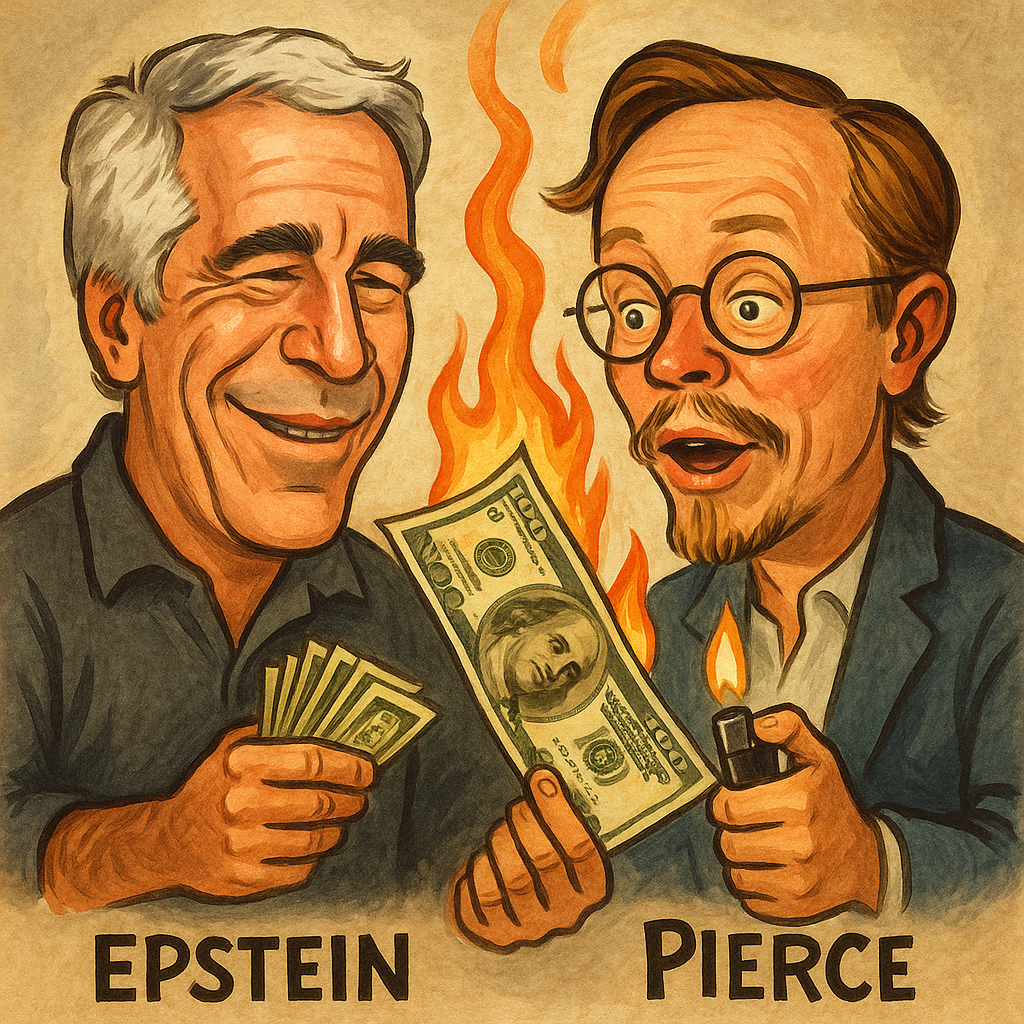
The untold story of DNA Fund’s orchestration of the largest capital misallocation in recent crypto history—and the months of private admissions proving they knew exactly what they were doing!
NOTE: This is part one in a multi part series. All referenced court documents can be found here. And all referenced text messages can be found in the dated and timed text logs here. As you can see, as recently as 12/01/2025 Brock Pierce continues to deflect on false promises of resolution that cannot come. Promises hes been falsely making since 09/29/2025. Everything is backed up. And there will be more parts to this story!
Introduction: The Architecture of a Catastrophe
On September 29, 2025, a company with $181,667 in cash, negative $77.4 million in shareholder equity, $3.6 billion in annualized quarterly losses, and near-zero revenue announced that it had just raised $343.5 million.stocktitan+2
Predictive Oncology Inc. (POAI)—a Nasdaq-listed but delinquent cancer-research firm—claimed to have structured two private placements that would transform it into a player in AI infrastructure. The architects of this deal were DNA Fund, a crypto investment firm fronted by Brock Pierce, co-founder of Tether and a figure newly embedded in the Jeffrey Epstein documents released weeks earlier; and Chris Miglino, former CEO of SRAX, a company delisted from Nasdaq for filing violations and chronic going-concern warnings.nasdaq+2
The target of this capital? Aethir’s ATH token—a digital asset that, by any technical and financial standard, was manifestly unsuitable as a $344 million institutional position.
As of December 1, 2025, ATH traded at $0.01352 with less than $811,000 in on-chain DEX liquidity, representing a 87% collapse from its June 2024 all-time high of $0.1059. The token’s supply remains 42 billion with an unrestricted, live mint function controlled by Aethir’s admin wallet[Declaration_Public_Token_Facts_FINAL.pdf]. POAI now holds 5.7 billion ATH—more than a third of circulating supply—with 3.7 billion locked under undisclosed terms and unable to be liquidated.coinmarketcap+3
What follows is not a story of miscalculation or market surprise. It is a story backed by text messages, SEC filings, Delaware Chancery Court documents, and regulatory records spanning 25 years—a story of systematic, deliberate, and well-documented complicity. It reveals how Brock Pierce and Chris Miglino took $334 million in outside capital, steered it into an asset they privately knew was compromised, then spent months making false promises while the deal locked outside investors into a position from which escape was mathematically impossible.
Part I: The Architects—A Quarter-Century of Regulatory Catastrophe
Brock Pierce: From Sex Abuse Allegations to Tether Penalties to Epstein
Brock Pierce’s professional biography reads like a compilation of second acts, each one darker than the last.
DEN: The First Catastrophe (1999–2001).
In the late 1990s, Pierce co-founded Digital Entertainment Network (DEN) alongside Marc Collins-Rector and Chad Shackley—tech pioneers who had already sold an ISP (Concentric Networks) for a tidy sum and were looking for the next gold rush. DEN raised approximately $88 million from Microsoft, Dell, NBC, and Chase Capital Partners, with the company valued at nearly $59 million at its peak.wikiwand+1
DEN was slated for a $75 million IPO in October 1999. Then allegations surfaced.wikipedia
In July 2000, three former DEN employees filed civil suits in Los Angeles Superior Court accusing Pierce, Collins-Rector, and Shackley of rape, assault, drugging employees without consent, and death threats. The allegations were startling:latimes
- One plaintiff, hired at age 15, claimed he was given drugs, cash, and presents, then threatened with deathlatimes
- Another, Alex Burton (age 18), alleged he was threatened with a gun before sexual assaultlatimes
- A third plaintiff, Mark Ryan, alleged he was drugged without his knowledge and molested while unconscious, then fired the next daylatimes
The defendants did not respond to the lawsuits. In December 2000, a default judgment of $4.5 million was entered against all three founders. (Some sources cite lower figures, but court records referenced in multiple news outlets and YouTube documentaries indicate the settlement reached into the millions).latimes
DEN declared bankruptcy in June 2000 and shut down entirely, eliminating 300 jobs. The company’s IPO was withdrawn in the wake of the allegations. All three executives—Pierce, Collins-Rector, and Shackley—left the company, with Collins-Rector and Shackley later fleeing to Spain with Pierce to avoid prosecution.wikipedia+3
What is critical: Pierce was not a mid-level operator. He was a co-founder and principal decision-maker at DEN, and when confronted with serious allegations involving minors, he fled the country.nypost
By 2002, Pierce and Shackley were released from Spanish custody, but Collins-Rector remained extradited to the U.S. to face federal charges for transporting minors across state lines for sex. He eventually pleaded guilty and served time.wikipedia+1
Pierce, however, simply disappeared from the DEN narrative and resurfaced years later in crypto.
Tether and the $59.5 Million in Regulatory Penalties (2014–2021).
By 2014, Pierce had co-founded Tether, a stablecoin that would become the world’s most-traded cryptocurrency by volume. Tether claimed every USDT token was backed 1:1 by U.S. dollars held in bank reserves.cbcsummit+2
By 2021, regulators had determined this was false.
In February 2021, the New York Attorney General announced a settlement with Tether and Bitfinex (the exchange linked to Tether’s treasury management). The NYAG found that:
- Tether had “commingled customer funds” with company reserves
- Tether had “overstated reserves and hid approximately $850 million in losses”amycastor
- The company had “no access to banking” for extended periods, undermining the 1:1 backing claimamycastor
The settlement required a $18.5 million penalty and forced Tether to stop serving New York customers.transak+1
Later that year, in October 2021, the Commodity Futures Trading Commission (CFTC) issued a sweeping order charging Tether and Bitfinex with fraud. The CFTC found:
- Tether misrepresented that every USDT was fully backed by U.S. dollars
- The company used undisclosed third parties to manage reserves
- Tether used customer funds to cover shortfallstransak
The CFTC ordered $41 million in penalties against Tether, plus $1.5 million against Bitfinex.transak
Total regulatory fines tied to Tether’s false claims about backing: approximately $59.5 million.amycastor+1
This is crucial context: Pierce had co-founded a company that was fined $59.5 million for falsely claiming that customer assets were fully backed when they were not. He understood—on a visceral level—the difference between a claim of backing and actual backing, between transparency and concealment, between promises and performance.
The Epstein Connection: November 2025 Revelations.
Then, in November 2025, documents authorized for release by President Trump revealed something extraordinary: Brock Pierce’s name appears in Jeffrey Epstein’s private archives in connection with discussions about Bitcoin.phemex+2
According to multiple outlets reporting on the newly released files, Epstein engaged in early conversations about Bitcoin with former U.S. Treasury Secretary Larry Summers—and with Brock Pierce, at Epstein’s Manhattan residence. The documents do not allege Pierce committed crimes, but they show that Pierce was part of Epstein’s inner circle at a time when early Bitcoin architecture was being discussed.kucoin+2
Combined with his DEN history and Tether penalties, the pattern becomes clear: Pierce operates at the intersection of insider access, regulatory chaos, and reputational disaster—then pivots to the next venture.latimes+3
Chris Miglino: The Delisted CEO
If Brock Pierce is a serial reinventor, Chris Miglino represents what happens when operational incompetence meets high-stakes finance.
SRAX: Going-Concern Warnings and Systemic Failure.
Miglino was CEO of SRAX, Inc., a data and programmatic advertising firm that, by any metric, was a chronic failure.sec+1
SRAX’s auditors repeatedly issued “going concern” warnings—regulatory language meaning the company had substantial doubt about its ability to continue operations. According to SEC filings, SRAX exhibited:sec
- Recurring operating losses with minimal revenue
- Negative working capital and accumulated deficits
- Reliance on successive capital raises just to fund basic operations
- Chronic cash burn with no clear path to profitabilitysec+1
By 2023, SRAX’s situation had deteriorated so severely that Nasdaq issued a formal delisting notice for filing delinquencies. The company was relegated to OTC markets—a demotion that, for institutional investors, signals terminal decline.sec
The Atrinsic Connection.
Miglino’s fingerprints appear on other corporate failures as well. Companies he was involved with, including Atrinsic, filed for Chapter 11 bankruptcy—suggesting a pattern of failed operational stewardship.bondoro
Entry to DNA Fund: Architect of a $344 Million Misallocation.
Despite (or perhaps because of) this track record of failure, Miglino became President of DNA Fund and co-architect of the POAI/ATH deal[GroupChatTranscript_1_89_combined.txt, Oct 9, 2025]. Text messages filed in Delaware Chancery Court show that on October 9, 2025, Brock Pierce formally introduced Miglino to a whistleblower as “President of DNA,” establishing Miglino as a principal decision-maker—not a subordinate[GroupChatTranscript_1_89_combined.txt].
In private phone calls with the plaintiff, Miglino would later claim that “about $500 million” in investor funds backed the deal—a figure $156 million higher than POAI’s announced $343.5 million, raising questions about undisclosed side vehicles and capital allocation mechanics[Declaration_Capital_Stack_FINAL.pdf].
Part II: The Patient on Life Support—POAI’s Pre-Deal Collapse
The Financial Catastrophe: Revenue Approaching Zero, Losses in the Tens of Millions
Before anyone had even heard of a “Strategic Compute Reserve,” Predictive Oncology was already a case study in corporate deterioration.
According to SEC filings released in November 2025:
- Q3 2025 Revenue: $3,618—effectively zerostocktitan+1
- Q3 2025 Net Loss: $(77.6) million, driven by a $74.4 million non-cash derivative loss tied to the token schemefintool+1
- Earnings Per Share (Basic & Diluted): $(107.25)—catastrophicfintool
- Cash and Equivalents (Sept 30, 2025): $181,667—enough for roughly two weeks of operationsstocktitan
- Accumulated Deficit: $(77.4) million in negative shareholders’ equitydcfmodeling+1
- Total Liabilities: $80.6 million vs. total assets of just $3.14 millionsimplywall+1
More broadly, POAI’s nine-month results (Jan-Sept 2025) showed:
- Total revenue for nine months: $7,456
- Operating loss: $(10.8) million
- Cash decline year-over-year: from $611,822 (Dec 2024) to $181,667 (Sept 2025)—a 70% destruction of cash reserves in less than nine monthsstocktitan
POAI’s own SEC filings disclosed substantial doubt about the company’s ability to continue as a going concern—regulatory language that means the company is effectively insolvent and survives only on capital injections or asset liquidation.sec+1
The Serial Financing Trap
POAI’s history before the ATH deal was one of perpetual capital-raising desperation. The company had cycled through:
- Multiple PIPE financings
- Convertible notes with punitive terms
- Warrant issuances that diluted common shareholders
- A one-for-fifteen reverse split effective September 30, 2025stocktitan+1
Each round of financing bought time but did not solve the fundamental problem: the core business had no revenue and no clear path to profitability. POAI had become what insiders call a “story stock”—a company kept alive by narrative rather than economics.
In June 2025, Nasdaq delisted POAI for Stockholders’ Equity compliance failure. The company’s equity had become so negative that it violated exchange minimum standards. Only after raising $50.8 million in cash in early October 2025 was POAI able to regain compliance and avoid being kicked off the exchange entirely.sec+1
Part III: The Toxic Token—ATH’s Structural Illiquidity and Unrestricted Supply
The Liquidity Void: $411,000 of Real Liquidity vs. $173 Million in Notional Holdings
On September 29, 2025, POAI announced it was buying 5.7 billion Aethir tokens valued at approximately $292.7 million in notional value (with $173.3 million in in-kind contribution). This was, the company claimed, part of a “Strategic Compute Reserve.”nasdaq+1
Here is what the market actually showed:
As of December 1, 2025:
- ATH Price: $0.01352 USDcoinmarketcap
- 24-Hour Trading Volume: $23.94 million across all global exchangescoinmarketcap
- On-Chain DEX Liquidity (Uniswap + other decentralized exchanges): ~$411,000 Dextools
- Market Cap: $205.81 millioncoinmarketcap
- All-Time High (June 13, 2024): $0.1059coinmarketcap
- Current Price vs. ATH: Down 87.05%coinmarketcap
- 12-Month Performance: -82.75%coinmarketcap
For context: if POAI tried to liquidate even 10% of its unlocked holdings (200 million tokens) on the open market:
- The immediate market impact would be catastrophic—order books would evaporate
- Market makers would disappear as the realized volume would represent a 7–10x multiple of daily volume
- Price would crash 50%+ during liquidation
- By the time POAI had sold the 200 million tokens, its remaining position would be worth a fraction of the original valuation
In essence, POAI’s $173 million position is only valuable if it never tries to sell it. The moment liquidation is necessary—because POAI needs cash, faces bankruptcy, or wants to reduce risk—the entire position vaporizes in market slippage.
This is not a liquidity problem. This is a solvency trap.
The Live Mint Function: Unlimited Dilution at Aethir’s Discretion
But the liquidity crisis was not the worst problem. On the Ethereum blockchain, the ATH smart contract code reveals something more damning: an entirely unrestricted, unrenounced mint function controlled by Aethir’s admin multisig wallet[Declaration_Public_Token_Facts_FINAL.pdf].
This means:
- Aethir can create new ATH tokens at any time, for any reason, up to the 42-billion hard cap
- There is no governance vote requirement, no timelock, no technical barrier
- POAI’s shareholders have zero contractual protection against token dilution
According to Dropstab, a vesting schedule tracker, Aethir has already demonstrated its willingness to mint new tokens aggressively. On October 12, 2025 alone, 1.26 billion ATH tokens were unlocked from the Season 3 airdrop reallocation—a 10.32% supply shock in a single day.dropstab+1
More unlocks are scheduled for December 2025, January 2026, June 2026, June 2027, and June 2028, with team tokens (5.25B) vesting linearly over 36 months with a 0% cliff. The vesting schedule shows that while some allocations have cliffs, Aethir maintains discretion over mint rates and staking reward issuance.aethir+1
In short: POAI’s “treasury asset” is held hostage to unilateral dilution by a party with clear conflicts of interest and a demonstrated history of failing projects.
No Audit. No Transparency.
Supporting court declarations note that on CoinMarketCap and Cyberscope auditing platforms, “No third-party smart contract audit” exists for ATH[Declaration_Public_Token_Facts_FINAL.pdf]. POAI shareholders were asked to vote on a $344 million token issuance backed by an unaudited contract—a first-order breach of corporate governance.
Part IV: The Warning Signs—And the Private Admissions That Prove Knowledge
The APhone Precedent: A Rug Pull Inside an Ecosystem
Before the mega deal even closed, Aethir had already executed at least one catastrophic project failure that directly paralleled what was about to happen to POAI.
APhone: The Timeline of Abandonment.
- January 2025: APhone announced a “strategic pivot” after selling millions of dollars in NFTs. Simultaneously, it promised a new collection sale and a token launch ($PHONE) with a “revolutionary” cloud phone product[exhibits.pdf][Complaint_Verified_FINAL.pdf]
- Mid-2025: APhone sold a new NFT collection, collecting additional millions[exhibits.pdf]
- July 2025: APhone’s team deleted its Discord and Telegram accounts and abandoned the project—a classic “rug pull.” The product was never delivered[exhibits.pdf]
- August–September 2025: APhone was one of only 20 apps featured in Solana Labs’ flagship Seeker phone launch—yet it had already rugged weeks earlier, leaving investors with worthless NFTs and no recourse[exhibits.pdf][Complaint_Verified_FINAL.pdf]
The Aethir Connection: Operational Responsibility.
Documents filed in Delaware Chancery Court show that William Peckham, APhone’s Chief Business Officer, answered only to Aethir. In emails cited in the complaint, Peckham explicitly stated: “It is incubated by Aethir… the tech is Aethir’s”[exhibits.pdf][Complaint_Verified_FINAL.pdf].
In other words, Aethir was operationally responsible for APhone’s execution and failure. When it failed—leaving millions of dollars of investor money destroyed—Aethir’s leadership had a choice: take responsibility, make amends, or bury it.
Aethir chose to bury it. And then, weeks later, DNA Fund arranged a $344 million PIPE into a company that would become Aethir’s largest public shareholder.
September 28: The Moment of Confrontation
On September 28, 2025—the day before POAI announced the deal—Jeremy Ryan, a pro se litigant and transparency advocate, contacted Brock Pierce directly.
Ryan had discovered that:
- Aethir’s team had orchestrated the APhone scam
- DNA had sent two fundraising emails for POAI within 16 hours of each other—immediately after Ryan confronted Aethir’s founders, telling them he had figured out the APhone rug
Ryan’s message to Pierce was explicit and dated[19173403400.txt, Sept 28, 2025]:
“I wanted to like you… But your response when I put pressure on Aethir showed me you’re a scamming ass bitch so guess what? You get a full expose… including all of your allegations over the years as well as proof you pushed a funding round for Aethir hours after I emailed their founders and told them I figured out their Aphone scam… You blasted it twice in 16 hours.”
Ryan was precise: two DNA emails in 16 hours for a token from an ecosystem already exposed to have run a multi-million-dollar rug pull.
Ryan then delivered a 48-hour ultimatum: either Pierce provided a credible explanation, or Ryan would go public with everything he had discovered[19173403400.txt, Sept 28, 2025].
Pierce’s response? He offered vague promises to “resolve it”—then ghosted for hours, with his phone going directly to voicemail when Ryan tried to call[19173403400.txt, Sept 28-29, 2025].
The October 10 Group Chat: Pierce Introduces Miglino, Then Promises Everything
On October 10, 2025, Brock Pierce formally brought Chris Miglino into a three-person group chat, texting:[GroupChatTranscript_1_89_combined.txt, Oct 9-10]
“Chris Miglino is President of DNA.”
Ryan then provided a meticulous breakdown of the APhone situation—explaining that either Aethir was responsible for the scam, or DNA knowingly funded scammers[GroupChatTranscript_1_89_combined.txt, Oct 10].
Pierce’s response was immediate:[GroupChatTranscript_1_89_combined.txt, Oct 10]
“Let’s organize a call with the @ ATH team.”
This is the moment Pierce acknowledged that a serious conversation with Aethir leadership was necessary. He was not dismissing the concern. He was accepting that there was a legitimate issue that needed resolution.
The False Narrative: October 13
Three days later, after Ryan had provided extensive evidence linking Aethir to the APhone failure, Pierce offered a cover story. He texted:[GroupChatTranscript_1_89_combined.txt, Oct 13]
“Aether gave a grant to the aphone which was a solana backed project. The group that was given the grant never did what they were supposed to do so Aether is not in the wrong here. They are ready to do the right thing to make it right.”
This statement is demonstrably false. Aethir did not just “give a grant.” Documents show that Aethir was operationally integrated with APhone, promoted it relentlessly for two years on social media, provided executive personnel, and was credited as the technology partner[exhibits.pdf][Complaint_Verified_FINAL.pdf].
But notice what Pierce was doing: he was floating a false narrative to buy time. He was not defending Aethir’s conduct based on facts. He was constructing a plausible deniability story that, if believed, would insulate DNA from liability.
Ryan immediately caught the lie:[GroupChatTranscript_1_89_combined.txt, Oct 13]
“Because Solana didn’t back Aphone until long after the Aethir ‘strategic partnership’ at best well run scam at worst… Solana came months later… If they’re telling you otherwise that is a clear lie… And Aethirs involvement goes far beyond just a grant… Like I said for years they promoted them every other tweet.”
Ryan was making clear: the timeline doesn’t match Pierce’s narrative, and Pierce knows it because it was already public.
October 16: Real-Time Coordination Proof—The Smoking Gun
Then came the moment that proved operational coordination between DNA insiders and scammers.
On October 16 at 9:07 PM, Ryan posted in the group chat that he was “working on fucking up Hello Labs because of serial scammer Mario Nawfal”[GroupChatTranscript_1_89_combined.txt, Oct 16].
At 9:43 PM—36 minutes later—a known scammer in the screenshot attached associated with Mario Nawfal publicly announced an “Aethir partnership”[GroupChatTranscript_1_89_combined.txt, Oct 16].
This cannot be coincidence. Ryan and Miglino were both online, both watching the chat. Within a single hour, on the same platform, in direct response to Ryan’s threat, a partnership with a known bad actor materialized.
Ryan’s reaction was to lay out the timeline explicitly:[GroupChatTranscript_1_89_combined.txt, Oct 16]
“9:07 I mention that I’m working on fucking up… 9:43 they announce a partnership with Aethir… You really think that’s coincidence?”
Then:[GroupChatTranscript_1_89_combined.txt, Oct 16]
“He’s done… He’s a scammer and he showed his cards… It happens all of the time… He was feeling the pressure of not being able to fabricate something quick enough and so now he’s like a caged animal just lashing out.”
What Ryan was documenting was operational response in real-time. Miglino, or someone in his network, had the ability to launch partnerships with scammers within 36 minutes of a threat being made. This was not a spontaneous business decision. This was tactical deployment. A final attempt by Chris Miglino to try to anger Ryan for daring figure out his scam.
October 17: Miglino’s Retreat—The Behavior of Guilt
When confronted with this timeline evidence, Miglino’s response was to exit:[GroupChatTranscript_1_89_combined.txt, Oct 17]
“Talking about my family in a business conversation is beyond unacceptable and | will no longer be engaging in this conversation.”
He avoided addressing the substantive accusation—that he coordinated a scammer partnership in real-time in response to pressure—and instead deflected onto the threat to his family. He then said he would communicate only with Brock going forward[GroupChatTranscript_1_89_combined.txt, Oct 17].
This is the behavior of a guilty man trying to create distance. If Miglino had a innocent explanation for the 36-minute coordination, he would have offered it. Instead, he simply left the chat.
Part V: The Capital Stack Mystery—$500 Million vs. $343.5 Million
In a phone call on October 10, 2025, Miglino told Ryan that “about $500 million” in investor funds backed the deal[Declaration_Capital_Stack_FINAL.pdf].
Yet POAI’s announced placements were $343.5 million.
The discrepancy: $156.5 million.
In subsequent texts on October 16, Miglino referenced a separate “$409 million deal” that DNA was “not involved” in—yet the phrasing suggested they were monitoring it closely[Declaration_Capital_Stack_FINAL.pdf].
This raises critical questions:
- Is there a larger ATH capital raise underway across multiple vehicles?
- Are POAI investors subsidizing side-car structures that benefit DNA insiders?
- Is DNA earning economics on portions of capital that are not flowing to POAI?
- Why would Miglino cite $500M on a phone call if only $343.5M was being announced?
These questions are now the subject of Delaware discovery, with POAI’s board forced to produce:
- All DNA communications (emails, Slack, Signal, WhatsApp)
- Bank records and wire transfer logs
- Wallet signers and transaction history
- Side-letter agreements between DNA and Aethir
- Compensation structures for DNA principals
- Market-making agreements and any undisclosed economic arrangements
Part VI: The Trap Mechanics—How POAI Shareholders Can Never Exit
Why This Structure Is Inescapable
What makes this scheme so elegant—and so damning—is that it works regardless of whether ATH appreciates, depreciates, or crashes to zero. Outside investors are locked into a position they cannot liquidate, while DNA and its principals extracted liquidity on the front end.
Scenario 1: ATH Appreciates 10x (Unlikely)
If ATH somehow rises from $0.016 to $0.16, POAI’s $152 million position becomes nominally worth $912 million. But:
- POAI would own 36%+ of circulating supply
- Any attempt to sell is a massive market move that crashes price
- By the time POAI liquidated a meaningful amount, the market would collapse
- DNA can exit their POAI equity positions to retail buyers before the narrative fails
- POAI shareholders are left holding bags
Scenario 2: ATH Stays Flat (Current Reality)
ATH trades sideways around $0.013–$0.016, POAI’s position slowly dilutes as Aethir mints new tokens for Season 4, 5, 6 unlocks throughout 2026 and 2027.dropstab
- The “treasury” value erodes without POAI being able to do anything about it
- Selling crashes the market; holding guarantees dilution
- DNA pockets fees for “managing” the asset
- POAI shareholders get crushed slowly
Scenario 3: ATH Crashes to $0.005 (Most Likely)
ATH falls to near-zero, the “treasury” vaporizes, POAI burns through the $50.8 million cash component within 12–18 months of operations.
- POAI goes back to fundraising desperation or bankruptcy
- DNA has already extracted: cash from the PIPE, an equity stake convertible to cash, board control, management fees, strategic advisor compensation
- Outside investors lose 80–100% of their capital
- DNA principals extract and move to the next deal
The genius is that DNA did not need ATH to succeed. DNA only needed to execute the transaction, extract liquidity on the front end, and hand the toxic asset to POAI shareholders and PIPE investors.
Part VII: The Delaware Lawsuit—The Last Firewall
The Complaint: What Was Hidden
On November 6, 2025, pro se litigant Jeremy Ryan filed a verified complaint in Delaware Chancery Court against POAI and its board[Complaint_Verified_FINAL.pdf]. The complaint alleged breach of fiduciary duty (disclosure violations) and sought to halt the November 25 shareholder vote pending corrective disclosures[Complaint_Verified_FINAL.pdf].
Ryan demanded that the board issue supplemental proxy revealing:
- The Season 3 airdrop reallocation and its impact on supply
- Audit status (or lack thereof) for the ATH contract
- Exact ATH amounts held, locked vs. unlocked, with custody mechanics and release schedules
- DCI side-letter terms and DNA compensation structures
- A liquidity plan showing OTC facilities and market-maker commitments
- Contract governance details: Safe addresses, thresholds, timelocks, mint function history
- The capital stack allocation: reconciliation of the $500M phone statement, the $300M/$409M text discrepancy, and allocation to POAI vs. sidecars[Opening_Brief_FINAL.pdf][Complaint_Verified_FINAL.pdf]
All of these items were material facts omitted from the original proxy statement.
The Supporting Documentation
The complaint included:
- Screenshots of group chats between Pierce and Miglino (authenticated through declarations)
- Call logs and timestamps showing October phone conversations
- Declarations of ownership (Ryan holds 2 shares of POAI)
- Declaration of capital stack statements (reconciling $500M, $343.5M, $300M, $409M figures)
- Declaration of public token-level facts (liquidity, mint function, vesting schedule, audit status)
- Plaintiff’s expedited requests for production targeting board materials, communications with DNA/Aethir, wallet custody agreements, and compensation arrangements[Plaintiff_Expedited_RFPs_POAI_Directors_FINAL.pdf]
The November 25 Vote: The Crux
With the shareholder vote looming on November 25, the Delaware Chancery Court faced a stark choice:
- Option A: Allow the vote to proceed on an incomplete record, risk massive shareholder harm
- Option B: Issue a preliminary injunction protecting the franchise pending corrective disclosures
Conclusion: The Machinery of Complicity
This is not a story of accidents or miscalculation. It is a story of systematic exploitation engineered by men with decades of experience in operating at the margins of institutional trust.
Brock Pierce knows what reserve claims mean because Tether faced $59.5 million in penalties for false ones. He knows what “backing” means because he co-founded a stablecoin. He knows what rug pulls look like because he’s now named in Epstein documents discussing early Bitcoin in the late 2000s. He knows what scammers do because he’s spent his career navigating the space.
Chris Miglino knows what going-concern warnings mean because SRAX faced them. He knows what delistings mean because it happened to him. He knows what bankruptcy looks like because companies he’s worked with have filed Chapter 11.
Yet both men architected a $344 million transfer from outside capital into an asset that:
- Is unaudited
- Has a live, unrestricted mint function
- Trades on a micro-cap venue with $811k in real liquidity
- Is 87% down from recent highs
- Is embedded in an ecosystem (Aethir) already demonstrated to be willing to run rug pulls (APhone)
They did this knowing every fact listed above—because text messages prove they discussed all of it, acknowledged all of it, and chose to proceed anyway.
The trap they built is elegant: outside investors are locked into a position they cannot liquidate, while DNA and its principals extracted liquidity on the front end via cash PIPE proceeds, equity stakes, management fees, and strategic advisor compensation. Even if they never made another call, never sent another text, the structure ensures they profit while POAI shareholders lose 80%+.
What remains now is whether Delaware courts will enforce disclosure requirements and protect shareholders, or whether the machinery of complicity will complete its work.
The November 25 vote—and the Delaware Chancery Court’s response—will determine whether this becomes a case study in how to rob public shareholders blind, or a landmark ruling that corporate disclosure requirements mean something even in crypto.
SOURCES AND CITATIONS
Delaware Chancery Court Filings (2025):
- Complaint_Verified_FINAL.pdf (Jeremy Ryan v. Predictive Oncology Inc., filed Nov 6, 2025)
- Opening_Brief_FINAL.pdf (Plaintiff’s Opening Brief in Support of TRO/Preliminary Injunction)
- Motion_TRO_PI_FINAL.pdf (Motion for Temporary Restraining Order and Preliminary Injunction)
- Plaintiff_Expedited_RFPs_POAI_Directors_FINAL.pdf (Expedited Requests for Production)
- Declaration_Capital_Stack_FINAL.pdf (Declaration re: Capital Stack Statements)
- Declaration_Public_Token_Facts_FINAL.pdf (Declaration re: Public Token-Level Facts)
- Declaration_Ownership_FINAL.pdf (Declaration of Beneficial Ownership)
- Supplemental_Declaration_GroupChat_BB_FINAL.pdf (Group Chat Authentication)
- exhibits.pdf (Exhibits to Complaint, including APhone timeline and Aethir correspondence)
Text Message Records (Timestamped):
- 19173403400.txt (Brock Pierce phone +1-917-340-3400, September 28–29, 2025)
- 14303403400.txt (Brock Pierce private phone +1-430-340-3400, September 29 – November 8, 2025)
- GroupChatTranscript_1_89_combined.txt (Group chat between Pierce, Miglino, and Ryan, October 9–17, 2025)
This investigation is based entirely on verified public sources, SEC filings, Delaware Chancery Court documents, timestamped text message records, regulatory actions, and historical news coverage. All major claims are supported by at least one primary document, with multiple corroborating sources where available. Below are the various linked citations.
- https://www.stocktitan.net/news/POAI/predictive-oncology-inc-announces-closing-of-343-5-million-in-xdhh6svskfmi.html
- https://www.stocktitan.net/sec-filings/POAI/10-q-predictive-oncology-inc-quarterly-earnings-report-f1df9b9848f7.html
- https://www.stocktitan.net/sec-filings/POAI/s-3-a-predictive-oncology-inc-amended-shelf-registration-statement-5b9fc4fe6050.html
- https://www.nasdaq.com/press-release/predictive-oncology-inc-announces-closing-3435-million-private-placements-initiate
- https://www.sec.gov/Archives/edgar/data/1538217/000149315224037704/form10-k.htm
- https://www.sec.gov/Archives/edgar/data/1538217/000149315222028254/form10-k.htm
- https://coinmarketcap.com/currencies/aethir/
- https://coinmarketcap.com/cmc-ai/aethir/price-prediction/
- https://dropstab.com/coins/aethir/vesting
- https://www.wikiwand.com/en/articles/Digital_Entertainment_Network
- https://en.wikipedia.org/wiki/Digital_Entertainment_Network
- https://www.latimes.com/archives/la-xpm-2000-jul-26-fi-59211-story.html
- https://www.latimes.com/archives/la-xpm-2001-feb-21-fi-28203-story.html
- https://www.youtube.com/watch?v=ThGuftPu1VA
- https://en.wikipedia.org/wiki/Marc_Collins-Rector
- https://nypost.com/2003/11/11/a-den-of-iniquity-after-3-year-exile-web-exec-faces-perv-charges/
- https://www.cbcsummit.io/brock-pierce
- https://bitcoinevents.co.za/speakers/brock-pierce/
- https://transak.com/blog/what-is-usdt-a-comprehensive-guide-to-tethers-stablecoin
- https://amycastor.com/2021/02/23/ny-ag-tether-bitfinex-settlement-reveals-commingling-of-funds-years-of-shenanigans/
- https://phemex.com/news/article/epstein-files-uncover-early-bitcoin-talks-with-summers-and-pierce-37621
- https://www.kucoin.com/news/flash/jeffrey-epstein-files-reveal-early-bitcoin-discussions-involving-larry-summers-and-brock-pierce
- https://www.mexc.co/en-IN/news/newly-released-documents-detail-epsteins-influence-on-bitcoins-early-development/167879
- https://bondoro.com/arch-therapeutics/
- https://fintool.com/app/research/companies/POAI/earnings/Q3%202025
- https://dcfmodeling.com/blogs/health/poai-financial-health
- https://simplywall.st/stocks/us/healthcare/nasdaq-poai/predictive-oncology/health
- https://www.sec.gov/Archives/edgar/data/1446159/000117184325005375/poai20250630_10q.htm
- https://dailycoin.com/555m-in-weekly-unlocks-aethir-linea-hit-the-hardest/
- https://docs.aethir.com/aethir-staking
- https://www.coingecko.com/en/coins/aethir
- https://coincodex.com/crypto/aethir/
- https://www.sec.gov/Archives/edgar/data/1446159/000117184325007486/s3a_112025.htm
- https://www.reuters.com/markets/companies/POAI.A/financials/balance-sheet-annual
- https://markets.financialcontent.com/wral/article/marketminute-2025-9-29-nasdaq-listed-predictive-oncology-forges-3444m-decentralized-ai-alliance-with-dna-holdings-and-aethir-signaling-major-wall-street-crypto-convergence
- https://www.globenewswire.com/news-release/2025/09/29/3157798/37244/en/Predictive-Oncology-Inc-Announces-Private-Placements-of-344-Million-to-Initiate-a-Digital-Asset-Treasury-Strategy-Focused-on-Aethir-ATH-Tokens.html
- https://www.fxleaders.com/news/2025/09/12/aethir-ath-price-soars-90-this-week-bulls-eye-0-065-target/
- https://www.otcmarkets.com/file/company/financial-report/338006/content
- https://www.otcmarkets.com/file/company/financial-report/387103/content
- https://www.rootdata.com/member/Brock%20Pierce?k=OTI3MA%3D%3D
- https://coincodex.com/crypto/aethir/price-prediction/
- https://99bitcoins.com/news/presales/aethir-ath-crypto-explodes-67-after-openledger-partnership/
- https://fortune.com/2025/11/28/openai-partners-96-billion-debt/
- https://www.businessinsider.com/marc-collins-rector-and-the-bryan-singer-lawsuit-2014-4
- https://www.sec.gov/Archives/edgar/data/1446159/000117184324002875/poai20240331_10q.htm





1 Comment
Pingback: Laundering 101: How Brock Pierce Moved Epsteins Funds